


TIPS improves liver transplantation-free survival in cirrhotic patients with refractory ascites: an updated meta-analysis
- PMID: 24627607
- PMCID: PMC3949280
- DOI: 10.3748/wjg.v20.i10.2704
TIPS improves liver transplantation-free survival in cirrhotic patients with refractory ascites: an updated meta-analysis
Abstract
Aim: To compare the liver transplantation-free (LTF) survival rates between patients who underwent transjugular intrahepatic portosystemic shunts (TIPS) and those who underwent paracentesis by an updated meta-analysis that pools the effects of both number of deaths and time to death.
Methods: MEDLINE, EMBASE, and the Cochrane Library were searched from the inception to October 2012. LTF survival, liver transplantation, liver disease-related death, non-liver disease-related death, recurrent ascites, hepatic encephalopathy (HE) and severe HE, and hepatorenal syndrome were assessed as outcomes. LTF survival was estimated using a HR with a 95%CI. Other outcomes were estimated using OR with 95%CIs. Sensitivity analyses were performed to assess the effects of potential outliers in the studies according to the risk of bias and the study characteristics.
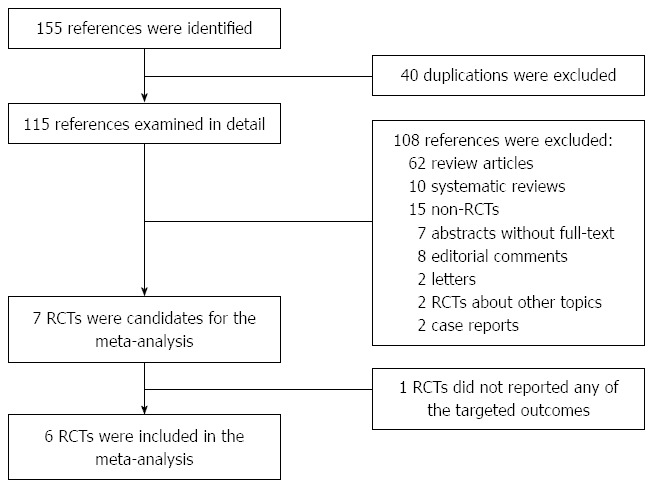
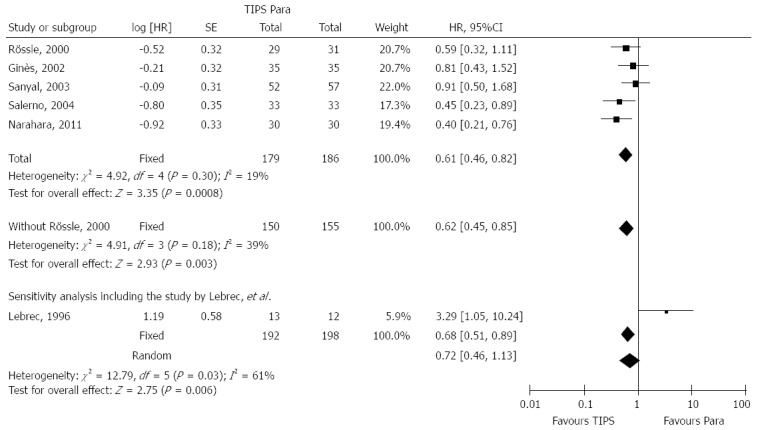
Results: Six randomized controlled trials with 390 patients were included. In comparison to paracentesis, TIPS significantly improved LTF survival (HR = 0.61, 95%CI: 0.46-0.82, P < 0.001). TIPS also significantly decreased liver disease-related death (OR = 0.62, 95%CI: 0.39-0.98, P = 0.04), recurrent ascites (OR = 0.15, 95%CI: 0.09-0.24, P < 0.001) and hepatorenal syndrome (OR = 0.32, 95%CI: 0.12-0.86, P = 0.02). However, TIPS increased the risk of HE (OR = 2.95, 95%CI: 1.87-4.66, P = 0.02) and severe HE (OR = 2.18, 95%CI: 1.27-3.76, P = 0.005).
Conclusion: TIPS significantly improved the LTF survival of cirrhotic patients with refractory ascites and decreased the risk of recurrent ascites and hepatorenal syndrome with the cost of increased risk of HE compared with paracentesis. Further studies are warranted to validate the survival benefit of TIPS in clinical practice settings.
Keywords: Ascites; Meta-analysis; Paracentesis; Survival; Transjugular intrahepatic portosystemic shunt.
Figures
References
-
- Arroyo V, Colmenero J. Ascites and hepatorenal syndrome in cirrhosis: pathophysiological basis of therapy and current management. J Hepatol. 2003;38 Suppl 1:S69–S89. - PubMed
-
- Rössle M, Gerbes AL. TIPS for the treatment of refractory ascites, hepatorenal syndrome and hepatic hydrothorax: a critical update. Gut. 2010;59:988–1000. - PubMed
-
- Salerno F, Guevara M, Bernardi M, Moreau R, Wong F, Angeli P, Garcia-Tsao G, Lee SS. Refractory ascites: pathogenesis, definition and therapy of a severe complication in patients with cirrhosis. Liver Int. 2010;30:937–947. - PubMed
-
- European Association for the Study of the Liver. EASL clinical practice guidelines on the management of ascites, spontaneous bacterial peritonitis, and hepatorenal syndrome in cirrhosis. J Hepatol. 2010;53:397–417. - PubMed
-
- Runyon BA. Management of adult patients with ascites due to cirrhosis: an update. Hepatology. 2009;49:2087–2107. - PubMed
Publication types
MeSH terms
LinkOut - more resources
Full Text Sources
Other Literature Sources
Medical
Miscellaneous
