Preanalytical requirements of urinalysis
- PMID: 24627718
- PMCID: PMC3936984
- DOI: 10.11613/BM.2014.011
Preanalytical requirements of urinalysis
Abstract
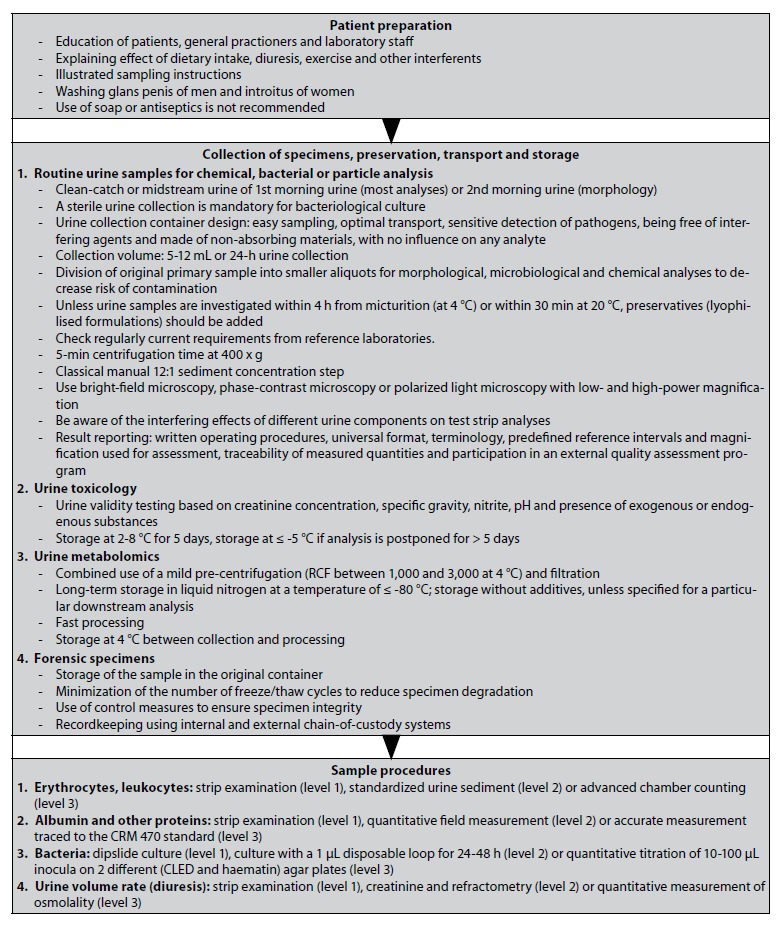
Urine may be a waste product, but it contains an enormous amount of information. Well-standardized procedures for collection, transport, sample preparation and analysis should become the basis of an effective diagnostic strategy for urinalysis. As reproducibility of urinalysis has been greatly improved due to recent technological progress, preanalytical requirements of urinalysis have gained importance and have become stricter. Since the patients themselves often sample urine specimens, urinalysis is very susceptible to preanalytical issues. Various sampling methods and inappropriate specimen transport can cause important preanalytical errors. The use of preservatives may be helpful for particular analytes. Unfortunately, a universal preservative that allows a complete urinalysis does not (yet) exist. The preanalytical aspects are also of major importance for newer applications (e.g. metabolomics). The present review deals with the current preanalytical problems and requirements for the most common urinary analytes.
Keywords: flow cytometry; preservatives; sample preparation; urinalysis.
Figures
References
-
- Coppens A, Speeckaert M, Delanghe J. The pre-analytical challenges of routine urinalysis. Acta Clin Belg. 2010;65:182–9. - PubMed
-
- Carlson DA, Statland BE. Automated urinalysis. Clin Lab Med. 1988;8:449–61. - PubMed
-
- Fogazzi GB, Cameron JS, Ritz E, Ponticelli C. The history of urinary microscopy to the end of the 19th century. Am J Nephrol. 1994;14:452–7. http://dx.doi.org/10.1159/000168764. - DOI - PubMed
-
- Langlois MR, Delanghe JR, Steyaert RS, Everaert KC, De Buyzere ML. Automated flow cytometry compared with an automated dipstick reader for urinalysis. Clin Chem. 1999;45:118–22. - PubMed
-
- Caleffi A, Manoni F, Alessio MG, Ottomano C, Lippi G. Quality in extra-analytical phases of urinanalysis. Biochemia Medica. 2010;20:179–83. http://dx.doi.org/10.11613/BM.2010.022. - DOI
Publication types
MeSH terms
LinkOut - more resources
Full Text Sources
Other Literature Sources
Medical
Research Materials