Review
. 2014 Jul;171(13):3132-45.
doi: 10.1111/bph.12689.

Structure of Class B GPCRs: new horizons for drug discovery

Affiliations
Review

Structure of Class B GPCRs: new horizons for drug discovery

Andrea Bortolato et al. Br J Pharmacol. 2014 Jul.

Abstract

Class B GPCRs of the secretin family are important drug targets in many human diseases including diabetes, neurodegeneration, cardiovascular disease and psychiatric disorders. X-ray crystal structures for the glucagon receptor and corticotropin-releasing factor receptor 1 have now been published. In this review, we analyse the new structures and how they compare with each other and with Class A and F receptors. We also consider the differences in druggability and possible similarity in the activation mechanisms. Finally, we discuss the potential for the design of small-molecule modulators for these important targets in drug discovery. This new structural insight allows, for the first time, structure-based drug design methods to be applied to Class B GPCRs.

Keywords: CRF1 receptor; Class B; GPCR; GPCR molecular signature; HHM; druggability; glucagon receptor; smoothened receptor.


Figures

Figure 1
Figure 1
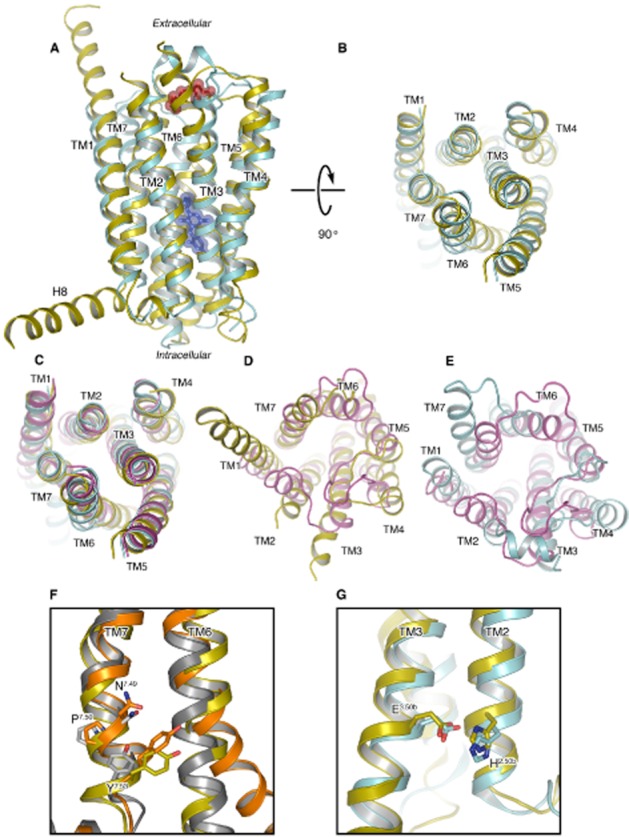
Comparisons of the CRF1 receptor, glucagon receptor and Class A receptors. (A) Superposition of the CRF1 (cyan, PDB ID 4K5Y) and the glucagon receptor (yellow, PDB ID 4L6R) crystal structures in cartoon representation as viewed from the membrane. TM1–7 are labelled along with the extended helix 8 (H8) visible in the glucagon receptor. Structurally conserved extracellular disulphide bonds for both are coloured red and represented as translucent spheres. The CP-376395 ligand visible in the CRF1 structure is represented as blue sticks and translucent spheres. (B) View as in (A) but rotated 90 degrees to view from the cytoplasm, intracellular loops have been removed for clarity. (C) View as in (B) with the dopamine D3 receptor (D3) superposed (magenta) on both Class B receptors. (D) View from extracellular space comparing the glucagon receptor and D3 only. (E) View as in (D) comparing CRF1 and D3 only. (F) Superposition of the glucagon receptor (yellow), β2-adrenoceptor in the active (orange, PDB ID 3SN6) and inactive (grey, PDB ID 2RH1) state, only TM6 and TM7 are shown. The conserved asparagine, proline and tyrosine residues of the Class A NPxxY motif in TM7 that play a role in activation are shown in stick representation with carbon atoms coloured in keeping with receptor, nitrogen and oxygen atoms coloured blue and red respectively. Tyr400 from the glucagon receptor is additionally highlighted. (G) Superposition of CRF1 and glucagon receptor crystal structures with colouring as in (A), only TM3 and TM2 are shown with the functionally relevant and conserved His2.50b/Glu3.50b in stick representation.
Figure 2
Figure 2
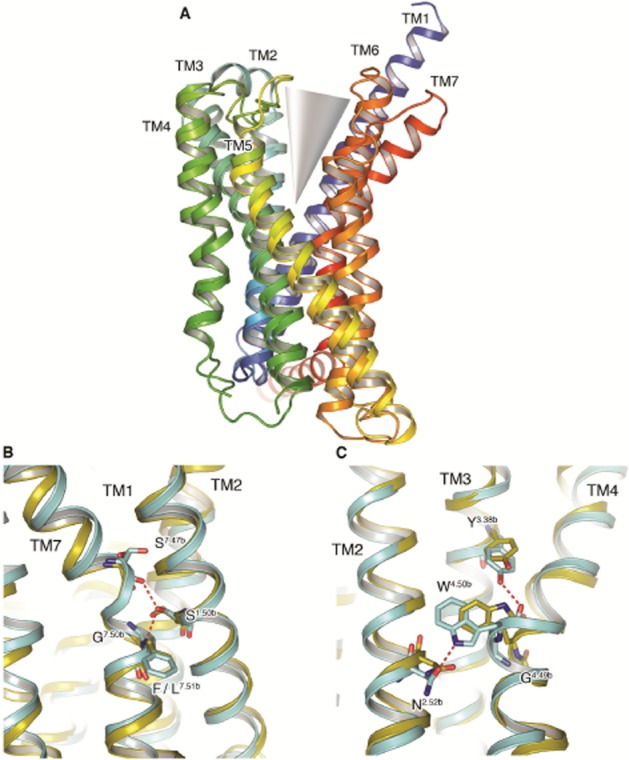
The CRF1 and glucagon receptors assume chalice-like open structures. (A) Superposition of the CRF1 and glucagon receptor crystal structures, both shown in rainbow colouration (blue through to red; denoting N to C-terminus polarity) as viewed from the membrane. The TM helices comprising the two halves of the chalice, or V-like, open configuration are labelled, and the orthosteric opening of both receptors exemplified. (B) Comparison of conserved sequence interactions between residues on TM1, TM2 and TM7 in the CRF1 (cyan) and glucagon receptor (yellow) structures. Hydrogen bonds are depicted as red dashed lines and residues are highlighted by stick representation with carbon atoms coloured in keeping with the receptor, nitrogen and oxygen atoms coloured blue and red respectively. (C) Comparison of conserved sequence interactions between residues on TM2, TM3 and TM4 in the CRF1 (cyan) and glucagon receptor (yellow) crystal structures. Hydrogen bonds and residues of interest are shown as in (B).
Figure 3
Figure 3
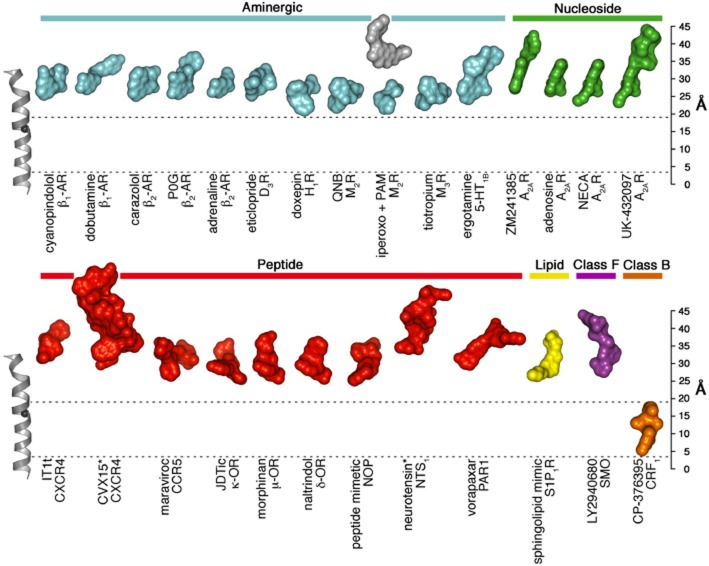
Locations of ligand-binding sites in GPCRs of known structure. The structures of a selected set of Class A, B and F receptor-ligand complexes were superimposed and the ligands are shown in surface representation to illustrate the locations of the ligand-binding sites and coloured according to receptor class and subfamily. TM4 from bovine rhodopsin (PDB ID 1HZX) is shown as a reference (left), with the Cα-carbon of the highly conserved W4.50 (Ballesteros-Weinstein numbering) (Ballesteros et al., 1995) displayed as a black sphere. A ‘ruler’ is included (right) for the purpose of ascertaining ligand heights (in Å) as measured from an intracellular boundary point defined by the Cα of Glu1504.39 along an axis parallel to TM4 from rhodopsin (PDB ID 1HZX). To highlight the unusual location of the small molecule-binding pocket in the CRF1 receptor, two dashed lines are displayed, indicating the cytoplasmic boundaries of the CRF1 antagonist and that of doxepin in the H1 receptor structure. Peptide ligands are marked with an asterisk. This figure was inspired by a recent illustration by Venkatakrishnan et al. (2013).
Figure 4
Figure 4
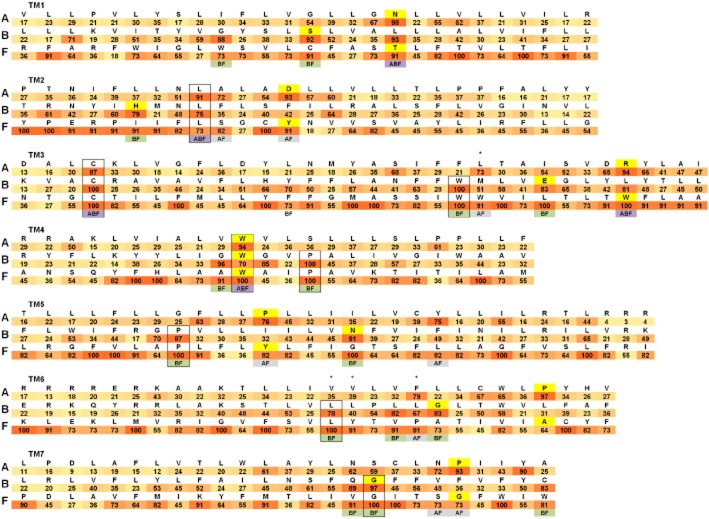
Structural sequence alignment of the TM helices of Class A, B and F. Only the TM helices are included and labelled TM1–7. A representative sequence (RS) for each class is shown. For every TM sequence the corresponding class name is included on the left. RSs have been created using the alignment of the TMDs of all the human GPCRs for the particular class. For every position in the TM region, the most conserved residue is included as reference with its percent identity within the class annotated below it (colour coded from white 0% to red 100% identity). Highlighted in yellow are the residues X.50 according to the Ballesteros–Weinstein numbering scheme for Class A and F and Wootten numbering scheme for Class B (Wootten et al., 2013). Identical conserved residues in two or three subfamilies are included in a black box. For TM positions with a percent identity greater than 70 in more than one class, the class names of the conserved amino acids are included below the corresponding TM location (ABF are highlighted in dark violet, AF in light violet and BF in green). Residues creating the Class A hydrophobic hindering mechanism (3.43, 6.44, 6.40 and 6.41) are indicated with an asterisk.
Figure 5
Figure 5
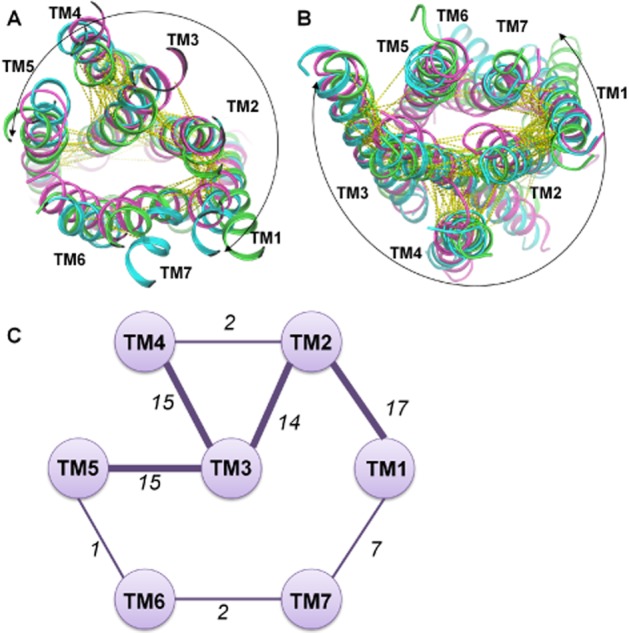
Topologically equivalent interhelical contacts among Class A, B and F. One representative crystal structure for each class has been included: β2-adrenoceptor in green, CRF1 in cyan and SMO receptor in magenta. Extracellular view (A) and intracellular view (B) of the common interhelical contacts are shown as yellow dotted lines. Most of the topologically equivalent network of interactions includes TM1–5 (highlighted by a curved arrow). (C) Schematic representation of the interhelical interaction network where TM helices are presented as circles. If consensus interactions are present between helices a line between the corresponding pair of circles is shown with the number of common contacts indicated. The thickness of the line is linked to the number of contacts between the TM helices.
Figure 6
Figure 6
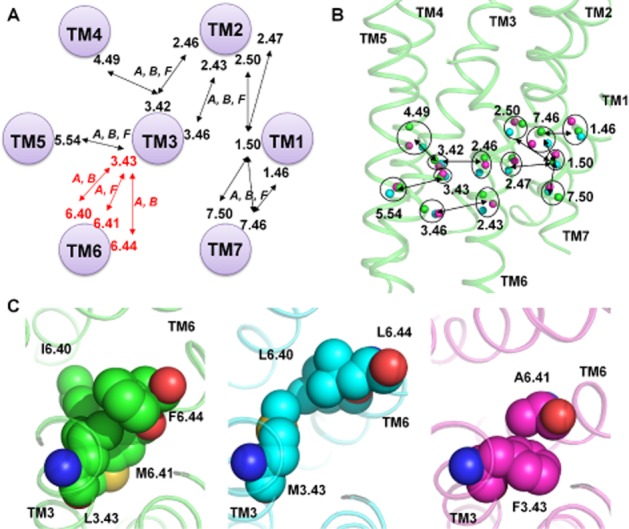
Common interhelical contacts among Class A, B and F created by conserved residues. (A) Consensus interactions among all three classes (A, B and F) are shown and connected by black arrows if created by residues conserved in at least two classes (according to the sequence alignment in Figure 4). Hydrophobic core residues are included in red, their interactions are shown using red arrows and the classes where they are present are indicated. (B) Location in the crystal structures of the conserved residues creating comparable topological contacts. Cα atoms are shown as spheres (β2-adrenoceptor in green including the backbone as cartoon, CRF1 receptor in cyan and SMO receptor in magenta) and topologically equivalent residues are included in a circle with their Ballesteros–Weinstein numbers. Residues in contact are linked by a black arrow. (C) Hydrophobic core contact residues for β2-adrenoceptor (left), CRF1 (centre) and SMO receptor (right).
Figure 7
Figure 7
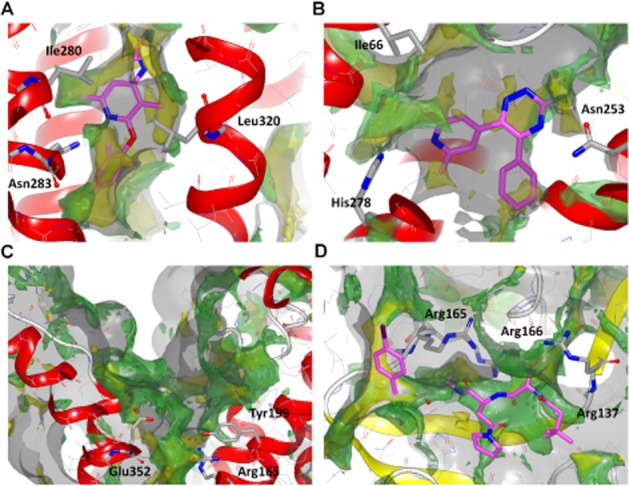
Druggability analysis using GRID. On the top row, comparison of two druggable sites: the CRF1 small molecule-binding site in complex with CP-376395 (A) and the adenosine A2A receptor-binding pocket bound to the triazine antagonist 4g (B). On the bottom row two less druggable binding regions: the CRF1 orthosteric site (C) and the cytomegalovirus serine protease in complex with a peptidomimetic inhibitor (D). The binding pocket surface generated using the GRID C3 (carbon sp3) probe has been contoured at 1 kcal·mol−1. The hydrophilic regions have been evaluated using the OH2 (water molecule) probe contoured at −5 kcal·mol−1, while the lipophilic/hydrophobic areas using the CRY probe contoured at −2.5 kcal·mol−1. C3, OH2 and CRY grids are represented as transparent solid surface respectively grey, green and yellow. Ligands are shown as stick with magenta carbon atoms. For reference, in each panel three important residues pointing towards the pocket are shown in stick representation.

References

    1. Alexander SPH, Benson HE, Faccenda E, Pawson AJ, Sharman JL, Spedding M, Peters JA, Harmar AJ, CGTP Collaborators The Concise Guide to PHARMACOLOGY 2013/14: G protein-couple receptors. Br J Pharmacol. 2013;170:1459–1581. - PMC - PubMed
    1. Bale TL, Vale WW. CRF and CRF receptors: role in stress responsivity and other behaviors. Annu Rev Pharmacol Toxicol. 2004;44:525–557. - PubMed
    1. Ballesteros JA, Weinstein H, Stuart CS. Methods in Neurosciences. New York: Academic; 1995. pp. 366–428.
    1. Barwell J, Gingell JJ, Watkins HA, Archbold JK, Poyner DR, Hay DL. Calcitonin and calcitonin receptor-like receptors: common themes with family B GPCRs? Br J Pharmacol. 2012;166:51–65. - PMC - PubMed
    1. Bissantz C, Logean A, Didier R. High-throughput modeling of human G-protein coupled receptors: amino acid sequence alignment, three-dimensional model building, and receptor library screening. J Chem Inf Comput Sci. 2004;44:1162–1176. - PubMed

MeSH terms

Substances