Clinical Trial
. 2014 May;39(10):1113-25.
doi: 10.1111/apt.12695. Epub 2014 Mar 16.

Randomised clinical trial: Lactobacillus GG modulates gut microbiome, metabolome and endotoxemia in patients with cirrhosis

Affiliations
Clinical Trial

Randomised clinical trial: Lactobacillus GG modulates gut microbiome, metabolome and endotoxemia in patients with cirrhosis

J S Bajaj et al. Aliment Pharmacol Ther. 2014 May.

Abstract

Background: Safety of individual probiotic strains approved under Investigational New Drug (IND) policies in cirrhosis with minimal hepatic encephalopathy (MHE) is not clear.

Aim: The primary aim of this phase I study was to evaluate the safety, tolerability of probiotic Lactobacillus GG (LGG) compared to placebo, while secondary ones were to explore its mechanism of action using cognitive, microbiome, metabolome and endotoxin analysis in MHE patients.

Methods: Cirrhotic patients with MHE patients were randomised 1:1 into LGG or placebo BID after being prescribed a standard diet and multi-vitamin regimen and were followed up for 8 weeks. Serum, urine and stool samples were collected at baseline and study end. Safety was assessed at Weeks 4 and 8. Endotoxin and systemic inflammation, microbiome using multi-tagged pyrosequencing, serum/urine metabolome were analysed between groups using correlation networks.

Results: Thirty MHE patients (14 LGG and 16 placebo) completed the study without any differences in serious adverse events. However, self-limited diarrhoea was more frequent in LGG patients. A standard diet was maintained and LGG batches were comparable throughout. Only in the LGG-randomised group, endotoxemia and TNF-α decreased, microbiome changed (reduced Enterobacteriaceae and increased Clostridiales Incertae Sedis XIV and Lachnospiraceae relative abundance) with changes in metabolite/microbiome correlations pertaining to amino acid, vitamin and secondary BA metabolism. No change in cognition was found.

Conclusions: In this phase I study, Lactobacillus GG is safe and well-tolerated in cirrhosis and is associated with a reduction in endotoxemia and dysbiosis.


Conflict of interest statement

Authors’ declaration of personal interests:

no personal conflicts of interest

Figures
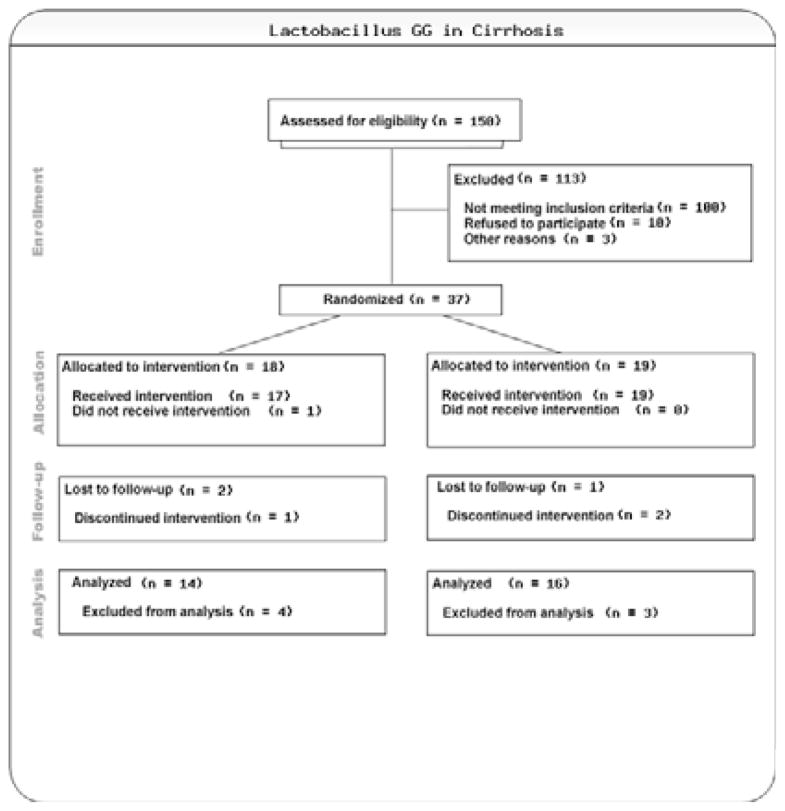
Figure 1
Figure 1
CONSORT diagram: The arm on the left is LGG while placebo is on the right
Figure 2
Figure 2
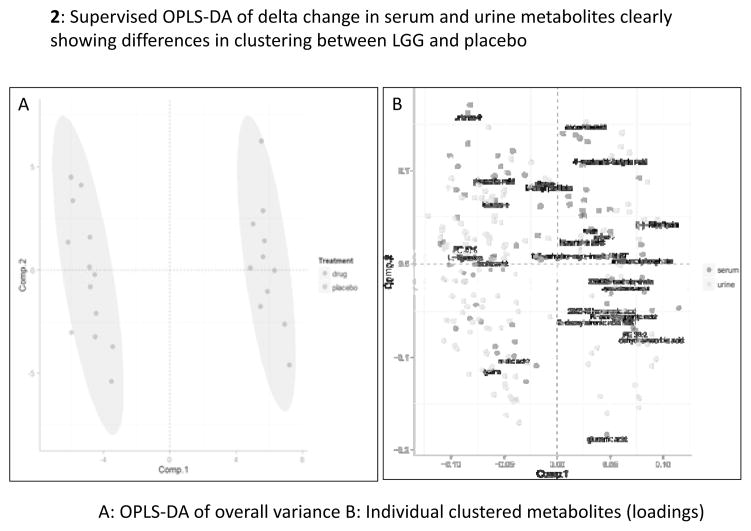
Supervised OPLS-DA of delta change in urine and serum metabolites clearly showing differences in clustering between LGG and placebo; the closer the dots, the more related the subjects are in their change of urine and serum metabolites. 2A: overall variances in differences between groups, 2B: individual metabolites that were significantly different between groups.
Figure 3
Figure 3
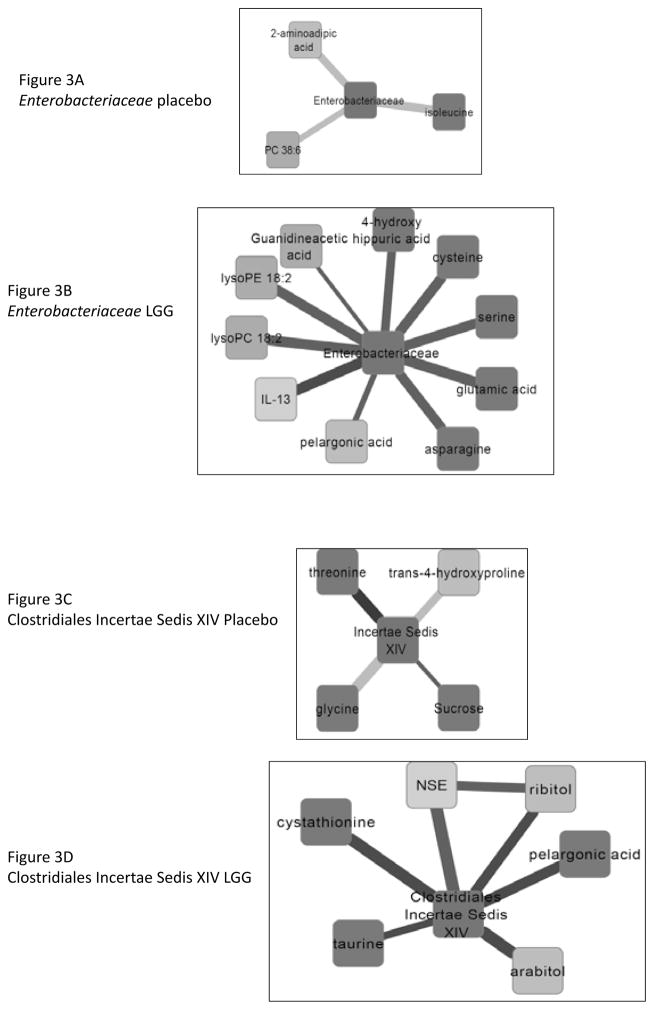
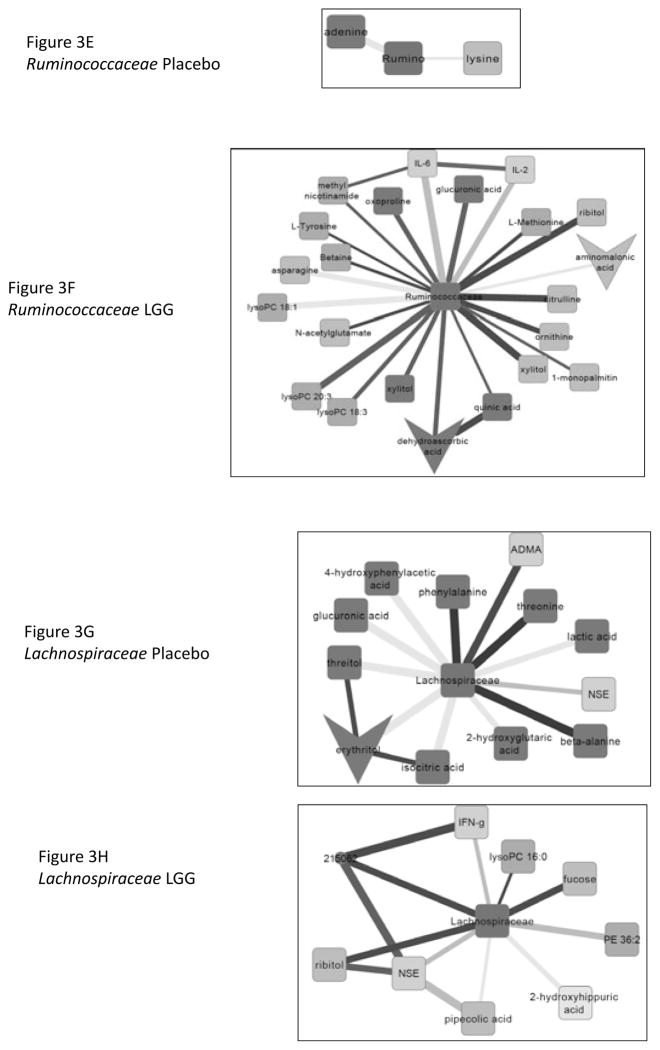
Sub-networks showing correlation network differences from baseline to week 8 in placebo and in Lactobacillus GG (LGG) groups separately centered on selected bacterial taxa. The following color scheme is applicable to all sub-networks Color of nodes: Blue: Inflammatory cytokine, Light green: serum metabolites, Dark green: urine metabolites. Color of Edges: Pink: negative remained negative but there is a net loss of negative correlation, Dark Blue: negative changed to positive, Yellow: positive remained positive but there is a net loss of positive correlation, Red: positive to negative, Dark green: shift negative to positive completely, Military green: shift positive to negative completely Figure 3A and B: Sub-networks of correlation changes from baseline to week 8 centered around Enterobacteriaceae in the placebo and LGG group respectively. In patients randomized to LGG, there were significant compositional changes from a direct correlation at baseline to inverse correlations after LGG supplementation. Several urinary ammoniagenic amino acids, products of nitrogen metabolism were positively linked with anti-inflammatory cytokine IL13. In placebo subjects there were no notable changes and inverse correlations. Figure 3C and D: Sub-networks of correlation changes from baseline to week 8 centered around Clostridiales Incertae Sedis XIV in the placebo and LGG group respectively. There were inverse correlation changes with taurine, arabitol, ribitol (intermediates with riboflavin and ascorbate metabolism) and the anti-oxidant cystathionine changed to positive after LGG supplementation. NSE, a marker of neuronal inflammation changed from positive to negative after LGG supplementation. By contrast, in the placebo group there only a minor loss of inverse correlation of Clostridiales Incertae Sedis XIV with three amino-acids, threonine, glycine and proline. Figure 3E and F: Sub-networks of correlation changes from baseline to week 8 centered around Ruminococcaceae in the placebo and LGG group respectively. Intermediates of urea cycle were positively correlated after LGG supplementation while there were consistent negative correlations with IL-6 and IL-2. There was lower urinary dehydro-ascorbate with lower intermediates in urine such as xylitol and increased serum vitamin C intermediates such as ribitol and xylitol. There was a decrease in correlation with aminomalonic acid, a marker of oxidative stress. In contrast, after placebo, there were little changes centered on adenine and lysine. Figure 3G and H: Sub-networks of correlation changes from baseline to week 8 centered around Lachnospiraceae in the placebo and LGG group respectively. In LGG-randomized patients, there were consistent negative associations between IFN-gamma and neuron-specific enolase (NSE) and change from negative to positive with fucose and ribitol. There was also a reduction in the extent of positive correlations with bacterial urinary nitrogen metabolism (hippuric acid) and pipecolic acid, a bacterial product of lysine. In placebo randomized patients there was a shift from negative to positive with urinary threonine, phenylalanine and alanine and shift completely from negative to positive with ADMA indicating continued endothelial dysfunction. There was a continued negative correlation with NSE and positive with lactate that reduced and with intermediates of riboflavin and ascorbate metabolism; threitol and erythritol.
Figure 3
Figure 3
Sub-networks showing correlation network differences from baseline to week 8 in placebo and in Lactobacillus GG (LGG) groups separately centered on selected bacterial taxa. The following color scheme is applicable to all sub-networks Color of nodes: Blue: Inflammatory cytokine, Light green: serum metabolites, Dark green: urine metabolites. Color of Edges: Pink: negative remained negative but there is a net loss of negative correlation, Dark Blue: negative changed to positive, Yellow: positive remained positive but there is a net loss of positive correlation, Red: positive to negative, Dark green: shift negative to positive completely, Military green: shift positive to negative completely Figure 3A and B: Sub-networks of correlation changes from baseline to week 8 centered around Enterobacteriaceae in the placebo and LGG group respectively. In patients randomized to LGG, there were significant compositional changes from a direct correlation at baseline to inverse correlations after LGG supplementation. Several urinary ammoniagenic amino acids, products of nitrogen metabolism were positively linked with anti-inflammatory cytokine IL13. In placebo subjects there were no notable changes and inverse correlations. Figure 3C and D: Sub-networks of correlation changes from baseline to week 8 centered around Clostridiales Incertae Sedis XIV in the placebo and LGG group respectively. There were inverse correlation changes with taurine, arabitol, ribitol (intermediates with riboflavin and ascorbate metabolism) and the anti-oxidant cystathionine changed to positive after LGG supplementation. NSE, a marker of neuronal inflammation changed from positive to negative after LGG supplementation. By contrast, in the placebo group there only a minor loss of inverse correlation of Clostridiales Incertae Sedis XIV with three amino-acids, threonine, glycine and proline. Figure 3E and F: Sub-networks of correlation changes from baseline to week 8 centered around Ruminococcaceae in the placebo and LGG group respectively. Intermediates of urea cycle were positively correlated after LGG supplementation while there were consistent negative correlations with IL-6 and IL-2. There was lower urinary dehydro-ascorbate with lower intermediates in urine such as xylitol and increased serum vitamin C intermediates such as ribitol and xylitol. There was a decrease in correlation with aminomalonic acid, a marker of oxidative stress. In contrast, after placebo, there were little changes centered on adenine and lysine. Figure 3G and H: Sub-networks of correlation changes from baseline to week 8 centered around Lachnospiraceae in the placebo and LGG group respectively. In LGG-randomized patients, there were consistent negative associations between IFN-gamma and neuron-specific enolase (NSE) and change from negative to positive with fucose and ribitol. There was also a reduction in the extent of positive correlations with bacterial urinary nitrogen metabolism (hippuric acid) and pipecolic acid, a bacterial product of lysine. In placebo randomized patients there was a shift from negative to positive with urinary threonine, phenylalanine and alanine and shift completely from negative to positive with ADMA indicating continued endothelial dysfunction. There was a continued negative correlation with NSE and positive with lactate that reduced and with intermediates of riboflavin and ascorbate metabolism; threitol and erythritol.

Comment in

References

    1. Bajaj JS, Hylemon PB, Ridlon JM, et al. Colonic mucosal microbiome differs from stool microbiome in cirrhosis and hepatic encephalopathy and is linked to cognition and inflammation. Am J Physiol Gastrointest Liver Physiol. 2012;303(6):G675–85. - PMC - PubMed
    1. Bajaj JS, Ridlon JM, Hylemon PB, et al. Linkage of gut microbiome with cognition in hepatic encephalopathy. Am J Physiol Gastrointest Liver Physiol. 2012;302(1):G168–75. - PMC - PubMed
    1. Chen Y, Yang F, Lu H, et al. Characterization of fecal microbial communities in patients with liver cirrhosis. Hepatology. 2011;54(2):562–72. - PubMed
    1. Ortiz M, Jacas C, Cordoba J. Minimal hepatic encephalopathy: diagnosis, clinical significance and recommendations. J Hepatol. 2005;42(Suppl 1):S45–53. - PubMed
    1. Shawcross DL, Wright G, Olde Damink SW, Jalan R. Role of ammonia and inflammation in minimal hepatic encephalopathy. Metab Brain Dis. 2007;22(1):125–38. - PubMed

Publication types

Substances