


Drug-resistant and hospital-associated Enterococcus faecium from wastewater, riverine estuary and anthropogenically impacted marine catchment basin
- PMID: 24629030
- PMCID: PMC4004213
- DOI: 10.1186/1471-2180-14-66
Drug-resistant and hospital-associated Enterococcus faecium from wastewater, riverine estuary and anthropogenically impacted marine catchment basin
Abstract
Background: Enterococci, ubiquitous colonizers of humans and other animals, play an increasingly important role in health-care associated infections (HAIs). It is believed that the recent evolution of two clinically relevant species, Enterococcus faecalis and Enterococcus faecium occurred in a big part in a hospital environment, leading to formation of high-risk enterococcal clonal complexes (HiRECCs), which combine multidrug resistance with increased pathogenicity and epidemicity. The aim of this study was to establish the species composition in wastewater, its marine recipient as well as a river estuary and to investigate the antimicrobial susceptibility of collected isolates. Molecular methods were additionally applied to test the presence of HiRRECC-related E. faecium.
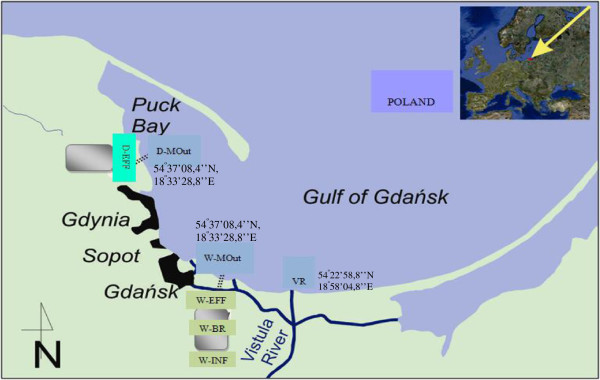
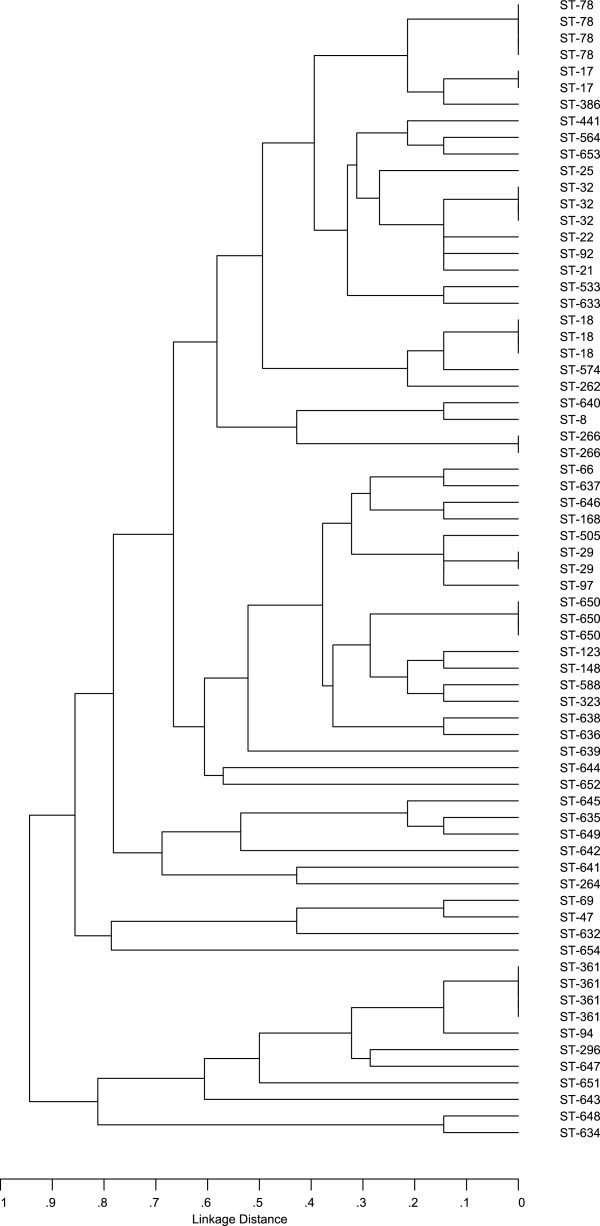
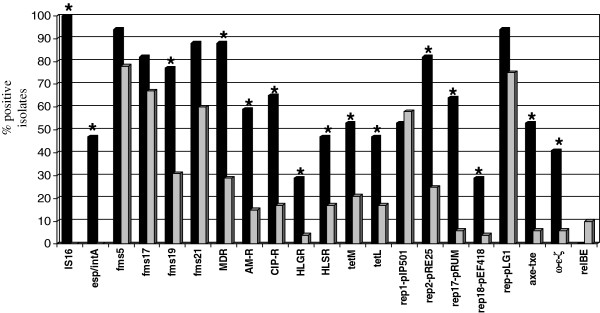
Results: Two wastewater treatment plants (WWTPs), their marine outfalls and Vistula river that influence significantly the quality of waters in Gulf of Gdansk were sampled to investigate the presence of Enterococcus spp. Four-hundred-twenty-eight isolates were obtained, including E. faecium (244 isolates, 57.0%), E. hirae (113 isolates, 26.4%) and E. faecalis (63 isolates, 14.7%); other species (E. gallinarum/casseliflavus, E. durans and E. avium) accounted for 1.9%. Antimicrobial susceptibility testing revealed the presence of isolates resistant to erythromycin, tetracycline, amipicillin, fluoroquinolones and aminoglycosides (high-level resistance), especially among E. faecium, where such isolates were usually characterized by multilocus sequence types associated with nosocomial lineages 17, 18 and 78 of this species representing HiRECC, formerly called CC17. These isolates not only carried several resistance determinants but were also enriched in genes encoding pathogenicity factors (Esp, pili) and genes associated with mobile genetic elements (MGE), a feature also typical for nosocomial HiRECC.
Conclusions: Our data show that WWTPs constitute an important source of enterococcal strains carrying antimicrobial resistance determinants, often associated with the presence of MGE, for the recipient water environment, thus increasing a pool of such genes for other organisms. The presence of HiRECCs in wastewaters and marine/river environment may indicate that adaptations gained in hospitals may be also beneficial for survival of such clones in other settings. There is an obvious need to monitor the release and spread of such strains in order to elucidate better ways to curb their dissemination.
Figures
References
-
- Aarestrup FM, Butaye P, Witte W. In: American Society for Microbiology. Gilmore MS, Clewell DB, Courvalin P, Dunny GM, Murray BE, Rice LB, editor. Washington DC: The Enterococci: pathogenesis, molecular biology and antibiotic resistance; 2002. Nonhuman reservoirs of Enterococci.
-
- Sood S, Malhotra M, Das BK, Kapil A. Enterococcal infections & antimicrobial resistance. Indian J Med Res. 2008;128:111–121. - PubMed
-
- European Centre for Disease Prevention and Control. Annual Epidemiological Report, Reporting on 2010 surveillance data and 2011 epidemic intelligence data. Stockholm: ECDC; 2012. p. 2013.
Publication types
MeSH terms
Substances
Associated data
- Actions
- Actions
- Actions
- Actions
- Actions
- Actions
LinkOut - more resources
Full Text Sources
Other Literature Sources
Medical
Miscellaneous
