


Self-reported cold sensitivity in patients with traumatic hand injuries or hand-arm vibration syndrome - an eight year follow up
- PMID: 24629077
- PMCID: PMC3995581
- DOI: 10.1186/1471-2474-15-83
Self-reported cold sensitivity in patients with traumatic hand injuries or hand-arm vibration syndrome - an eight year follow up
Abstract
Background: Cold sensitivity is a common complaint following hand injuries. Our aim was to investigate long-term self-reported cold sensitivity, and its predictors and the importance of sense of coherence (SOC), 8 years after a hand injury as well as in patients treated for Hand Arm Vibration Syndrome (HAVS) during the same time period.
Methods: Responses to the Cold Intolerance Symptom Severity (CISS) questionnaire and the Sense of Coherence (SOC) questionnaire were investigated in hand injured patients (n = 64) and in patients with HAVS (n = 26). The Mann-Whitney U-Test was used to identify significant differences between subgroups. When analysing predictors for cold sensitivity severity, the Spearman rank correlation (rS coefficient) were used for quantitative predictive variables, Mann-Whitney U-Test for dichotomous variables and Kruskal-Wallis Test for multiple categorical data. The Wilcoxon's signed rank test was used to investigate longitudinal changes in outcome.
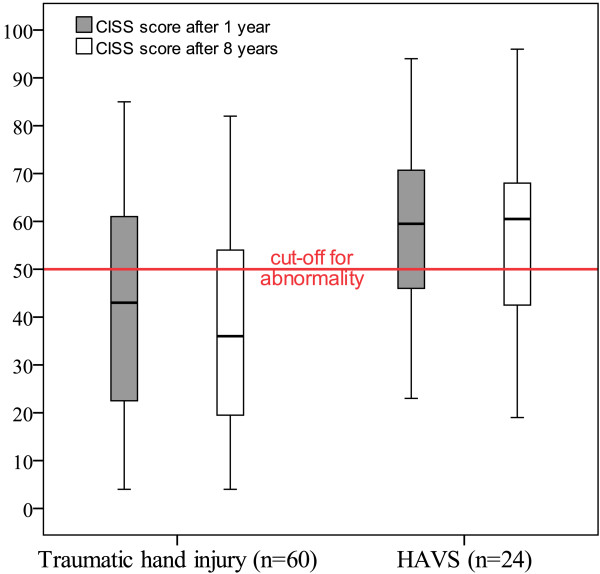
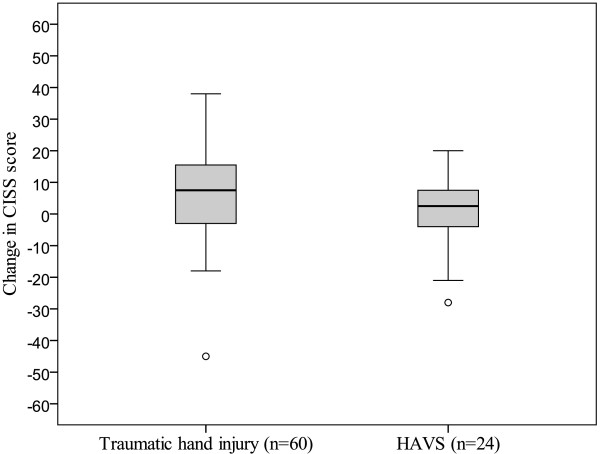
Results: There was a significant change in total CISS score for patients with traumatic hand injury, indicating fewer problems with cold sensitivity over time. Symptoms, such as stiffness, weakness and skin colour change on cold exposure, caused fewer problems, but perceived pain/aching and numbness remained unchanged as well as time needed for relief of symptoms on return to a warm environment. The negative impact of cold sensitivity on daily activities and at work was reduced, but problems when engaged in hobbies or when being exposed to cold wintry weather remained unchanged. None of the investigated predictors related to the hand injury were significantly associated with a change in cold sensitivity at the 8-year follow up. In contrast, no significant change in cold sensitivity was noted in the patients with HAVS for any of the situations included in the CISS questionnaire. A lower sense of coherence score correlated significantly with worse cold sensitivity (CISS score) in both patient groups.
Conclusions: The negative impact of cold sensitivity on daily life was reduced for patients with traumatic hand injury, but did not change over time in patients with HAVS. A low SOC is associated with worse cold sensitivity in such groups of patients. Information about relieving strategies should be provided for patients with cold sensitivity.
Figures
References
-
- McKirdy SW, Jacobs N, Nassab R, Starley IF. A retrospective review of cold intolerance following corrective surgery for Dupuytren's disease. Br J Hand Ther. 2007;12(2):55–59.
-
- Nijhuis TH, Smits ES, Jaquet JB, Van Oosterom FJ, Selles RW, Hovius SE. Prevalence and severity of cold intolerance in patients after hand fracture. J Hand Surg Eur. 2009;35(4):306–11. - PubMed
Publication types
MeSH terms
LinkOut - more resources
Full Text Sources
Other Literature Sources
Medical
