


Comment
doi: 10.1016/j.tics.2014.02.006.
Epub 2014 Mar 12.
When and how does autism begin?
Affiliations
- PMID: 24630165
- PMCID: PMC4389897
- DOI: 10.1016/j.tics.2014.02.006
Item in Clipboard
Comment
When and how does autism begin?
Trends Cogn Sci.
2014 Jun.
Abstract
Jones and Klin recently found that the well-known decreased fixations to eyes in children with autism spectrum disorder (ASD) are not present throughout infancy; instead a decline in eye fixations between 2 and 6 months predicts diagnosis. This decline is the earliest behavioral pattern linked to autism to date.
Copyright © 2014 Elsevier Ltd. All rights reserved.
Figures
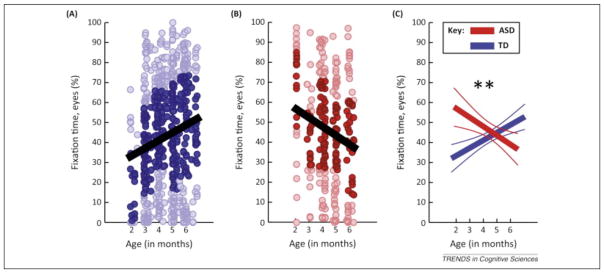
Developmental patterns of fixation to the eye region of faces. (A)
Raw data for eye fixations across age in a typically developing (TD) group
(blue). (B) Raw data for eye fixations across age in a group that
develops autism spectrum disorder (ASD) (red). (C) Hierarchical
linear model (HLM) summary of data with mean trend lines and 95%
confidence intervals, with significant interaction between diagnosis and age
(P=0.002). From Extended Data Figure 2 in
[1].
Comment on
-
Attention to eyes is present but in decline in 2-6-month-old infants later diagnosed with autism.Nature. 2013 Dec 19;504(7480):427-31. doi: 10.1038/nature12715. Epub 2013 Nov 6. Nature. 2013. PMID: 24196715 Free PMC article.
References
-
- Senju A, Johnson MH. Atypical eye contact in autism: Models, mechanisms and development. Neuroscience & Biobehavioral Reviews. 2009;33(8):1204–1214. - PubMed
-
- Gliga T, Csibra G. Seeing the face through the eyes: a developmental perspective on face expertise. Progress in Brain Research. 2007;164:323–339. - PubMed
-
- Elsabbagh M, Johnson MH. Getting answers from babies about autism. Trends in Cognitive Sciences. 2010;14(2):81–87. - PubMed
Publication types
MeSH terms
Grants and funding
LinkOut - more resources
Full Text Sources
Other Literature Sources
