


Parental role modeling of fruits and vegetables at meals and snacks is associated with children's adequate consumption
- PMID: 24630934
- PMCID: PMC4034448
- DOI: 10.1016/j.appet.2014.02.017
Parental role modeling of fruits and vegetables at meals and snacks is associated with children's adequate consumption
Abstract
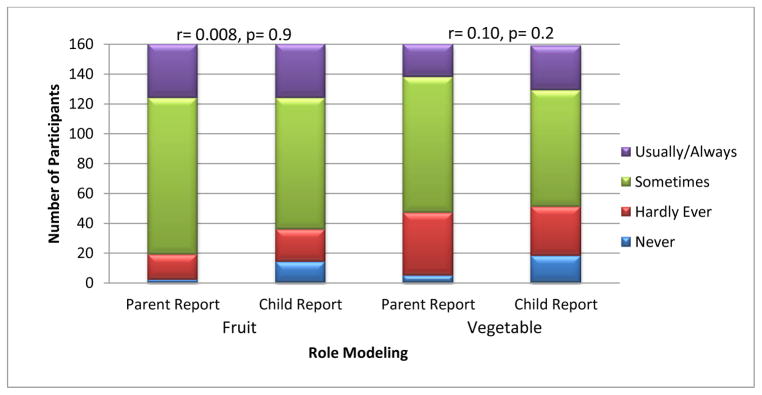
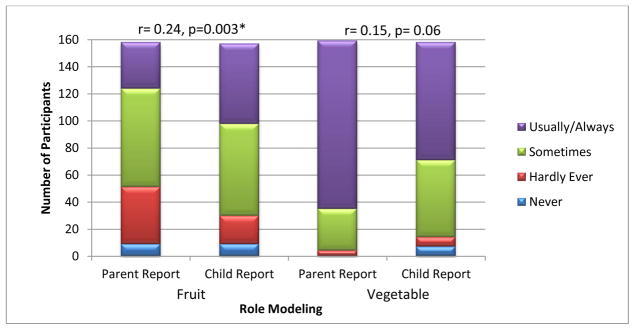
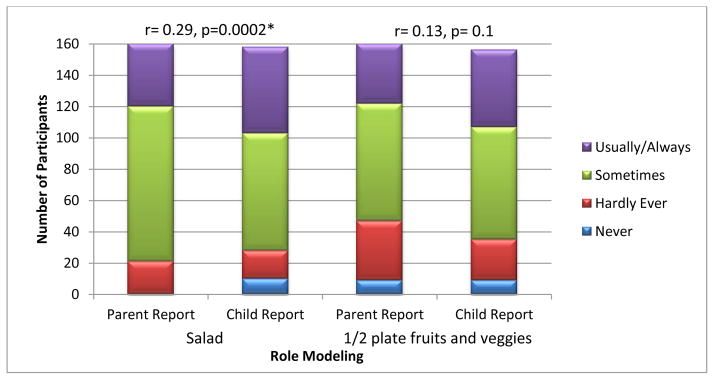
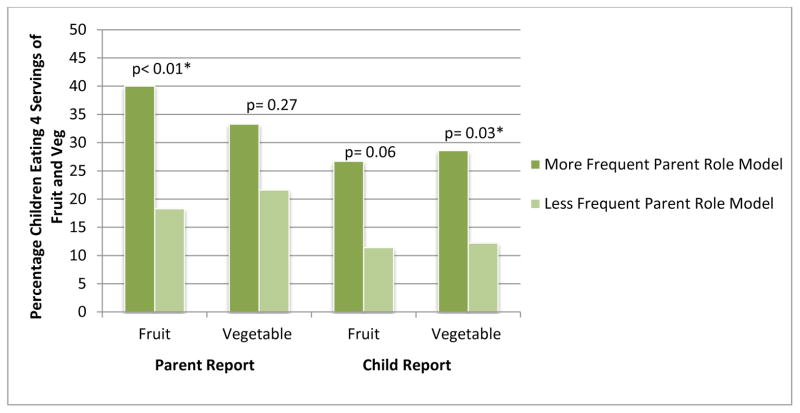
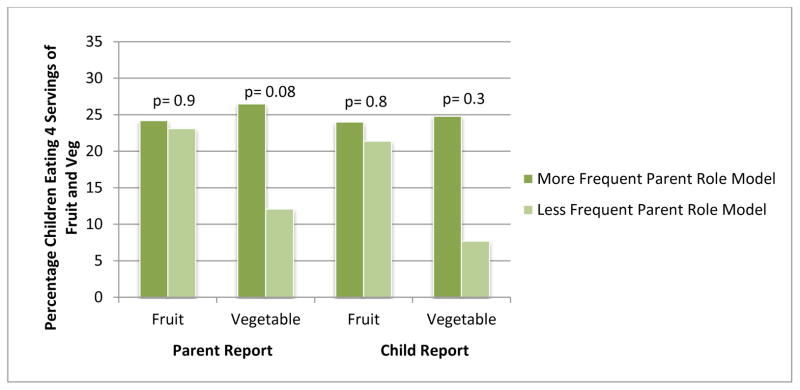
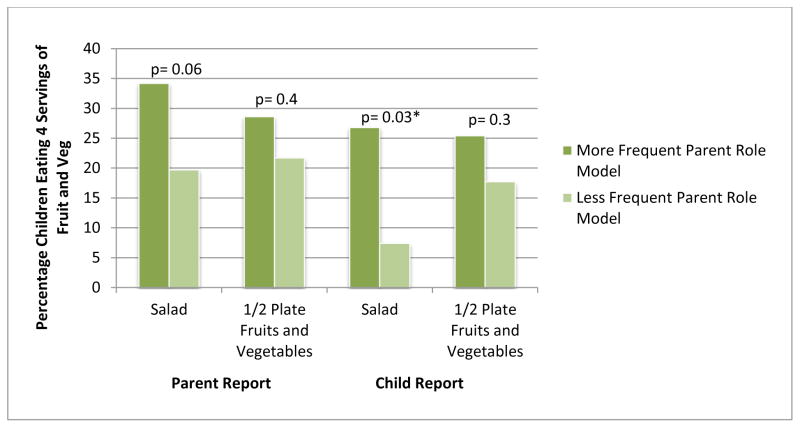
Research has shown that parental role modeling of healthful eating behaviors is positively correlated to children's dietary intake and fruit and vegetable (F&V) preferences. The purpose of this study is to (1) examine associations between parent and child report of parental role modeling of F&V consumption at snacks and dinner and (2) determine whether parental role modeling is associated with children meeting daily F&V recommendations. Parent-child dyads (N = 160) participating in the HOME Plus study completed baseline surveys on parental role modeling of F&V at snacks and dinner. Children also completed 24-hour dietary recalls. Spearman correlations and chi-square/Fisher's exact tests were used to examine relationships between parent and child report of parental role modeling of F&V at snacks and dinner and whether children met daily recommendations. On average, children consumed less than three daily servings of F&V with only 23% consuming the recommended servings. Statistically significant correlations were seen between parent and child report of parental role modeling fruit at dinner and green salad at dinner. Children who reported parental role modeling of vegetables at snack and salad at dinner were significantly more likely, than those who did not, to meet daily F&V recommendations. Parents who reported role modeling fruit at snack were significantly more likely to have children who met daily F&V recommendations. Results indicate that children are aware of their parents' eating behaviors and on occasion report this behavior similarly to their parents. Parents should be encouraged to utilize the opportunity to role model healthful dietary intake, especially at snacks, where consumption of F&V appears low.
Trial registration: ClinicalTrials.gov NCT01538615.
Keywords: Child nutrition; Family meals; Fruit and vegetable; Parent; Role modeling; Snacks.
Copyright © 2014 Elsevier Ltd. All rights reserved.
Figures
References
-
- Baranowski T, Sprague D, Baranowski JH, Harrison JA. Accuracy of maternal dietary recall for preschool children. Journal of the American Dietetic Association. 1991;91(6):669–674. - PubMed
-
- Bauer KW, Neumark-Sztainer D, Fulkerson JA, Hannan PJ, Story M. Familial correlates of adolescent girls’ physical activity, television use, dietary intake, weight, and body composition. The International Journal of Behavioral Nutrition and Physical Activity. 2011;8(1):25. doi: 10.1186/1479-5868-8-25. - DOI - PMC - PubMed
-
- Bere E, Klepp K. Correlates of fruit and vegetable intake among Norwegian schoolchildren: Parental and self-reports. Public Health Nutrition. 2004;7(8):991–998. - PubMed
-
- Boutelle KN, Lytle LA, Murray DM, Birnbaum AS, Story M. Perceptions of the family mealtime environment and adolescent mealtime behavior: Do adults and adolescents agree? Journal of Nutrition Education. 2001;33(3):128–33. - PubMed
-
- Burrows T, Golley RK, Khambalia A, McNaughton SA, Magarey A, Rosenkranz RR, Collins C. The quality of dietary intake methodology and reporting in child and adolescent obesity intervention trials: A systematic review. Obesity Reviews: An Official Journal of the International Association for the Study of Obesity. 2012;13(12):1125–1138. - PubMed
Publication types
MeSH terms
Associated data
Grants and funding
LinkOut - more resources
Full Text Sources
Other Literature Sources
Medical
Miscellaneous
