. 2014 Apr;106(4):dju047.
doi: 10.1093/jnci/dju047. Epub 2014 Mar 14.

Rare variants in TP53 and susceptibility to neuroblastoma

Affiliations

Rare variants in TP53 and susceptibility to neuroblastoma

Sharon J Diskin et al. J Natl Cancer Inst. 2014 Apr.

Abstract

TP53 is the most frequently mutated gene in human malignancies; however, de novo somatic mutations in childhood embryonal cancers such as neuroblastoma are rare. We report on the analysis of three independent case-control cohorts comprising 10290 individuals and demonstrate that rs78378222 and rs35850753, rare germline variants in linkage disequilibrium that map to the 3' untranslated region (UTR) of TP53 and 5' UTR of the Δ133 isoform of TP53, respectively, are robustly associated with neuroblastoma (rs35850753: odds ratio [OR] = 2.7, 95% confidence interval [CI] = 2.0 to 3.6, P combined = 3.43×10(-12); rs78378222: OR = 2.3, 95% CI = 1.8 to 2.9, P combined = 2.03×10(-11)). All statistical tests were two-sided. These findings add neuroblastoma to the complex repertoire of human cancers influenced by the rs78378222 hypomorphic allele, which impairs proper termination and polyadenylation of TP53 transcripts. Future studies using whole-genome sequencing data are likely to reveal additional rare variants with large effect sizes contributing to neuroblastoma tumorigenesis.


Figures
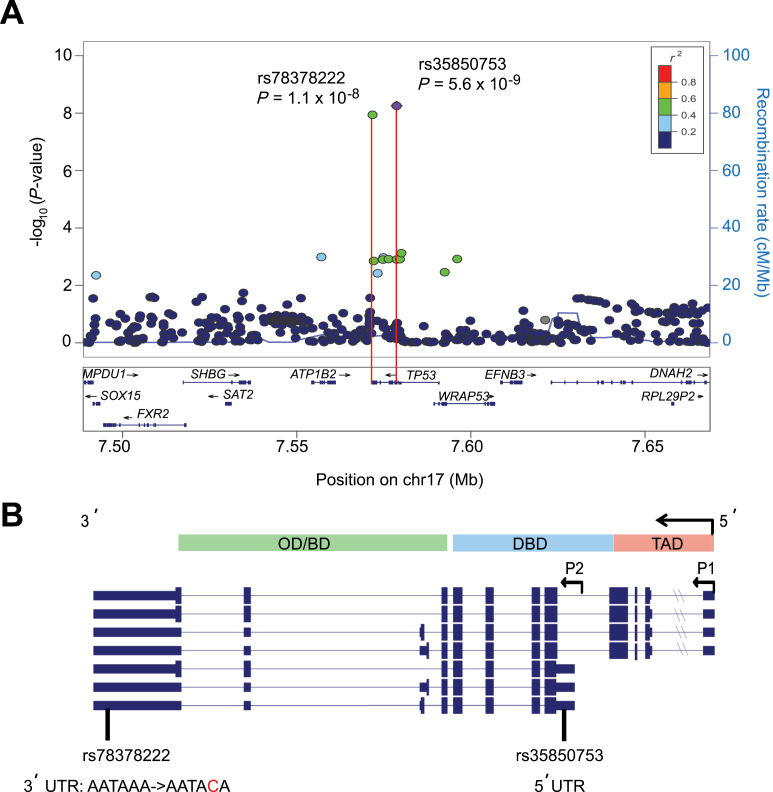
Figure 1.
Figure 1.
Discovery of rare variants within TP53 associated with neuroblastoma. A) Regional association plot of genotyped and imputed single nucleotide polymorphisms (SNPs) at the TP53 locus in a discovery cohort of 2101 case patients and 4202 control subjects of European ancestry. Plot was generated using LocusZoom (25). Y-axes represent the statistical significance of association (-log10 transformed P values) and the recombination rate. SNPs are color-coded based on pair-wise linkage disequilibrium (r 2) with most statistically significant SNP. Most statistically significant SNPs are labeled with P value, and most statistically significant SNP is shown in purple. Allelic P values generated by SNPTEST using score method (two-sided). B) Neuroblastoma-associated SNPs map to the 3΄ untranslated region (UTR) of TP53 and 5΄ UTR of the Δ133 isoform of TP53, respectively. The Δ133 isoform is transcribed by an alternative promoter (P2) and lacks a transactivation domain and part of the DNA binding domain. Shown are known isoforms of TP53 currently reported in the NCBI Reference Sequence database (RefSeq). BD = basic domain; DBD = DNA binding domain; OD = oligomerization domain; TAD = transactivation domain.

References

    1. Maris JM. Recent advances in neuroblastoma. N Engl J Med. 2010;362(23):2202–2211 - PMC - PubMed
    1. Mosse YP, Laudenslager M, Longo L, et al. Identification of ALK as a major familial neuroblastoma predisposition gene. Nature. 2008;455(7215):930–935 - PMC - PubMed
    1. Trochet D, Bourdeaut F, Janoueix-Lerosey I, et al. Germline mutations of the paired-like homeobox 2B (PHOX2B) gene in neuroblastoma. Am J Hum Genet. 2004;74(4):761–764 - PMC - PubMed
    1. Mosse YP, Laudenslager M, Khazi D, et al. Germline PHOX2B mutation in hereditary neuroblastoma. Am J Hum Genet. 2004;75(4):727–730 - PMC - PubMed
    1. Maris JM, Mosse YP, Bradfield JP, et al. Chromosome 6p22 locus associated with clinically aggressive neuroblastoma. N Engl J Med. 2008;358(24):2585–2593 - PMC - PubMed

Publication types

MeSH terms

Substances
