


Explaining Facial Imitation: A Theoretical Model
- PMID: 24634574
- PMCID: PMC3953219
- DOI: 10.1002/(SICI)1099-0917(199709/12)6:3/4<179::AID-EDP157>3.0.CO;2-R
Explaining Facial Imitation: A Theoretical Model
Abstract
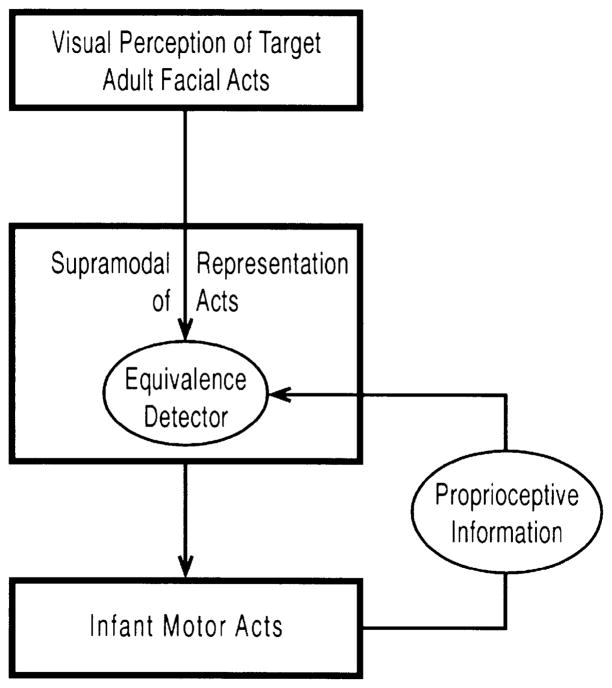
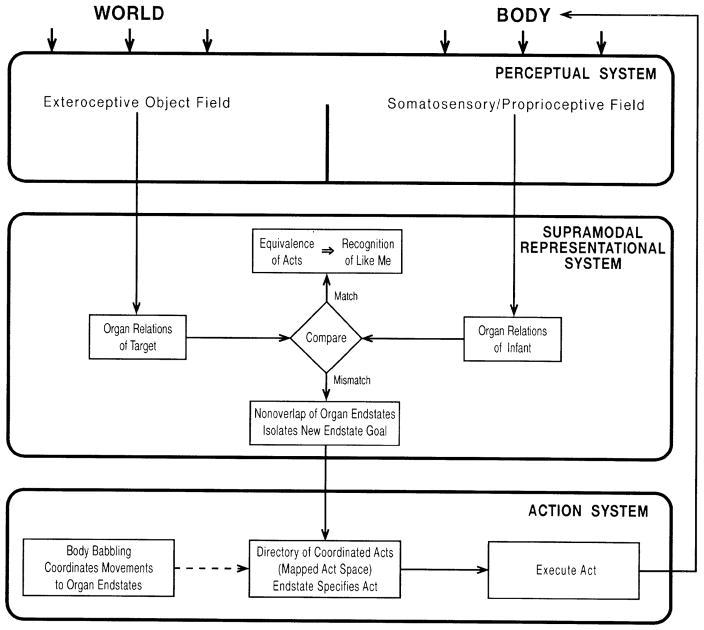
A long-standing puzzle in developmental psychology is how infants imitate gestures they cannot see themselves perform (facial gestures). Two critical issues are: (a) the metric infants use to detect cross-modal equivalences in human acts and (b) the process by which they correct their imitative errors. We address these issues in a detailed model of the mechanisms underlying facial imitation. The model can be extended to encompass other types of imitation. The model capitalizes on three new theoretical concepts. First, organ identification is the means by which infants relate parts of their own bodies to corresponding ones of the adult's. Second, body babbling (infants' movement practice gained through self-generated activity) provides experience mapping movements to the resulting body configurations. Third, organ relations provide the metric by which infant and adult acts are perceived in commensurate terms. In imitating, infants attempt to match the organ relations they see exhibited by the adults with those they feel themselves make. We show how development restructures the meaning and function of early imitation. We argue that important aspects of later social cognition are rooted in the initial cross-modal equivalence between self and other found in newborns.
Keywords: cross-modal; faces; imitation; memory; motor coordination; self.
Figures
References
-
- Abravanel E, DeYong NG. Does object modeling elicit imitative-like gestures from young infants? Journal of Experimental Child Psychology. 1991;52:22–40. - PubMed
-
- Abravanel E, Sigafoos AD. Exploring the presence of imitation during early infancy. Child Development. 1984;55:381–392. - PubMed
-
- Barr R, Dowden A, Hayne H. Developmental changes in deferred imitation by 6- to 24-month-old infants. Infant Behavior and Development. 1996;19:159–170.
-
- Bauer PJ, Mandler JM. Putting the horse before the cart: the use of temporal order in recall of events by one-year-old children. Developmental Psychology. 1992;28:441–452.
-
- Bertenthal BI. Origins and early development of perception, action, and representation. Annual Review of Psychology. 1996;47:431–459. - PubMed
Grants and funding
LinkOut - more resources
Full Text Sources