. 2013 Nov 28;3(2):114-23.
doi: 10.1016/j.molmet.2013.11.005. eCollection 2014 Apr.

Identification of a novel mitochondrial uncoupler that does not depolarize the plasma membrane

Affiliations

Identification of a novel mitochondrial uncoupler that does not depolarize the plasma membrane

Brandon M Kenwood et al. Mol Metab. .

Abstract

Dysregulation of oxidative phosphorylation is associated with increased mitochondrial reactive oxygen species production and some of the most prevalent human diseases including obesity, cancer, diabetes, neurodegeneration, and heart disease. Chemical 'mitochondrial uncouplers' are lipophilic weak acids that transport protons into the mitochondrial matrix via a pathway that is independent of ATP synthase, thereby uncoupling nutrient oxidation from ATP production. Mitochondrial uncouplers also lessen the proton motive force across the mitochondrial inner membrane and thereby increase the rate of mitochondrial respiration while decreasing production of reactive oxygen species. Thus, mitochondrial uncouplers are valuable chemical tools that enable the measurement of maximal mitochondrial respiration and they have been used therapeutically to decrease mitochondrial reactive oxygen species production. However, the most widely used protonophore uncouplers such as carbonyl cyanide p-trifluoromethoxyphenylhydrazone (FCCP) and 2,4-dinitrophenol have off-target activity at other membranes that lead to a range of undesired effects including plasma membrane depolarization, mitochondrial inhibition, and cytotoxicity. These unwanted properties interfere with the measurement of mitochondrial function and result in a narrow therapeutic index that limits their usefulness in the clinic. To identify new mitochondrial uncouplers that lack off-target activity at the plasma membrane we screened a small molecule chemical library. Herein we report the identification and validation of a novel mitochondrial protonophore uncoupler (2-fluorophenyl){6-[(2-fluorophenyl)amino](1,2,5-oxadiazolo[3,4-e]pyrazin-5-yl)}amine, named BAM15, that does not depolarize the plasma membrane. Compared to FCCP, an uncoupler of equal potency, BAM15 treatment of cultured cells stimulates a higher maximum rate of mitochondrial respiration and is less cytotoxic. Furthermore, BAM15 is bioactive in vivo and dose-dependently protects mice from acute renal ischemic-reperfusion injury. From a technical standpoint, BAM15 represents an effective new tool that allows the study of mitochondrial function in the absence of off-target effects that can confound data interpretation. From a therapeutic perspective, BAM15-mediated protection from ischemia-reperfusion injury and its reduced toxicity will hopefully reignite interest in pharmacological uncoupling for the treatment of the myriad of diseases that are associated with altered mitochondrial function.

Keywords: ANT, adenine nucleotide translocase; Bioenergetics; CCCP; DNP; ECAR, extracellular acidification rate; FCCP; FCCP, carbonyl cyanide p-trifluoromethoxyphenylhydrazone; Ischemia; Mitochondria; OCR, oxygen consumption rate; ROS, reactive oxygen species; TCA cycle, tricarboxylic acid cycle; TMPD, N,N,N′,N′-tetramethyl-p-phenylenediamine dihydrochloride; TMRM, tetramethylrhodamine.


Figures
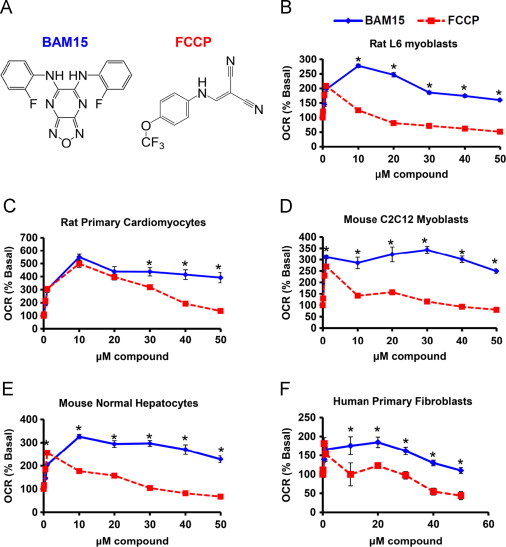
Figure 1
Figure 1
(A) BAM15 and FCCP are structurally unrelated. (B–F) FCCP- and BAM15-stimulated oxygen consumption rate (OCR) in L6 myoblasts, rat primary cardiomyocytes, mouse C2C12 myoblasts, mouse normal hepatocytes, and human primary fibroblasts at the indicated concentrations. Error bars indicate SEM. For (B–F), * indicates p<0.05 by two-way ANOVA with Bonferroni's posttest and N=6–8 wells per condition from three separate experiments.
Figure 2
Figure 2
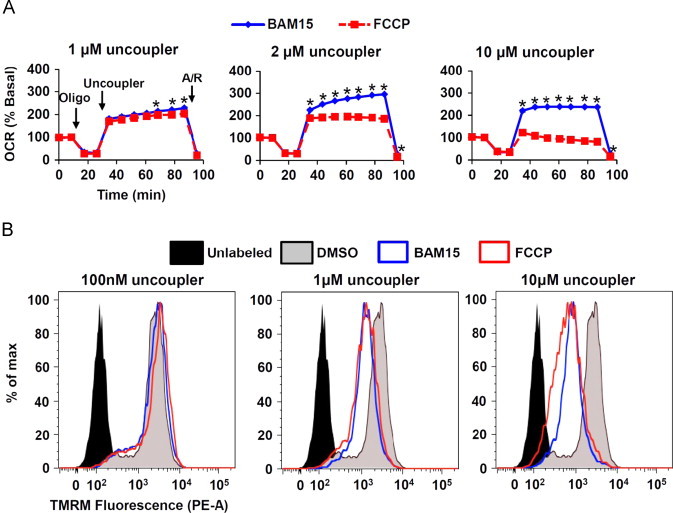
BAM15 causes mitochondrial uncoupling in cells. (A) L6 cells were sequentially treated with oligomycin (Oligo, 1 µM), the indicated concentration of BAM15 or FCCP (Uncoupler), and antimycin A (10 µM) plus rotenone (1 µM) (A/R) as indicated by arrows. (B) TMRM-loaded L6 cells were treated with the indicated concentrations of BAM15 or FCCP for 10 min prior to FACS analysis in the phycoerythrin (PE) channel. Uncoupler-treated cells are left-shifted, indicating loss of mitochondrial membrane potential. Error bars indicate SEM. For (A) * indicates p<0.05 by two-way ANOVA with Bonferroni's posttest. N=5 wells per condition over one experiment. For (B), N=one representative from three separate experiments.
Figure 3
Figure 3
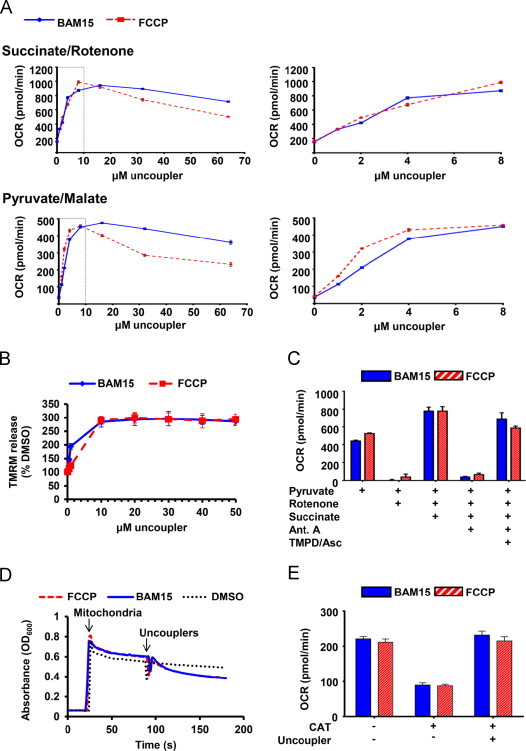
BAM15 is a mitochondrial protonophore. (A) Oxygen consumption rate (OCR) of isolated mouse liver mitochondria respiring on succinate in the presence of rotenone and pyruvate/malate was measured following treatment with increasing concentrations of BAM15 or FCCP. Right graphs expand the area that is indicated by the dotted box in the left graph. (B) BAM15 depolarizes isolated mitochondria. TMRM release in isolated mitochondria respiring on succinate (10 mM) in the presence of rotenone (1 µM) was measured following treatment with increasing concentrations of BAM15 and FCCP. Data is expressed as a percentage of fluorescence from DMSO (0.1%)-treated mitochondria. (C) Isolated mouse liver mitochondria respiring on pyruvate and malate in the presence of FCCP (5 µM) or BAM15 (5 µM) were treated sequentially with rotenone (4 µM), succinate (10 mM), antimycin A (4 µM), and the electron donors TMPD (100 µM) and ascorbate (10 mM). (D) BAM15 induces proton-dependent mitochondrial swelling. Absorbance at 600 nm was read over time following the addition of isolated mouse liver mitochondria respiring on succinate (10 mM) in the presence of rotenone (1 µM) and valinomycin. Mitochondria and 10 µM uncouplers were added at the indicated time points. (E) BAM15 increases oxygen consumption independent of the adenine nucleotide translocase. Oxygen consumption rate (OCR) was measured on permeabilized C2C12 cells respiring on succinate (10 mM) and treated with rotenone (2 µM) and ADP (4 mM). Mitochondria were then treated with carboxyatractyloside (CAT, 3 µg/mL), followed by FCCP or BAM15 (1 µM). Error bars indicate SEM. For (A and E) N=6–9 wells per condition over three separate experiments. For (B) N=3 experiments. For (C) N=3 wells/condition. For (D) N=one representative of three separate experiments.
Figure 4
Figure 4
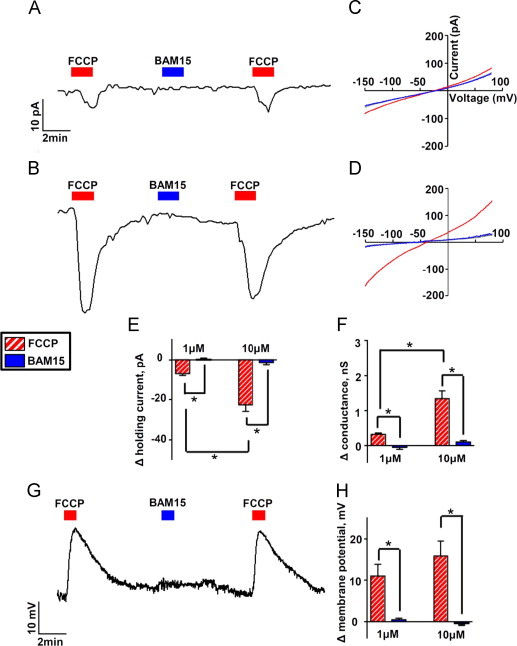
BAM15 does not alter plasma membrane electrophysiology. (A) Representative whole cell voltage clamp recording from a L6 cell showing the holding current (at −70 mV) during exposure to FCCP and BAM15 (both 1 µM). (B) Voltage clamp with 10 µM FCCP and BAM15. (C and D) Currents were elicited with a voltage ramp from −150 mV to +80 mV using 1 µM uncouplers in (C) and 10 µM uncouplers in (D); IV relationships are plotted under control conditions and in the presence of the uncouplers. (E) Average data comparing the change in holding current caused by FCCP and BAM15 at 1 µM and 10 µM. (F) Average data comparing the change in conductance generated by either drug in the range of −130 mV to −60 mV. (G) Representative whole cell current clamp recording at concentrations of 10 µM for FCCP and BAM15. (H) Average data comparing the change in membrane potential by both drugs. Error bars indicate SEM. For (E)–(H), * indicates p<0.05 by two-way ANOVA with Bonferroni's posttest, N=7–9 cells per condition.
Figure 5
Figure 5
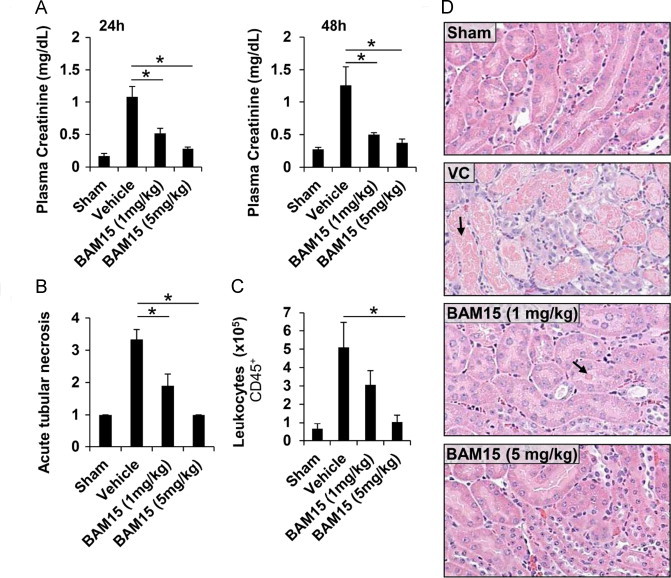
BAM15 protects against kidney ischemic-reperfusion injury. Male mice (8-week old, C57BL/6) were treated with vehicle control (VC) or BAM15 at 1 or 5 mg/kg 1 h prior to bilateral ischemia for 26 min followed by 48 h of reperfusion. Sham-operated mice underwent an identical surgical procedure, but the renal pedicles were not clamped. (A) BAM15 pretreatment dose-dependently protected from kidney damage, as indicated by the decreased plasma creatinine levels at 24 and 48 h following reperfusion, compared to VC. (B-D) BAM15 pretreatment decreased acute proximal tubular necrosis and leukocyte invasion of the kidney medulla 48 h following reperfusion. Arrows indicate sites of tubular cell death. Error bars indicate SEM. * indicates p < 0.05 compared to vehicle control by one-way ANOVA with Dunnett's posttest. N = 3-6 mice per group.

References

    1. Rousset S., Alves-Guerra M.C., Mozo J., Miroux B., Cassard-Doulcier A.M., Bouillaud F. The biology of mitochondrial uncoupling proteins. Diabetes. 2004;53(Suppl 1):S130–S135. - PubMed
    1. Korshunov S.S., Skulachev V.P., Starkov A.A. High protonic potential actuates a mechanism of production of reactive oxygen species in mitochondria. FEBS Letters. 1997;416:15–18. - PubMed
    1. Turrens J.F. Superoxide production by the mitochondrial respiratory chain. Bioscience Reports. 1997;17:3–8. - PubMed
    1. Lambert A.J., Brand M.D. Reactive oxygen species production by mitochondria. Methods in Molecular Biology. 2009;554:165–181. - PubMed
    1. Sack M.N. Mitochondrial depolarization and the role of uncoupling proteins in ischemia tolerance. Cardiovascular Research. 2006;72:210–219. - PubMed