


Reductive stress after exercise: The issue of redox individuality
- PMID: 24634834
- PMCID: PMC3953955
- DOI: 10.1016/j.redox.2014.02.003
Reductive stress after exercise: The issue of redox individuality
Abstract
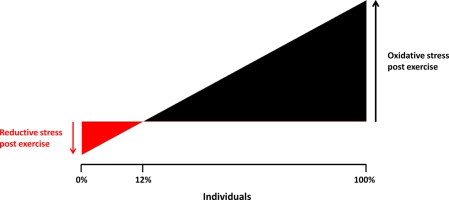
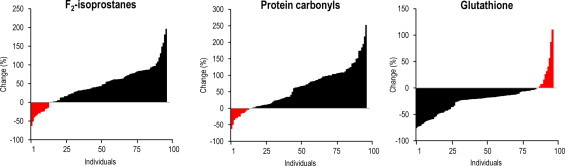
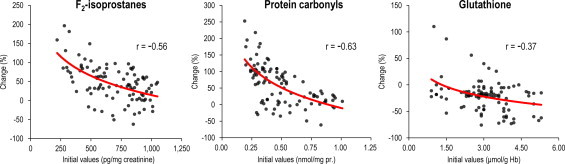
Exercise has been consistently used as an oxidant stimulus in redox biology studies. However, previous studies have focused on group differences and did not examine individual differences. As a result, it remains untested whether all individuals experience oxidative stress after acute exercise. Therefore, the main aim of the present study was to investigate whether some individuals exhibit unexpected responses after an acute eccentric (i.e., muscle-damaging) exercise session. Ninety eight (N = 98) young men performed an isokinetic eccentric exercise bout with the knee extensors. Plasma, erythrocytes and urine samples were collected immediately before and 2 days post-exercise. Three commonly used redox biomarkers (F2-isoprostanes, protein carbonyls and glutathione) were assayed. As expected, the two oxidant biomarkers (F2-isoprostanes and protein carbonyls) significantly increased 2 days after exercise (46% and 61%, respectively); whereas a significant decrease in glutathione levels (by -21%) was observed after exercise. A considerable number of the participants exhibited changes in the levels of biomarkers in the opposite, unexpected direction than the group average. More specifically, 13% of the participants exhibited a decrease in F2-isoprostanes and protein carbonyls and 10% of the participants exhibited an increase in glutathione levels. Furthermore, more than 1 out of 3 individuals exhibited either unexpected or negligible (from 0% to ± 5%) responses to exercise in at least one redox biomarker. It was also observed that the initial values of redox biomarkers are important predictors of the responses to exercise. In conclusion, although exercise induces oxidative stress in the majority of individuals, it can induce reductive stress or negligible stress in a considerable number of people. The data presented herein emphasize that the mean response to a redox stimulus can be very misleading. We believe that the wide variability (including the cases of reductive stress) described is not limited to the oxidant stimulus used and the biomarkers selected.
Keywords: Antioxidants; Free radicals; Individuality; Muscle damage; Oxidative stress; Redox biology.
Figures
References
Publication types
MeSH terms
Substances
LinkOut - more resources
Full Text Sources
Other Literature Sources
Miscellaneous
