


Review
doi: 10.1016/j.redox.2014.02.005.
eCollection 2014.
Hydrogen peroxide signaling in vascular endothelial cells
Affiliations
- PMID: 24634835
- PMCID: PMC3953958
- DOI: 10.1016/j.redox.2014.02.005
Item in Clipboard
Review
Hydrogen peroxide signaling in vascular endothelial cells
Redox Biol.
.
Abstract
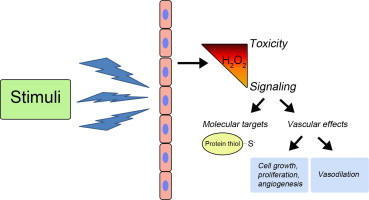
Redox signaling is implicated in different physiological and pathological events in the vasculature. Among the different reactive oxygen species, hydrogen peroxide (H2O2) is a very good candidate to perform functions as an intracellular messenger in the regulation of several biological events. In this review, we summarize the main physiological sources of H2O2 in the endothelium and the molecular mechanisms by which it is able to act as a signaling mediator in the vasculature.
Keywords: Endothelium; Hydrogen peroxide; Redox signaling; Vasodilation.
Figures
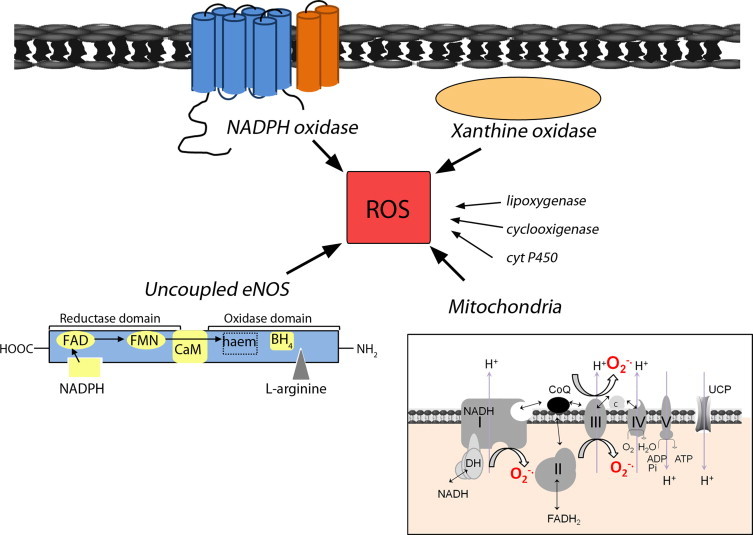
Sources of reactive oxygen species in the vascular endothelium.The major sources of ROS in the endothelium include NADPH oxidase isoform 4, eNOS uncoupling, mitochondrial respiration and xanthine oxidase. Other sources such as lipoxygenase, cyclooxygenase or cytochrome P450 also contribute to ROS generation in the vascular endothelium.
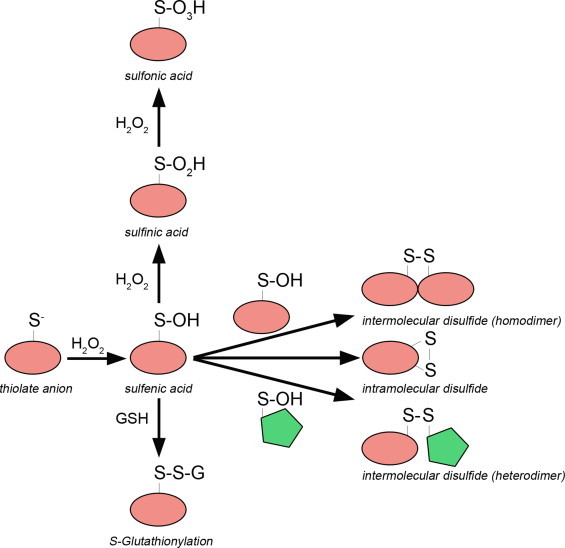
Protein thiol modifications by hydrogen peroxide.H2O2 induces cysteine dimerization (R–S–S–R) via the formation of the unstable intermediate sulfenic acid (R–SOH). Disulfides can form between cysteines located in the same protein (intramolecular disulfides), in different proteins (intermolecular disulfides), or between the protein thiol and glutathione (S-glutathionylation). In the presence of high concentrations of H2O2, the sulfenic acid can become further oxidized to sulfinic (R–SO2) or sulfonic (R–SO3) acid.
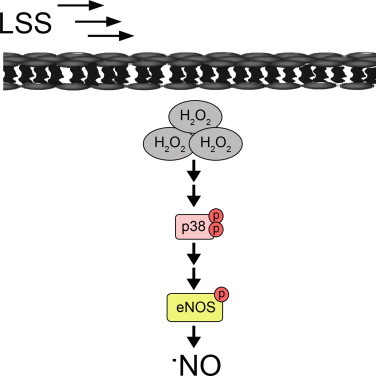
Laminar shear stress regulation of vascular tone.Hydrogen peroxide activation of p38 MAPK is a fundamental mechanism for laminar shear stress-mediated endothelium vasodilation.
References
Publication types
MeSH terms
Substances
LinkOut - more resources
Full Text Sources
Other Literature Sources
