


Insomnia symptoms, objective sleep duration and hypothalamic-pituitary-adrenal activity in children
- PMID: 24635035
- PMCID: PMC7090377
- DOI: 10.1111/eci.12263
Insomnia symptoms, objective sleep duration and hypothalamic-pituitary-adrenal activity in children
Abstract
Background: Insomnia symptoms are the most common parent-reported sleep complaints in children; however, little is known about the pathophysiology of childhood insomnia symptoms, including their association with hypothalamic-pituitary-adrenal (HPA) axis activation. The objective of this study is to examine the association between parent-reported insomnia symptoms, objective short sleep duration and cortisol levels in a population-based sample of school-aged children.
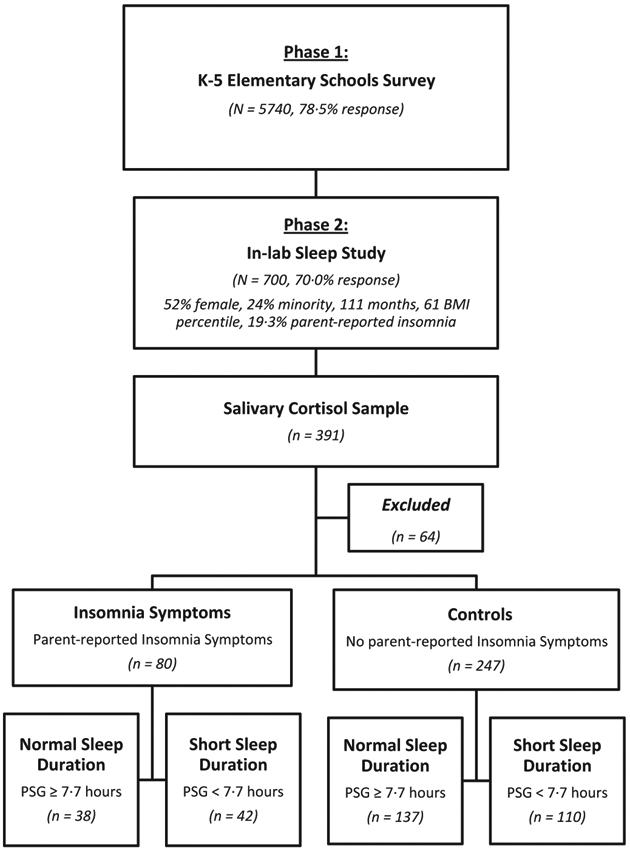
Design: A sample of 327 children from the Penn State Child Cohort (5-12 years old) underwent 9-h overnight polysomnography and provided evening and morning saliva samples to assay for cortisol. Objective short sleep duration was defined based on the median total sleep time (i.e., <7·7 h). Parent-reported insomnia symptoms of difficulty initiating and/or maintaining sleep were ascertained with the Pediatric Behavior Scale.
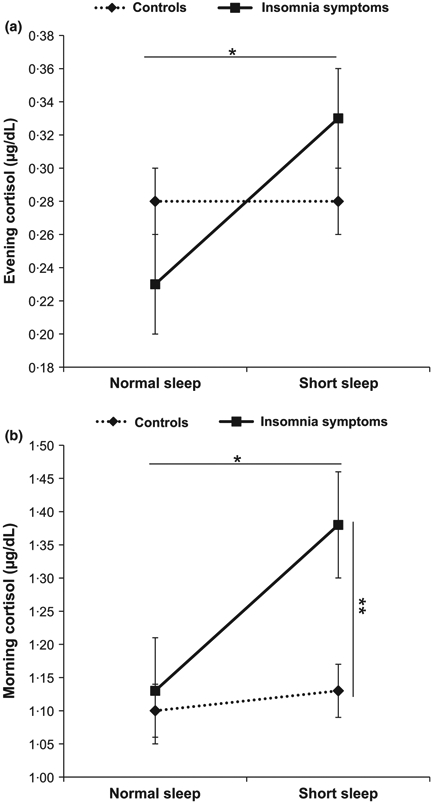
Results: Children with parent-reported insomnia symptoms and objective short sleep duration showed significantly increased evening (0·33±0·03 μg/dL) and morning (1·38±0·08 μg/dL) cortisol levels. In contrast, children with parent-reported insomnia symptoms and 'normal' sleep duration showed similar evening and morning cortisol levels (0·23±0·03 μg/dL and 1·13±0·08 μg/dL) compared with controls with 'normal' (0·28±0·02 μg/dL and 1·10±0·04 μg/dL) or short (0·28±0·02 μg/dL and 1·13±0·04 μg/dL) sleep duration.
Conclusions: Our findings suggest that insomnia symptoms with short sleep duration in children may be related to 24-h basal or responsive physiological hyperarousal. Future studies should explore the association of insomnia symptoms with short sleep duration with physical and mental health morbidity.
Keywords: Children; cortisol; insomnia symptoms; objective sleep duration.
© 2014 Stichting European Society for Clinical Investigation Journal Foundation.
Conflict of interest statement
Conflict of interests
The authors declare no competing financial conflict of interests.
Figures
References
-
- Smedje H, Broman JE, Hetta J. Parents’ reports of disturbed sleep in 5–7-year-old Swedish children. Acta Paediatr 1999;88:858–65. - PubMed
-
- Liu X, Sun Z, Uchiyama M, Shibui K, Kim K, Okawa M. Prevalence and correlates of sleep problems in Chinese schoolchildren. Sleep 2000;23:1053–62. - PubMed
-
- Stein MA, Mendelsohn J, Obermeyer WH, Amromin J, Benca R. Sleep and behavior problems in school-aged children. Pediatrics 2001;107:E60. - PubMed
-
- Spruyt K, O’Brien LM, Cluydts R, Verleye GB, Ferri R. Odds, prevalence and predictors of sleep problems in school-age normal children. J Sleep Res 2005;14:163–76. - PubMed
MeSH terms
Substances
Grants and funding
LinkOut - more resources
Full Text Sources
Other Literature Sources
Medical
