


Mechanisms of the inward remodeling process in resistance vessels: is the actin cytoskeleton involved?
- PMID: 24635509
- PMCID: PMC3988214
- DOI: 10.1111/micc.12105
Mechanisms of the inward remodeling process in resistance vessels: is the actin cytoskeleton involved?
Abstract
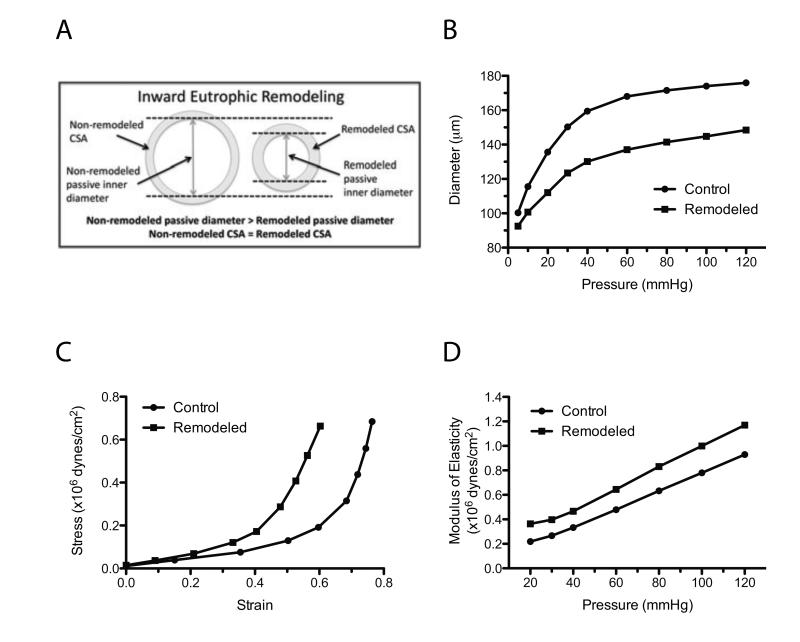
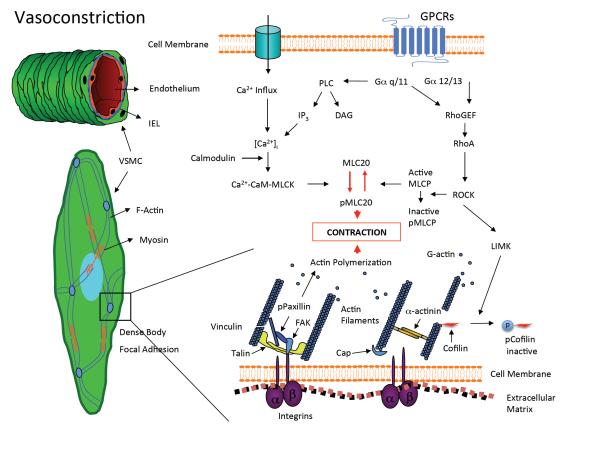
The resistance arteries and arterioles are the vascular components of the circulatory system where the greatest drop in blood pressure takes place. Consequently, these vessels play a preponderant role in the regulation of blood flow and the modulation of blood pressure. For this reason, the inward remodeling process of the resistance vasculature, as it occurs in hypertension, has profound consequences on the incidence of life-threatening cardiovascular events. In this manuscript, we review some of the most prominent characteristics of inwardly remodeled resistance arteries including their changes in vascular passive diameter, wall thickness, and elastic properties. Then, we explore the known contribution of the different components of the vascular wall to the characteristics of inwardly remodeled vessels, and pay particular attention to the role the vascular smooth muscle actin cytoskeleton may play on the initial stages of the remodeling process. We end by proposing potential ways by which many of the factors and mechanisms known to participate in the inward remodeling process may be associated with cytoskeletal modifications and participate in reducing the passive diameter of resistance vessels.
Keywords: Rac; Rho; actin polymerization; elasticity; hypertension; matrix metalloproteinases; stiffness; strain; stress; transglutaminase.
© 2013 John Wiley & Sons Ltd.
Figures
References
-
- Adler KB, Krill J, Alberghini TV, Evans JN. Effect of cytochalasin D on smooth muscle contraction. Cell motility. 1983;3:545–551. - PubMed
-
- Andrianantoandro E, Pollard TD. Mechanism of actin filament turnover by severing and nucleation at different concentrations of ADF/cofilin. Mol Cell. 2006;24:13–23. - PubMed
-
- Bakker EN, Buus CL, Spaan JA, Perree J, Ganga A, Rolf TM, Sorop O, Bramsen LH, Mulvany MJ, Vanbavel E. Small artery remodeling depends on tissue-type transglutaminase. Circ Res. 2005;96:119–126. - PubMed
-
- Bakker EN, Buus CL, VanBavel E, Mulvany MJ. Activation of resistance arteries with endothelin-1: from vasoconstriction to functional adaptation and remodeling. J Vasc Res. 2004;41:174–182. - PubMed
Publication types
MeSH terms
Substances
Grants and funding
LinkOut - more resources
Full Text Sources
Other Literature Sources
Miscellaneous
