


A questionnaire to assess the relevance and credibility of observational studies to inform health care decision making: an ISPOR-AMCP-NPC Good Practice Task Force report
- PMID: 24636373
- PMCID: PMC4217656
- DOI: 10.1016/j.jval.2013.12.011
A questionnaire to assess the relevance and credibility of observational studies to inform health care decision making: an ISPOR-AMCP-NPC Good Practice Task Force report
Erratum in
- Value Health. 2014 Jun;17(4):489
Abstract
Evidence-based health care decisions are best informed by comparisons of all relevant interventions used to treat conditions in specific patient populations. Observational studies are being performed to help fill evidence gaps. Widespread adoption of evidence from observational studies, however, has been limited because of various factors, including the lack of consensus regarding accepted principles for their evaluation and interpretation. Two task forces were formed to develop questionnaires to assist decision makers in evaluating observational studies, with one Task Force addressing retrospective research and the other Task Force addressing prospective research. The intent was to promote a structured approach to reduce the potential for subjective interpretation of evidence and drive consistency in decision making. Separately developed questionnaires were combined into a single questionnaire consisting of 33 items. These were divided into two domains: relevance and credibility. Relevance addresses the extent to which findings, if accurate, apply to the setting of interest to the decision maker. Credibility addresses the extent to which the study findings accurately answer the study question. The questionnaire provides a guide for assessing the degree of confidence that should be placed from observational studies and promotes awareness of the subtleties involved in evaluating those.
Keywords: bias; checklist; comparative effectiveness research; confounding; consensus; credibility; decision making; prospective observational study; quality; questionnaire; relevance; retrospective observational study; validity.
Copyright © 2014 International Society for Pharmacoeconomics and Outcomes Research (ISPOR). Published by Elsevier Inc. All rights reserved.
Conflict of interest statement
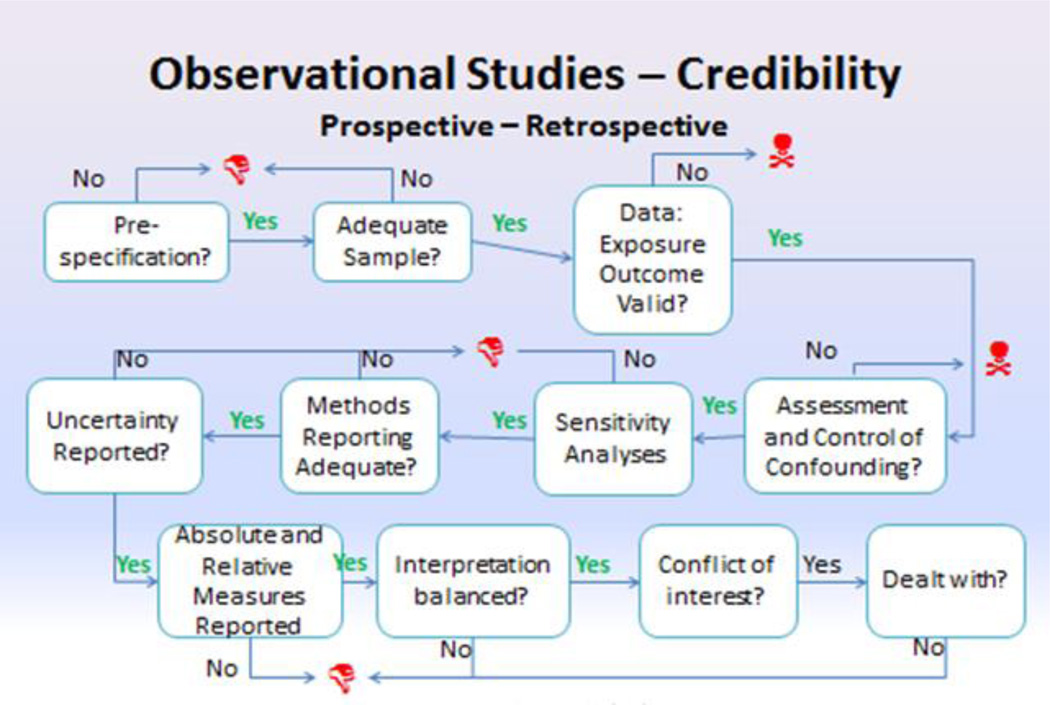
Two questions were used in the conflicts of interest domain in all of the questionnaires:
Conflicts of interest may be stated by authors; however, reviewers may also seek information from public sources including web-based CVs or faculty pages. In some cases, conflicts are not stated in a research report simply due to editorial policy rather than a lack of their existence. While some journals adhere strictly to uniform standards for disclosing conflicts, such as those promoted by the International Committee of Medical Journal Editors (ICMJE), others may not. Readers should not misinterpret absence of a stated conflict as evidence of absence of a conflict.
Potential conflicts of interest may include financial interests in the study results, desire for professional recognition, or other non-monetary incentives. Steps to address potential conflicts of interest include disclosure of any potential conflicts of interest, involving third parties in the design, conduct, and analysis of studies, and agreements that provide independence of researchers (including freedom to publicly disseminate results) from funding entities [28].
Figures
References
-
- Garrison LP, Neumann PJ, Jr, Erickson P, Marshall D, Mullins CD. Using real-world data for coverage and payment decisions: the ISPOR Real-World Data Task Force report. Value in health : the journal of the International Society for Pharmacoeconomics and Outcomes Research. 2007;10(5):326–335. - PubMed
-
- Balshem H, Helfand M, Schunemann HJ, Oxman AD, Kunz R, Brozek J, et al. GRADE guidelines: 3. Rating the quality of evidence. Journal of clinical epidemiology. 2011;64(4):401–406. - PubMed
Publication types
MeSH terms
Grants and funding
LinkOut - more resources
Full Text Sources
Other Literature Sources
