


Role for monocyte chemoattractant protein-1 in the induction of chronic muscle pain in the rat
- PMID: 24637038
- PMCID: PMC4303347
- DOI: 10.1016/j.pain.2014.03.004
Role for monocyte chemoattractant protein-1 in the induction of chronic muscle pain in the rat
Abstract
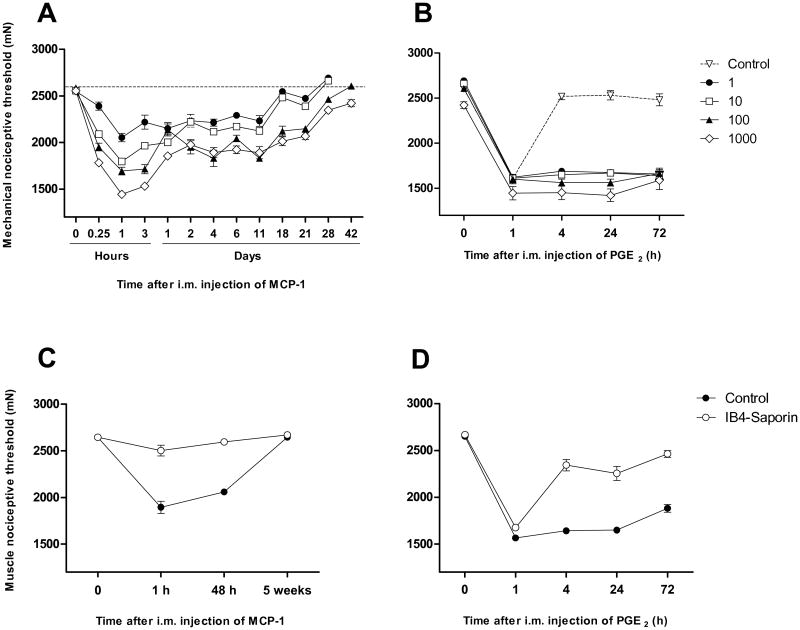
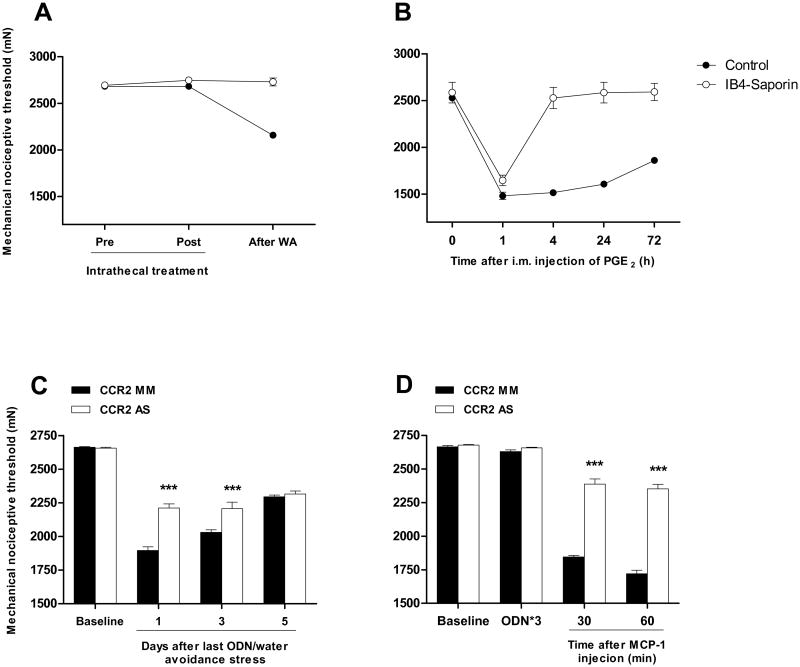
While raised levels of monocyte chemoattractant protein 1 (MCP-1) have been observed in patients with chronic muscle pain, direct evidence for its role as an algogen in skeletal muscle is still lacking. In the rat, MCP-1 induces a dose-dependent mechanical hyperalgesia lasting for up to 6weeks. Following recovery, rats exhibited a markedly prolonged hyperalgesia to an intramuscular injection of prostaglandin E2, hyperalgesic priming. Intrathecal pretreatment with isolectin B4 (IB4)-saporin, which selectively destroys IB4-positive (IB4+) nociceptors, markedly decreased MCP-1-induced hyperalgesia and prevented the subsequent development of priming. To evaluate the involvement of MCP-1 in stress-induced chronic pain we administered, intrathecally, antisense (AS) or mismatch oligodeoxynucleotides directed against CCR2 (the canonical receptor for MCP-1) mRNA, during the exposure to water-avoidance stress, a model of stress-induced persistent muscle pain. The AS treatment attenuated this hyperalgesia, whereas IB4-saporin abolished water-avoidance stress-induced muscle hyperalgesia and prevented stress-induced hyperalgesic priming. These results indicate that MCP-1 induces persistent muscle hyperalgesia and a state of latent chronic sensitization to other algogens, by action on its cognate receptor on IB4+ nociceptors. Because MCP-1 also contributes to stress-induced widespread chronic muscle pain, it should be considered as a player in chronic musculoskeletal pain syndromes.
Keywords: Fibromyalgia; Inflammation; Myalgia; Nociceptor; Stress.
Copyright © 2014. Published by Elsevier B.V.
Figures
References
-
- Akopian AN, Souslova V, England S, Okuse K, Ogata N, Ure J, Smith A, Kerr BJ, McMahon SB, Boyce S, Hill R, Stanfa LC, Dickenson AH, Wood JN. The tetrodotoxin-resistant sodium channel SNS has a specialized function in pain pathways. Nature neuroscience. 1999;2(6):541–548. - PubMed
Publication types
MeSH terms
Substances
Grants and funding
LinkOut - more resources
Full Text Sources
Other Literature Sources
Medical
Research Materials
Miscellaneous
