. 2014 Mar-Apr;5(2):250-3.
doi: 10.4161/gmic.27917. Epub 2014 Jan 23.

Redox signaling mediates symbiosis between the gut microbiota and the intestine

Redox signaling mediates symbiosis between the gut microbiota and the intestine

Andrew S Neish et al. Gut Microbes. 2014 Mar-Apr.

Abstract

The microbiota that populates the intestinal tract affects many physiological processes, such as cell proliferation, epithelial barrier function, and immune responses. However, the molecular mechanisms by which the microbiota influences these events remain unknown. It was recently reported by our research group that specific taxa of intestinal bacteria induce the rapid and transient enzymatic production of reactive oxygen species (ROS) within enterocytes. Whereas NADPH oxidase 2 (Nox2) catalyzed ROS generation in response to microbial perception by bone marrow-derived phagocytes is well-studied, the function of ROS generated by Nox1 in enterocytes in response to microbial signals is not fully understood. It is established that ROS can act as signaling molecules in diverse transduction pathways by the rapid and transient oxidation of oxidant-sensitive thiol groups harbored within sensor regulatory proteins. Because commensal-bacterial-stimulated ROS generation in enterocytes has been shown to induce a wide range of physiological processes, in our recent manuscript, we proposed a paradigm wherein the influence of the microbiota on intestinal physiology is mediated in part by redox-dependant signaling.

Keywords: ROS; lactobacilli; microbiota; proliferation; symbiosis.


Figures
None
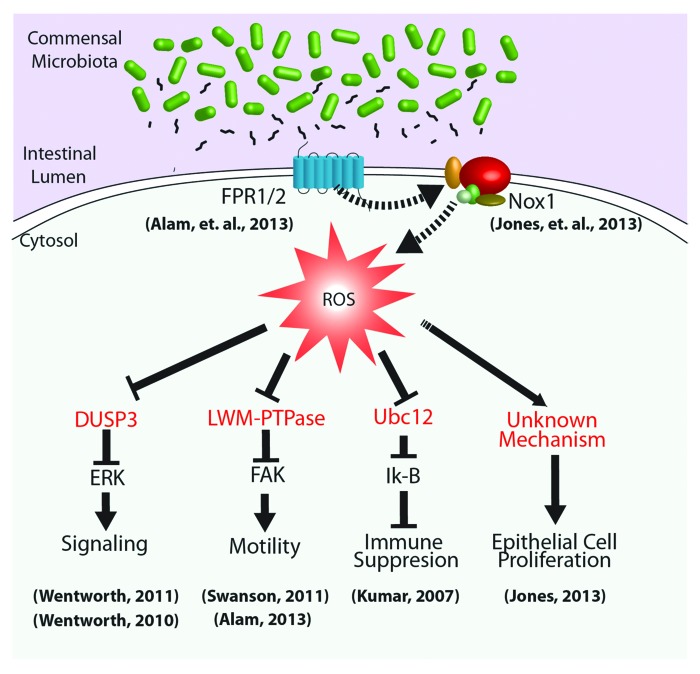
Figure 1. Cellular signaling pathways regulated by microbial-elicited ROS generation. Commensal microbiota and/or their products within the intestinal lumen influence the activity of homeostatic processes through the regulation of cellular redox processes. For example, luminal bacteria produce and shed small formylated peptides, which are perceived via formyl peptide receptors localized to the apical surface of gut epithelia. These, and likely other receptors, activate NADPH oxidases that transduce microbial signals via highly localized ROS production, affecting the oxidation status and thus the activity of redox sensor regulatory proteins (in red), such as DUSP3, LMW-PTPase, and the Nedd8 ligase, Ubc12. Downstream basic cellular processes, including proliferation, motility, and inflammation, can thus be modulated by changes in microbial-dependent cellular redox balance.

References

    1. Neish AS. Microbes in gastrointestinal health and disease. Gastroenterology. 2009;136:65–80. doi: 10.1053/j.gastro.2008.10.080. - DOI - PMC - PubMed
    1. Dethlefsen L, McFall-Ngai M, Relman DA. An ecological and evolutionary perspective on human-microbe mutualism and disease. Nature. 2007;449:811–8. doi: 10.1038/nature06245. - DOI - PMC - PubMed
    1. Gill SR, Pop M, Deboy RT, Eckburg PB, Turnbaugh PJ, Samuel BS, Gordon JI, Relman DA, Fraser-Liggett CM, Nelson KE. Metagenomic analysis of the human distal gut microbiome. Science. 2006;312:1355–9. doi: 10.1126/science.1124234. - DOI - PMC - PubMed
    1. Bäckhed F, Ley RE, Sonnenburg JL, Peterson DA, Gordon JI. Host-bacterial mutualism in the human intestine. Science. 2005;307:1915–20. doi: 10.1126/science.1104816. - DOI - PubMed
    1. Xu J, Mahowald MA, Ley RE, Lozupone CA, Hamady M, Martens EC, Henrissat B, Coutinho PM, Minx P, Latreille P, et al. Evolution of symbiotic bacteria in the distal human intestine. PLoS Biol. 2007;5:e156. doi: 10.1371/journal.pbio.0050156. - DOI - PMC - PubMed

Publication types
