


Clinically relevant transmitted drug resistance to first line antiretroviral drugs and implications for recommendations
- PMID: 24637804
- PMCID: PMC3956602
- DOI: 10.1371/journal.pone.0090710
Clinically relevant transmitted drug resistance to first line antiretroviral drugs and implications for recommendations
Abstract
Background: The aim was to analyse trends in clinically relevant resistance to first-line antiretroviral drugs in Spain, applying the Stanford algorithm, and to compare these results with reported Transmitted Drug Resistance (TDR) defined by the 2009 update of the WHO SDRM list.
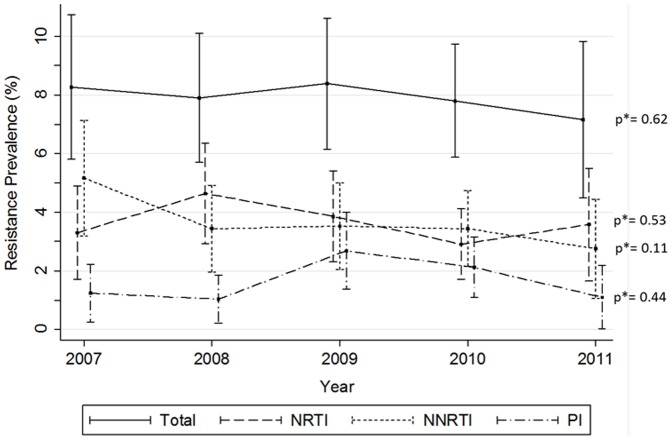
Methods: We analysed 2781 sequences from ARV naive patients of the CoRIS cohort (Spain) between 2007-2011. Using the Stanford algorithm "Low-level resistance", "Intermediate resistance" and "High-level resistance" categories were considered as "Resistant".
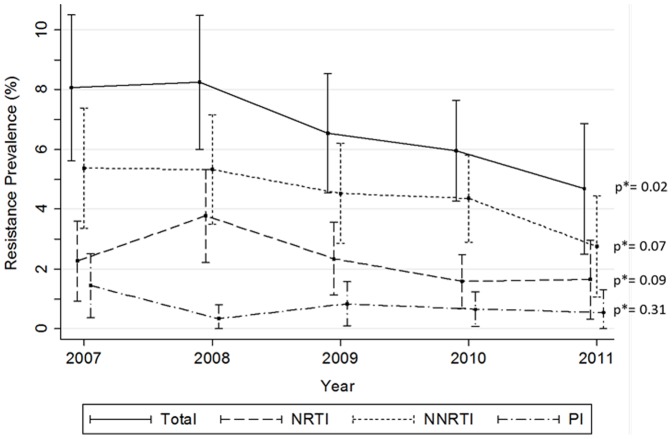
Results: 70% of the TDR found using the WHO list were relevant for first-line treatment according to the Stanford algorithm. A total of 188 patients showed clinically relevant resistance to first-line ARVs [6.8% (95%Confidence Interval: 5.8-7.7)], and 221 harbored TDR using the WHO list [7.9% (6.9-9.0)]. Differences were due to a lower prevalence in clinically relevant resistance for NRTIs [2.3% (1.8-2.9) vs. 3.6% (2.9-4.3) by the WHO list] and PIs [0.8% (0.4-1.1) vs. 1.7% (1.2-2.2)], while it was higher for NNRTIs [4.6% (3.8-5.3) vs. 3.7% (3.0-4.7)]. While TDR remained stable throughout the study period, clinically relevant resistance to first line drugs showed a significant trend to a decline (p = 0.02).
Conclusions: Prevalence of clinically relevant resistance to first line ARVs in Spain is decreasing, and lower than the one expected looking at TDR using the WHO list. Resistance to first-line PIs falls below 1%, so the recommendation of screening for TDR in the protease gene should be questioned in our setting. Cost-effectiveness studies need to be carried out to inform evidence-based recommendations.
Conflict of interest statement
Figures
References
-
- Wittkop L, Günthard HF, de Wolf F, Dunn D, Cozzi-Lepri A, et al. (2011) Effect of transmitted drug resistance on virological and immunological response to initial combination antiretroviral therapy for HIV (EuroCoord-CHAIN joint project): a European multicohort study. Lancet Infect Dis 11: 363–371. - PubMed
-
- Kuritzkes DR, Lalama CM, Ribaudo HJ, Marcial M, Meyer WA 3rd, et al. (2008) Preexisting resistance to nonnucleoside reverse-transcriptase inhibitors predicts virologic failure of an efavirenz-based regimen in treatment-naive HIV-1-infected subjects. J Infect Dis 197: 867–870. - PubMed
-
- European AIDS clinical Society. EACS Guidelines v6.1. Available: http://www.europeanaidsclinicalsociety.org. Accessed: 12 Nov 2012.
-
- Office of AIDS Research Advisory Council (OARAC). Bethesda (US). Guidelines for the Use of Antiretroviral Agents in HIV-1-Infected Adults and Adolescents. Available: http://www.aidsinfo.nih.gov/. Accessed: 28 Mar 2012.
-
- Thompson MA, Aberg JA, Hoy JF, Telenti A, Benson C, et al. (2012) Antiretroviral Treatment of Adult HIV Infection: 2012 Recommendations of the International Antiviral Society–USA Panel. JAMA 308: 387–402. - PubMed
Publication types
MeSH terms
Substances
LinkOut - more resources
Full Text Sources
Other Literature Sources
Medical
