Review
. 2014 Aug;33(8):1289-302.
doi: 10.1007/s10096-014-2086-y. Epub 2014 Mar 18.

Probiotics in respiratory virus infections

Affiliations
Review

Probiotics in respiratory virus infections

L Lehtoranta et al. Eur J Clin Microbiol Infect Dis. 2014 Aug.

Abstract

Viral respiratory infections are the most common diseases in humans. A large range of etiologic agents challenge the development of efficient therapies. Research suggests that probiotics are able to decrease the risk or duration of respiratory infection symptoms. However, the antiviral mechanisms of probiotics are unclear. The purpose of this paper is to review the current knowledge on the effects of probiotics on respiratory virus infections and to provide insights on the possible antiviral mechanisms of probiotics. A PubMed and Scopus database search was performed up to January 2014 using appropriate search terms on probiotic and respiratory virus infections in cell models, in animal models, and in humans, and reviewed for their relevance. Altogether, thirty-three clinical trials were reviewed. The studies varied highly in study design, outcome measures, probiotics, dose, and matrices used. Twenty-eight trials reported that probiotics had beneficial effects in the outcome of respiratory tract infections (RTIs) and five showed no clear benefit. Only eight studies reported investigating viral etiology from the respiratory tract, and one of these reported a significant decrease in viral load. Based on experimental studies, probiotics may exert antiviral effects directly in probiotic-virus interaction or via stimulation of the immune system. Although probiotics seem to be beneficial in respiratory illnesses, the role of probiotics on specific viruses has not been investigated sufficiently. Due to the lack of confirmatory studies and varied data available, more randomized, double-blind, and placebo-controlled trials in different age populations investigating probiotic dose response, comparing probiotic strains/genera, and elucidating the antiviral effect mechanisms are necessary.


Figures
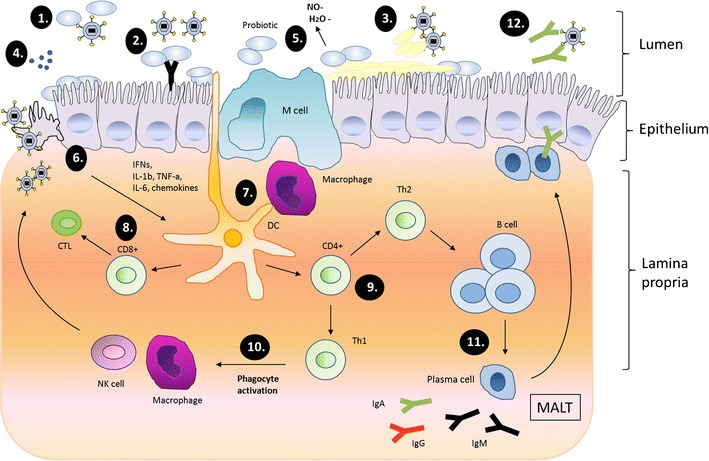
Fig. 1
Fig. 1
Schematic presentation of possible antiviral effect mechanisms of probiotics in respiratory virus infections (adapted from Lehtoranta [80]). 1 Probiotic bacteria may bind directly to the virus and inhibit virus attachment to the host cell receptor. 2 Adhesion of probiotics on the epithelial surface may block viral attachment by steric hindrance, cover receptor sites in a non-specific manner, or by competing for specific carbohydrate receptors. 3 Probiotics may induce mucosal regeneration: intestinal mucins may bind to viruses, and inhibit their adherence to epithelial cells and inhibit virus replication. 4 Probiotics also show direct antimicrobial activity against pathogens by producing antimicrobial substances. 5 Induction of low-grade nitric oxide (NO) production and dehydrogenase production may have antiviral activities. 6 Modulation of immune response through epithelial cells. 7 Modulation and activation of immune responses through macrophages and dendritic cells (DCs). 8 Upon activation, CD8+ T lymphocytes differentiate into cytotoxic T lymphocytes (CTLs), which destroy virus-infected cells. 9 CD4+ T lymphocytes differentiate into Th1 and Th2 cells. 10 T-helper cells type 1 (Th1) activates phagocytes, promoting virus killing. 11 Th2-cells induce proliferation of B-cells, which travel to secondary lymphatic organs in mucosa-associated lymphoid tissue (MALT) and differentiate into immunoglobulin (Ig)-producing plasma cells, which may migrate back to the infection site. 12 Secretory antibodies neutralize the virus

References

    1. Fendrick AM, Monto AS, Nightengale B, Sarnes M. The economic burden of non-influenza-related viral respiratory tract infection in the United States. Arch Intern Med. 2003;163:487–494. doi: 10.1001/archinte.163.4.487. - DOI - PubMed
    1. Tapparel C, Siegrist F, Petty TJ, Kaiser L. Picornavirus and enterovirus diversity with associated human diseases. Infect Genet Evol. 2013;14:282–293. doi: 10.1016/j.meegid.2012.10.016. - DOI - PubMed
    1. Zambon MC. Epidemiology and pathogenesis of influenza. J Antimicrob Chemother. 1999;44:3–9. doi: 10.1093/jac/44.suppl_2.3. - DOI - PubMed
    1. Langley GF, Anderson LJ. Epidemiology and prevention of respiratory syncytial virus infections among infants and young children. Pediatr Infect Dis J. 2011;30:510–517. - PubMed
    1. Robinson CM, Seto D, Jones MS, Dyer DW, Chodosh J. Molecular evolution of human species D adenoviruses. Infect Genet Evol. 2011;11:1208–1217. doi: 10.1016/j.meegid.2011.04.031. - DOI - PMC - PubMed

Substances
