


Fast reconstruction for multichannel compressed sensing using a hierarchically semiseparable solver
- PMID: 24639238
- PMCID: PMC4167172
- DOI: 10.1002/mrm.25222
Fast reconstruction for multichannel compressed sensing using a hierarchically semiseparable solver
Abstract
Purpose: The adoption of multichannel compressed sensing (CS) for clinical magnetic resonance imaging (MRI) hinges on the ability to accurately reconstruct images from an undersampled dataset in a reasonable time frame. When CS is combined with SENSE parallel imaging, reconstruction can be computationally intensive. As an alternative to iterative methods that repetitively evaluate a forward CS+SENSE model, we introduce a technique for the fast computation of a compact inverse model solution.
Methods: A recently proposed hierarchically semiseparable (HSS) solver is used to compactly represent the inverse of the CS+SENSE encoding matrix to a high level of accuracy. To investigate the computational efficiency of the proposed HSS-Inverse method, we compare reconstruction time with the current state-of-the-art. In vivo 3T brain data at multiple image contrasts, resolutions, acceleration factors, and number of receive channels were used for this comparison.
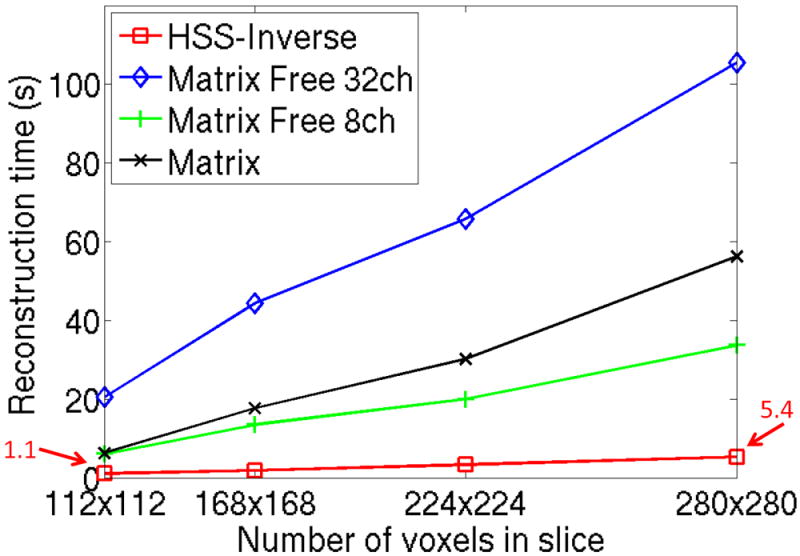
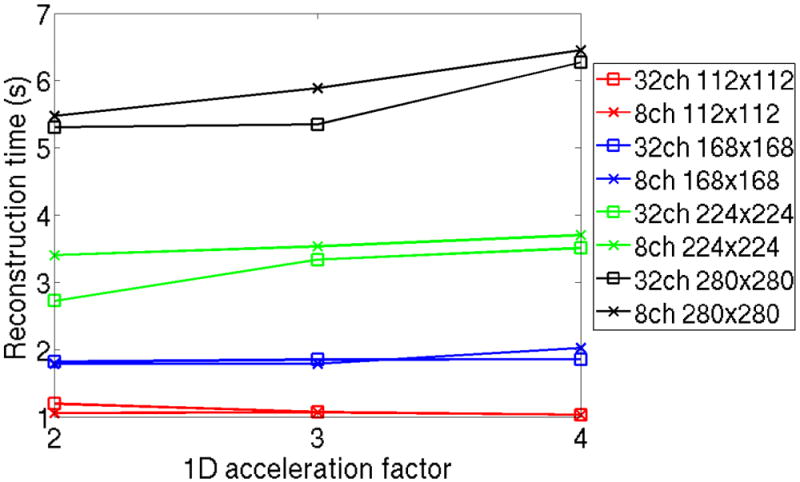
Results: The HSS-Inverse method allows for >6× speedup when compared to current state-of-the-art reconstruction methods with the same accuracy. Efficient computational scaling is demonstrated for CS+SENSE with respect to image size. The HSS-Inverse method is also shown to have minimal dependency on the number of parallel imaging channels/acceleration factor.
Conclusions: The proposed HSS-Inverse method is highly efficient and should enable real-time CS reconstruction on standard MRI vendors' computational hardware.
Keywords: SENSE; compressed sensing; hierarchically semiseparable; parallel imaging.
© 2014 Wiley Periodicals, Inc.
Figures
References
-
- Xia J, Chandrasekaran S, Gu M, Li XS. Superfast multifrontal method for large structured linear systems of equations. SIAM J Matrix Anal A. 2009;31(3):1382–1411.
-
- Chen Y, Davis T, Hager W, Rajamanickam S. Algorithm 887: CHOLMOD, Supernodal Sparse Cholesky Factorization and Update/Downdate. ACM T Math Software. 2008;35(3):22.
-
- Lustig M, Donoho D, Pauly JM. Sparse MRI: The application of compressed sensing for rapid MR imaging. Magn Reson Med. 2007;58(6):1182–95. - PubMed
-
- Pruessmann KP, Weiger M, Scheidegger MB, Boesiger P. SENSE: sensitivity encoding for fast MRI. Magn Reson Med. 1999;42(5):952–962. - PubMed
-
- Block KT, Uecker M, Frahm J. Undersampled radial MRI with multiple coils. Iterative image reconstruction using a total variation constraint. Magn Reson Med. 2007;57(6):1086–98. - PubMed
Publication types
MeSH terms
Grants and funding
LinkOut - more resources
Full Text Sources
Other Literature Sources
Medical
