


Do population-based interventions widen or narrow socioeconomic inequalities? The case of breastfeeding promotion
- PMID: 24639438
- PMCID: PMC4121556
- DOI: 10.1093/ije/dyu051
Do population-based interventions widen or narrow socioeconomic inequalities? The case of breastfeeding promotion
Abstract
Background: Despite numerous population-based randomized intervention trials, the impact of such interventions on socioeconomic inequalities has rarely been examined. We used data from a large cluster-randomized trial to assess the impact of a breastfeeding promotion intervention on socioeconomic inequalities in breastfeeding (exclusivity and duration) and in child cognitive ability at early school age.
Methods: The Promotion of Breastfeeding Intervention Trial (PROBIT) randomized 31 Belarusian maternity hospitals and their affiliated polyclinics either to receive a breastfeeding promotion intervention modelled on the WHO/UNICEF Baby-Friendly Hospital Initiative or to continue the standard practices in effect at the time of randomization. We estimated and compared inequalities in discontinuation of exclusive breastfeeding before 3 months and of any breastfeeding before 12 months and in child verbal IQ at age 6.5 years, across maternal education strata between the two intervention arms.
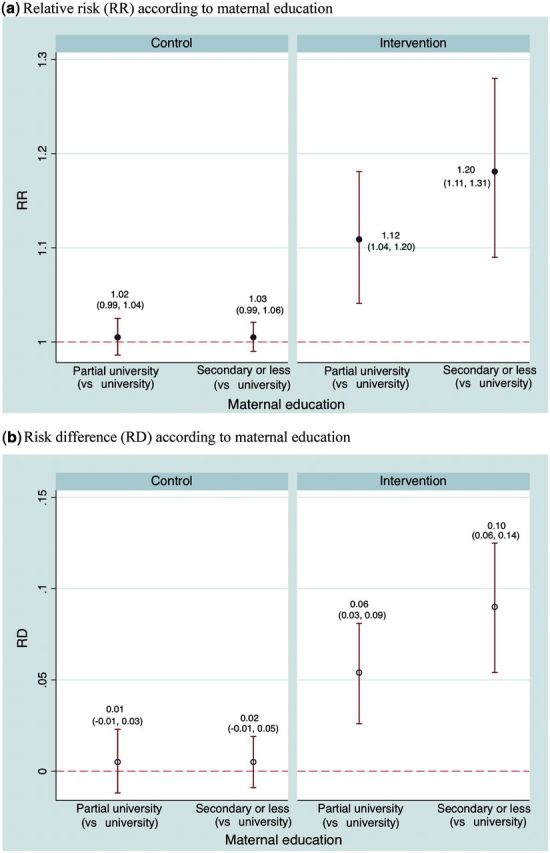
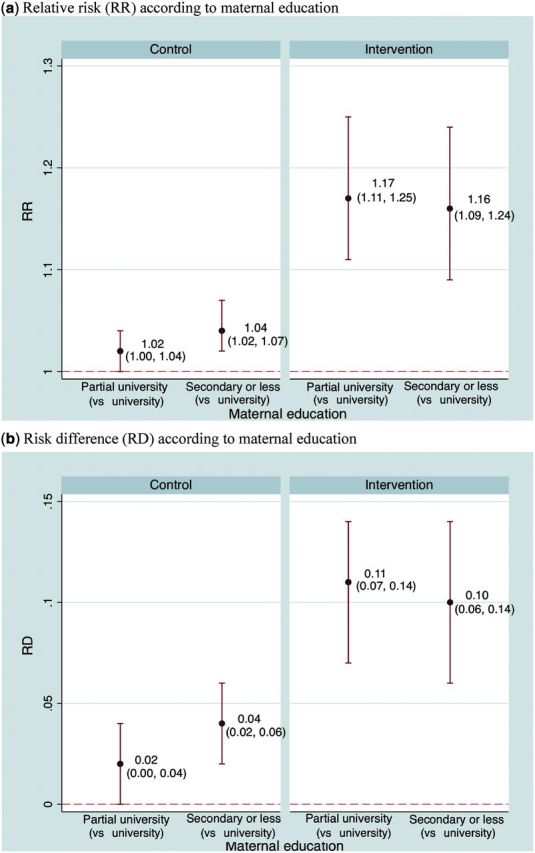
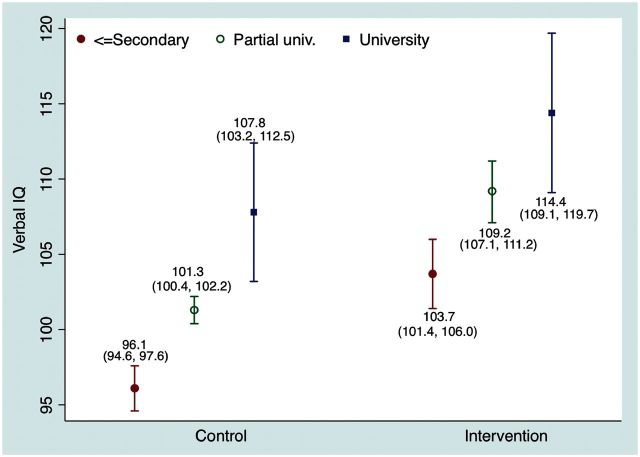
Findings: Socioeconomic inequalities in discontinuing exclusive breastfeeding before 3 months were negligible in the control group. However, graded inequalities by maternal education emerged in the intervention group {relative risk [RR] = 1.12 [95% confidence interval (CI): 1.04, 1.20] for partial university and RR = 1.20 [95% CI: 1.11, 1.31] for secondary education or less vs complete university; risk difference [RD] = 0.06 [95% CI: 0.03, 0.09] and 0.10 [95% CI: 0.06, 0.14], respectively}. For discontinuing any breastfeeding before 12 months, small socioeconomic gradients in the control group were widened in the intervention group (RR = 1.04 and 1.16, respectively, for mothers with secondary education or less). Despite these differential effects on breastfeeding, however, we observed a small, nonsignificant reduction in socioeconomic inequalities in child verbal IQ at age 6.5 years.
Conclusions: A population-based intervention to promote breastfeeding slightly widened socioeconomic inequalities in breastfeeding but not those in child cognitive ability.
Keywords: Health inequalities; breastfeeding; cognitive functioning; randomized intervention trials.
© The Author 2014; all rights reserved. Published by Oxford University Press on behalf of the International Epidemiological Association.
Figures
Comment in
-
Commentary: What is a population-based intervention? Returning to Geoffrey Rose.Int J Epidemiol. 2014 Aug;43(4):1292-3. doi: 10.1093/ije/dyu111. Epub 2014 May 20. Int J Epidemiol. 2014. PMID: 24844844 Free PMC article. No abstract available.
References
-
- Commission on Social Determinants of Health (CSDH). Closing the Gap in a Generation: Health Equity Through Action on the Social Determinants of Health. Geneva: World Health Organization, 2008.
-
- Gepkens A, Gunning-Schepers LJ. Interventions to reduce socioeconomic health differences: A review of the international literature. Eur J Public Health 1996;63:218–26.
-
- Haines A, Sanders D, Lehmann U, et al. Achieving child survival goals: potential contribution of community health workers. Lancet 2007;369:2121–31. - PubMed
-
- Lorenc T, Petticrew M, Welch V, Tugwell P. What types of interventions generate inequalities? Evidence from systematic reviews. J Epidemiol Community Health 2013;67:190–93. - PubMed
Publication types
MeSH terms
Grants and funding
LinkOut - more resources
Full Text Sources
Other Literature Sources
Medical
Miscellaneous
