


The interplay of attention and consciousness in visual search, attentional blink and working memory consolidation
- PMID: 24639586
- PMCID: PMC3965169
- DOI: 10.1098/rstb.2013.0215
The interplay of attention and consciousness in visual search, attentional blink and working memory consolidation
Abstract
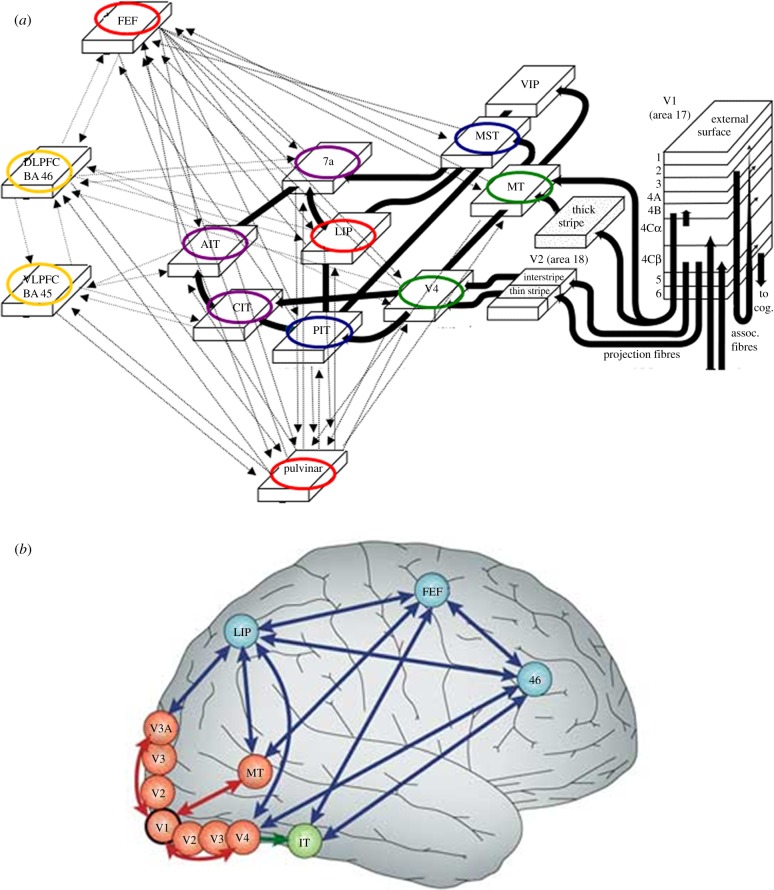
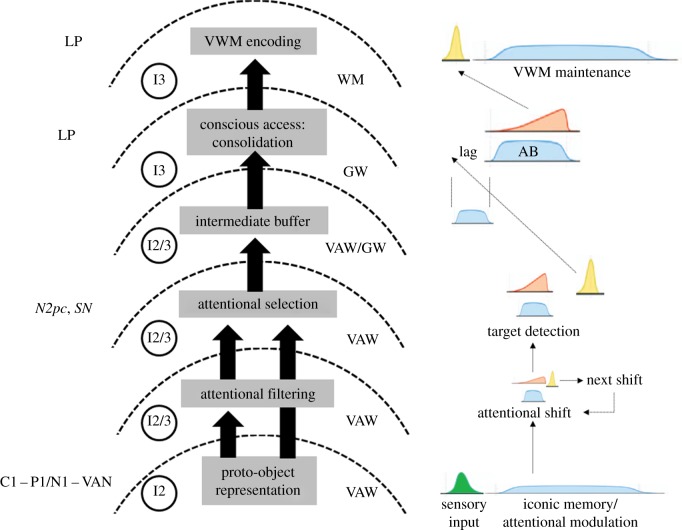
Despite the acknowledged relationship between consciousness and attention, theories of the two have mostly been developed separately. Moreover, these theories have independently attempted to explain phenomena in which both are likely to interact, such as the attentional blink (AB) and working memory (WM) consolidation. Here, we make an effort to bridge the gap between, on the one hand, a theory of consciousness based on the notion of global workspace (GW) and, on the other, a synthesis of theories of visual attention. We offer a theory of attention and consciousness (TAC) that provides a unified neurocognitive account of several phenomena associated with visual search, AB and WM consolidation. TAC assumes multiple processing stages between early visual representation and conscious access, and extends the dynamics of the global neuronal workspace model to a visual attentional workspace (VAW). The VAW is controlled by executive routers, higher-order representations of executive operations in the GW, without the need for explicit saliency or priority maps. TAC leads to newly proposed mechanisms for illusory conjunctions, AB, inattentional blindness and WM capacity, and suggests neural correlates of phenomenal consciousness. Finally, the theory reconciles the all-or-none and graded perspectives on conscious representation.
Keywords: attention; attentional blink; consciousness; visual search; working memory.
Figures
Comment in
-
On the interplay between working memory consolidation and attentional selection in controlling conscious access: parallel processing at a cost--a comment on 'The interplay of attention and consciousness in visual search, attentional blink and working memory consolidation'.Philos Trans R Soc Lond B Biol Sci. 2015 Feb 5;370(1661):20140197. doi: 10.1098/rstb.2014.0197. Philos Trans R Soc Lond B Biol Sci. 2015. PMID: 25533105 Free PMC article. No abstract available.
-
Rapid switching and complementary evidence accumulation enable flexibility of an all-or-none global workspace for control of attentional and conscious processing: a reply to Wyble et al.Philos Trans R Soc Lond B Biol Sci. 2015 Feb 5;370(1661):20140315. doi: 10.1098/rstb.2014.0315. Philos Trans R Soc Lond B Biol Sci. 2015. PMID: 25533107 Free PMC article. No abstract available.
References
-
- Baars BJ. 1988. A cognitive theory of consciousness. Cambridge, UK: Cambridge University Press.
Publication types
MeSH terms
LinkOut - more resources
Full Text Sources
Other Literature Sources
Miscellaneous
