


Reduced UCP-1 content in in vitro differentiated beige/brite adipocytes derived from preadipocytes of human subcutaneous white adipose tissues in obesity
- PMID: 24642703
- PMCID: PMC3958417
- DOI: 10.1371/journal.pone.0091997
Reduced UCP-1 content in in vitro differentiated beige/brite adipocytes derived from preadipocytes of human subcutaneous white adipose tissues in obesity
Abstract
Introduction: Brown adipose tissue (BAT) is a potential therapeutic target to reverse obesity. The purpose of this study was to determine whether primary precursor cells isolated from human adult subcutaneous white adipose tissue (WAT) can be induced to differentiate in-vitro into adipocytes that express key markers of brown or beige adipose, and whether the expression level of such markers differs between lean and obese young adult males.
Methods: Adipogenic precursor cells were isolated from lean and obese individuals from subcutaneous abdominal WAT biopsies. Cells were grown to confluence, differentiated for 2.5 weeks then harvested for measurement of gene expression and UCP1 protein.
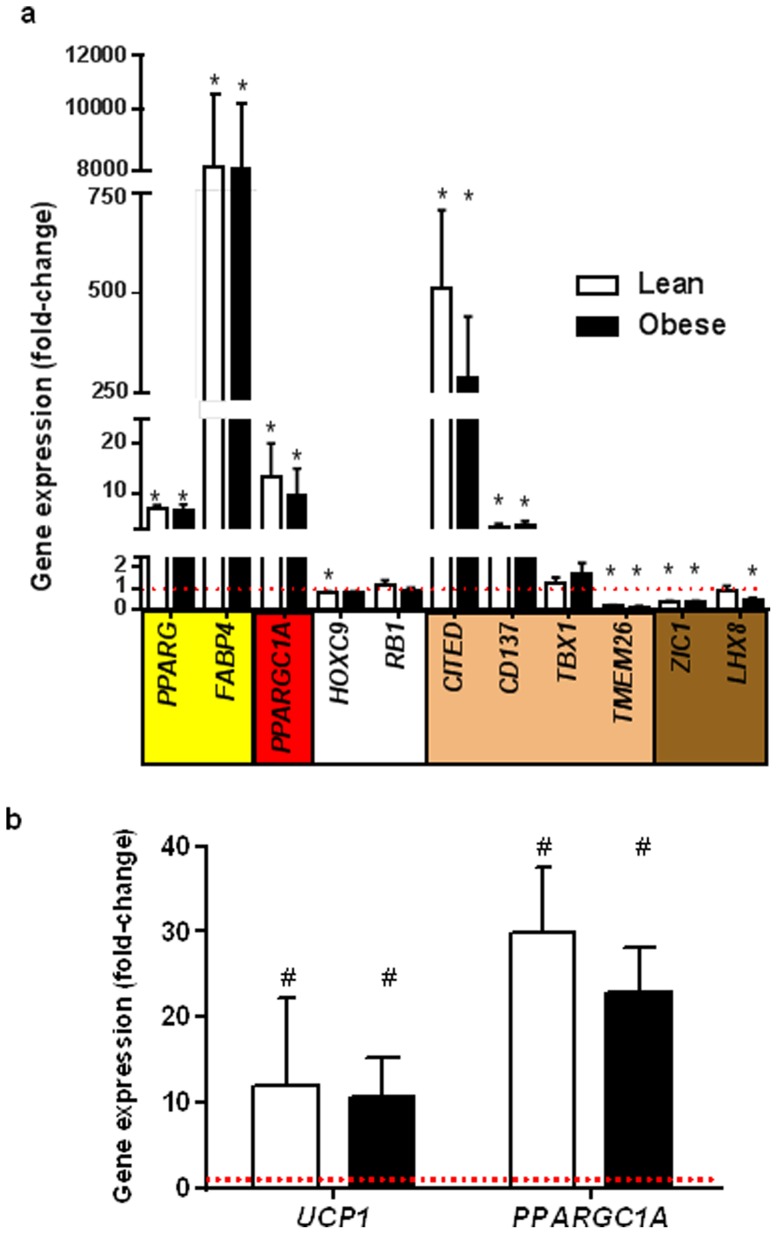
Results: There was no difference between groups with respect to differentiation into adipocytes, as indicated by oil red-O staining, rates of lipolysis, and expression of adipogenic genes (FABP4, PPARG). WAT genes (HOXC9, RB1) were expressed equally in the two groups. Post differentiation, the beige adipose specific genes CITED1 and CD137 were significantly increased in both groups, but classic BAT markers ZIC1 and LHX8 decreased significantly. Cell lines from both groups also equally increased post-differentiation expression of the thermogenic-responsive gene PPARGC1A (PGC-1α). UCP1 gene expression was undetectable prior to differentiation, however after differentiation both gene expression and protein content were increased in both groups and were significantly greater in cultures from lean compared with obese individuals (p<0.05).
Conclusion: Human subcutaneous WAT cells can be induced to attain BAT characteristics, but this capacity is reduced in WAT cells from obese individuals.
Conflict of interest statement
Figures


Similar articles
-
Chronic peroxisome proliferator-activated receptor gamma (PPARgamma) activation of epididymally derived white adipocyte cultures reveals a population of thermogenically competent, UCP1-containing adipocytes molecularly distinct from classic brown adipocytes.J Biol Chem. 2010 Mar 5;285(10):7153-64. doi: 10.1074/jbc.M109.053942. Epub 2009 Dec 22. J Biol Chem. 2010. PMID: 20028987 Free PMC article.
-
BMP4 and BMP7 induce the white-to-brown transition of primary human adipose stem cells.Am J Physiol Cell Physiol. 2014 Mar 1;306(5):C431-40. doi: 10.1152/ajpcell.00290.2013. Epub 2013 Nov 27. Am J Physiol Cell Physiol. 2014. PMID: 24284793
-
α-Lipoic acid treatment increases mitochondrial biogenesis and promotes beige adipose features in subcutaneous adipocytes from overweight/obese subjects.Biochim Biophys Acta. 2015 Mar;1851(3):273-81. doi: 10.1016/j.bbalip.2014.12.013. Epub 2014 Dec 24. Biochim Biophys Acta. 2015. PMID: 25542506
-
White, brown, beige/brite: different adipose cells for different functions?Endocrinology. 2013 Sep;154(9):2992-3000. doi: 10.1210/en.2013-1403. Epub 2013 Jun 19. Endocrinology. 2013. PMID: 23782940 Review.
-
Thyroid hormone and adipocyte differentiation.Thyroid. 2008 Feb;18(2):185-95. doi: 10.1089/thy.2007.0254. Thyroid. 2008. PMID: 18279019 Review.
Cited by
-
A Renewable Source of Human Beige Adipocytes for Development of Therapies to Treat Metabolic Syndrome.Cell Rep. 2018 Dec 11;25(11):3215-3228.e9. doi: 10.1016/j.celrep.2018.11.037. Cell Rep. 2018. PMID: 30540952 Free PMC article.
-
Effects of Diets Differing in Composition of 18-C Fatty Acids on Adipose Tissue Thermogenic Gene Expression in Mice Fed High-Fat Diets.Nutrients. 2018 Feb 23;10(2):256. doi: 10.3390/nu10020256. Nutrients. 2018. PMID: 29473916 Free PMC article.
-
The capacity of differentiation of stromal vascular fraction cells into beige adipocytes is markedly reduced in subjects with overweight/obesity and insulin resistance: effect of genistein.Int J Obes (Lond). 2021 Nov;45(11):2471-2481. doi: 10.1038/s41366-021-00921-3. Epub 2021 Jul 30. Int J Obes (Lond). 2021. PMID: 34331001
-
E3 ligase FBXW7 suppresses brown fat expansion and browning of white fat.EMBO Rep. 2025 Feb;26(3):748-767. doi: 10.1038/s44319-024-00337-w. Epub 2025 Jan 2. EMBO Rep. 2025. PMID: 39747664 Free PMC article.
-
Mitochondria in White, Brown, and Beige Adipocytes.Stem Cells Int. 2016;2016:6067349. doi: 10.1155/2016/6067349. Epub 2016 Mar 17. Stem Cells Int. 2016. PMID: 27073398 Free PMC article. Review.
References
Publication types
MeSH terms
Substances
LinkOut - more resources
Full Text Sources
Other Literature Sources
Medical
Research Materials
Miscellaneous
