. 2014 Mar;26(3):962-80.
doi: 10.1105/tpc.113.122069. Epub 2014 Mar 18.

A conserved network of transcriptional activators and repressors regulates anthocyanin pigmentation in eudicots

Affiliations

A conserved network of transcriptional activators and repressors regulates anthocyanin pigmentation in eudicots

Nick W Albert et al. Plant Cell. 2014 Mar.

Abstract

Plants require sophisticated regulatory mechanisms to ensure the degree of anthocyanin pigmentation is appropriate to myriad developmental and environmental signals. Central to this process are the activity of MYB-bHLH-WD repeat (MBW) complexes that regulate the transcription of anthocyanin genes. In this study, the gene regulatory network that regulates anthocyanin synthesis in petunia (Petunia hybrida) has been characterized. Genetic and molecular evidence show that the R2R3-MYB, MYB27, is an anthocyanin repressor that functions as part of the MBW complex and represses transcription through its C-terminal EAR motif. MYB27 targets both the anthocyanin pathway genes and basic-helix-loop-helix (bHLH) ANTHOCYANIN1 (AN1), itself an essential component of the MBW activation complex for pigmentation. Other features of the regulatory network identified include inhibition of AN1 activity by the competitive R3-MYB repressor MYBx and the activation of AN1, MYB27, and MYBx by the MBW activation complex, providing for both reinforcement and feedback regulation. We also demonstrate the intercellular movement of the WDR protein (AN11) and R3-repressor (MYBx), which may facilitate anthocyanin pigment pattern formation. The fundamental features of this regulatory network in the Asterid model of petunia are similar to those in the Rosid model of Arabidopsis thaliana and are thus likely to be widespread in the Eudicots.


Figures
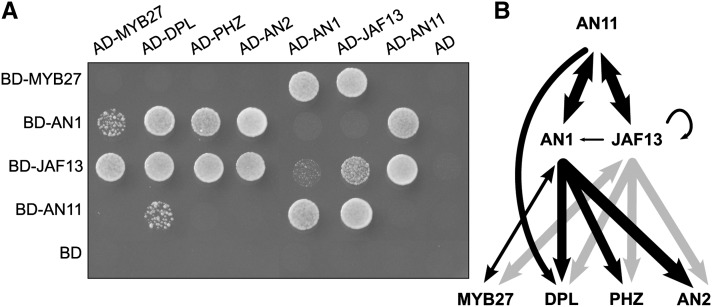
Figure 1.
Figure 1.
MYB27 Binds Members of the MBW Activation Complex. (A) Protein–protein interactions between members of the MBW regulatory complex and MYB27 were determined by Y2H assays. The regulators tested were AN1 and JAF13 (bHLH), AN2, DPL, and PHZ (R2R3-MYB activators), AN11 (WDR), and MYB27 (R2R3-MYB repressor). The relative interaction strengths were determined by increasing the concentration of 3-AT. The assay shown represents growth on selective media lacking Leu, Trp, and His, supplemented with 25 mM 3-AT. AD, GAL4 activation domain; BD, GAL4 DNA binding domain. (B) Summary of interactions between MBW regulators. The relative strength of the interactions (as measured in the yeast system) is indicated by the thickness of the arrows. Arrows indicate protein–protein interactions and do not indicate hierarchy/sequence of regulation.
Figure 2.
Figure 2.
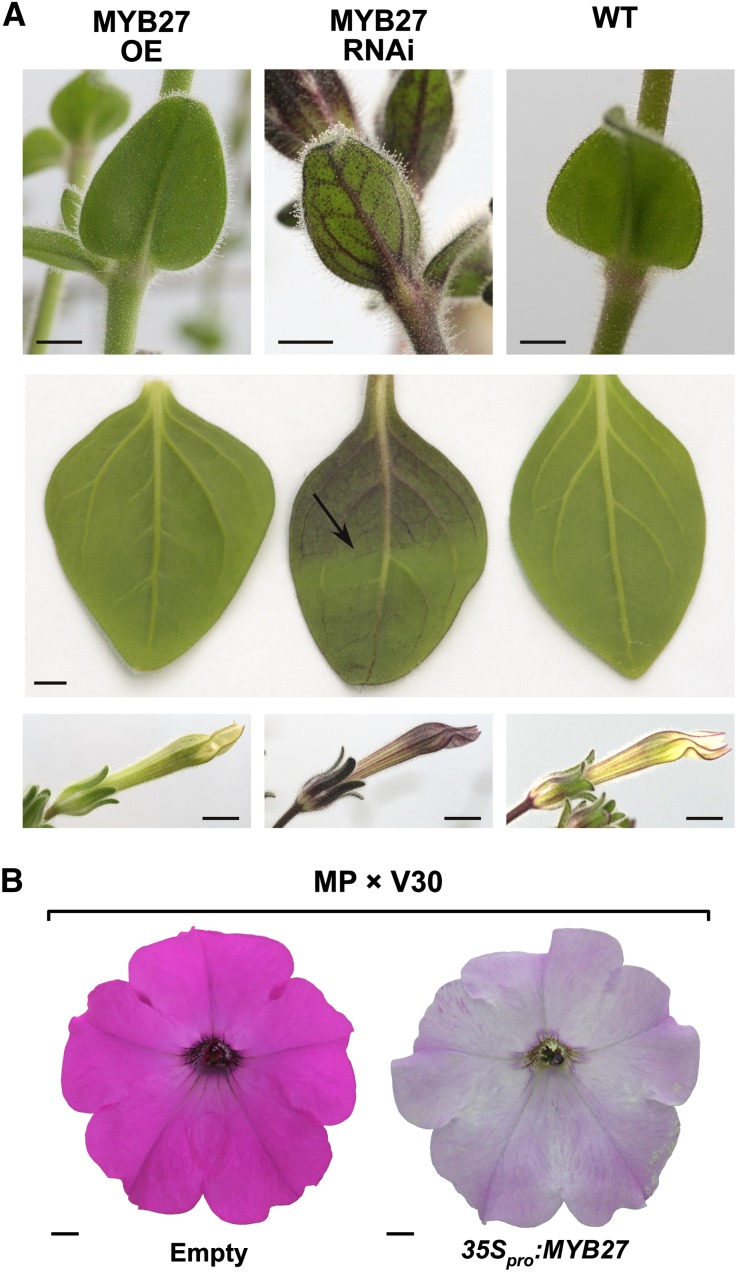
MYB27 Is a Repressor of Anthocyanin Pigmentation. (A) Pigmentation phenotypes of leaves, stems, and flowers of stable transgenic petunias overexpressing MYB27 (MYB27 OE and 35Spro:MYB27), MYB27 silenced (MYB27 RNAi), or wild-type MPs. The top panel shows young leaves, middle panel shows mature fully expanded leaves, and the bottom panel shows developing flower buds. The arrow indicates where a wire support cage shaded a portion of the abaxial leaf surface from a MYB27 RNAi plant. (B) Floral pigmentation phenotypes of representative progeny from a 35Spro:MYB27 (MP background; an2) × V30 (AN2+) petunia cross. Bars = 0.5 cm.
Figure 3.
Figure 3.
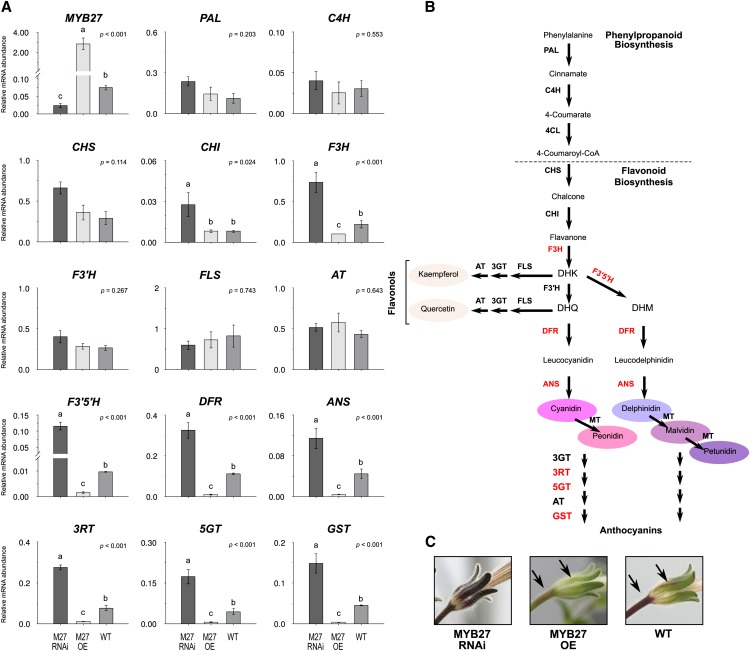
Phenylpropanoid and Flavonoid Gene Expression in Sepals of MYB27 Overexpression and Suppression Petunias. (A) Transcript abundance for MYB27 or phenylpropanoid/flavonoid biosynthesis genes was determined by qRT-PCR. Means ± se are shown for MYB27 RNAi or MYB27 OE transgenic lines and wild-type MP controls: n = 3 biological replicates consisting of independent lines; n = 2 for the wild type. Statistical significance was determined by one-way ANOVA (P values reported); significant differences between means (LSD, P = 0.05) are indicated where letters (a, b, and c) above the bar differ. (B) The position of each gene examined is shown in the diagram of the flavonoid pathway. Genes targeted by MYB27 are highlighted in red. (C) Pigmentation phenotypes of the sepal tissues analyzed from MYB27 RNAi, MYB27 OE, or wild-type MP. Arrows indicate anthocyanin pigmentation on the pedicel and main vein of the sepal.
Figure 4.
Figure 4.
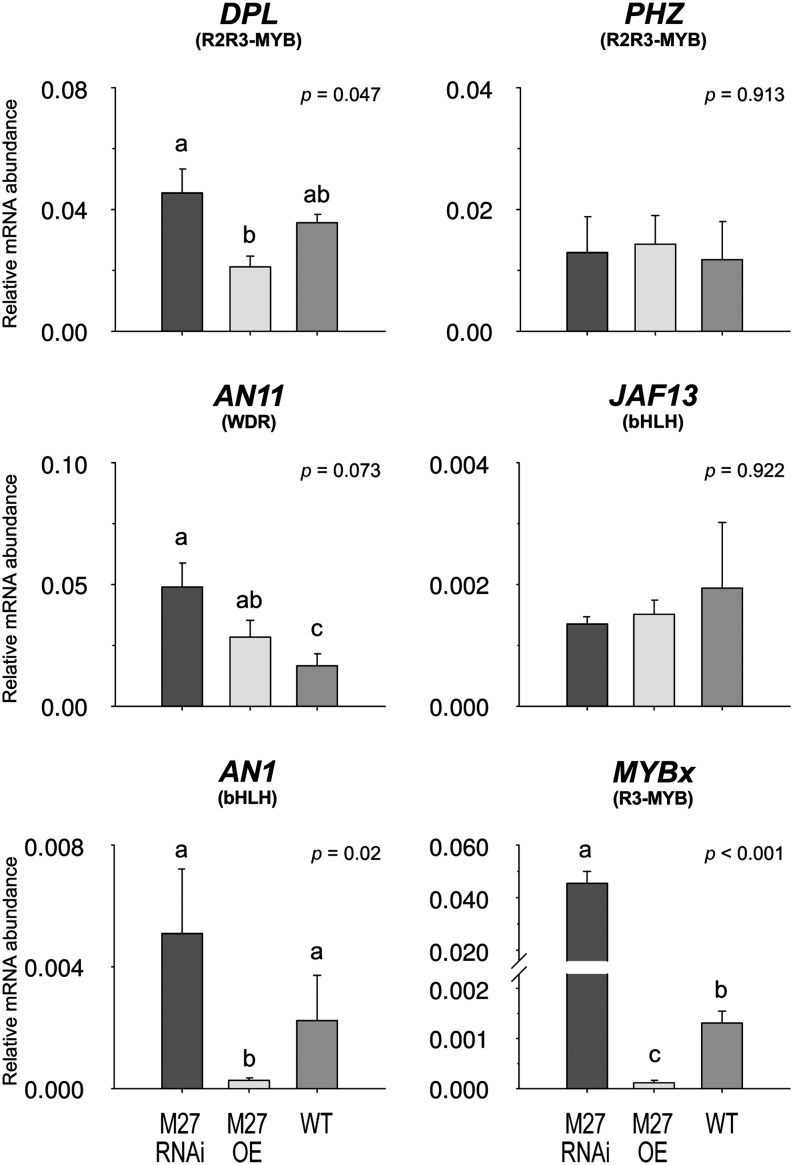
MYB27 Regulates AN1 and MYBx Expression in Transgenic Petunias. Transcript abundance for anthocyanin regulators in sepal tissue determined by qRT-PCR. Means ± se are shown for MYB27 RNAi or MYB27 OE transgenic lines and wild-type MP controls: n = 3 biological replicates consisting of independent lines; n = 2 for the wild type. Statistical significance was determined by one-way ANOVA (P values reported); significant differences between means (LSD, P = 0.05) are indicated where letters (a, b, and c) above the bar differ.
Figure 5.
Figure 5.
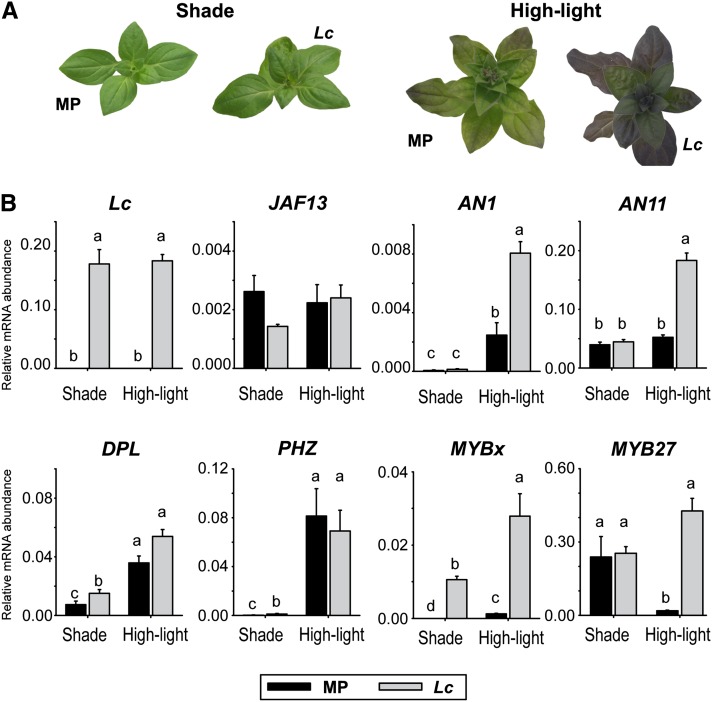
Expression of Anthocyanin Regulators in 35Spro:Lc Petunias. (A) Anthocyanin pigmentation phenotypes of wild-type MP or plants expressing the maize bHLH anthocyanin regulator Lc from a CaMV35S promoter, grown under shade (50 to 350 µmol m−2 s−1) or high-light (750 µmol m−2 s−1) conditions. (B) Transcript abundance for the Lc transgene or endogenous anthocyanin regulators in MP or Lc petunias. Means ± se are shown (n = 4 biological replicates); statistical significance was determined by one-way ANOVA (P < 0.001); significant differences between means (LSD, P = 0.05) are indicated where letters (a, b, c, and d) above the bar differ.
Figure 6.
Figure 6.
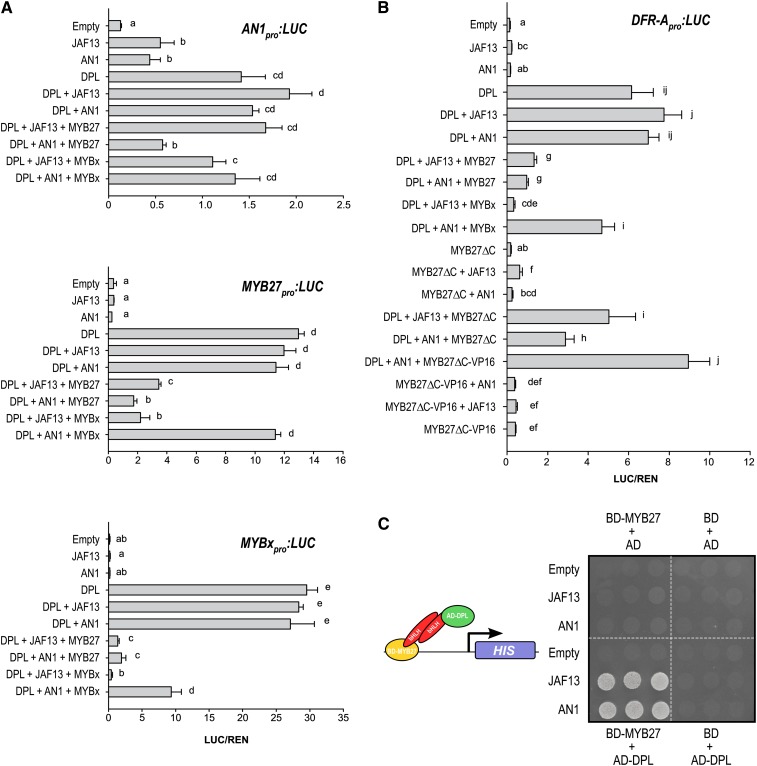
MYB27 Is a Corepressor of the MBW Activation Complex. (A) and (B) Activation and repression assays were performed upon the promoters of the anthocyanin regulatory genes AN1pro, MYB27pro, and MYBxpro (A) or the anthocyanin biosynthetic gene DFR-Apro (B) using a dual luciferase assay. Agrobacteria containing the reporter and effector constructs were coinfiltrated into N. benthamiana leaves. The effector constructs express each TF from a CaMV35S promoter: DPL (R2R3-MYB activator), JAF13 and AN1 (bHLH), MYB27 (R2R3-MYB repressor), and MYBx (R3-MYB repressor). Additionally, two modified versions of MYB27 were assayed: MYB27ΔC (EAR motif removed) and MYB27ΔC-VP16 (EAR motif removed + viral activation domain). Firefly luciferase (LUC) values are reported relative to the Renilla luciferase (REN) control; means ± se (n = 4). Statistical significance was determined by one-way ANOVA (P < 0.001); significant differences between means (LSD, P = 0.05) are indicated where letters (a, b, c, etc.) above the bar differ. (C) Y3H assay of BD-MYB27, AD-DPL, JAF13, or AN1. The assay shown is grown on selective media lacking Leu, Trp, uracil, and His. The diagram indicates the protein–protein interactions required to activate the HIS reporter gene. [See online article for color version of this figure.]
Figure 7.
Figure 7.
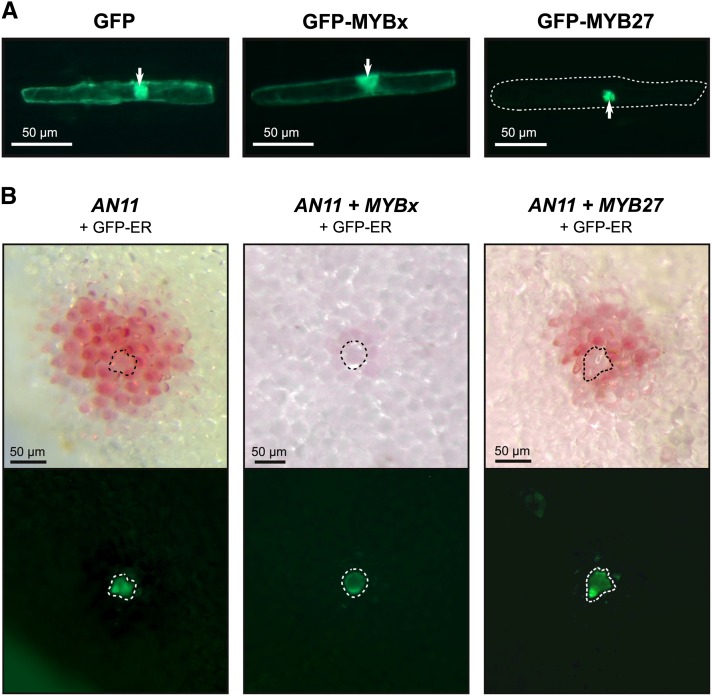
Localization and Intercellular Movement of MYB Repressors and AN11. (A) Biolistic transformation of onion bulb scale epidermis with 35Spro:GFP, 35Spro:GFP-MYBx, or 35Spro:GFP-MYB27 viewed with blue light on a dissecting microscope; arrows indicate the nucleus and the cell margins are indicated (dotted boundary) for GFP-MYB27. (B) Biolistic transformation of petunia W134 (an11) petals with 35Spro:AN11, 35Spro:AN11 + 35Spro:MYBx, or 35Spro:AN11 + 35Spro:MYB27. A 35Spro:GFP-ER construct was included in all transformation as an internal control to label the transformed cells; GFP was viewed with blue light. The transformed cell is indicated (dotted boundary).
Figure 8.
Figure 8.
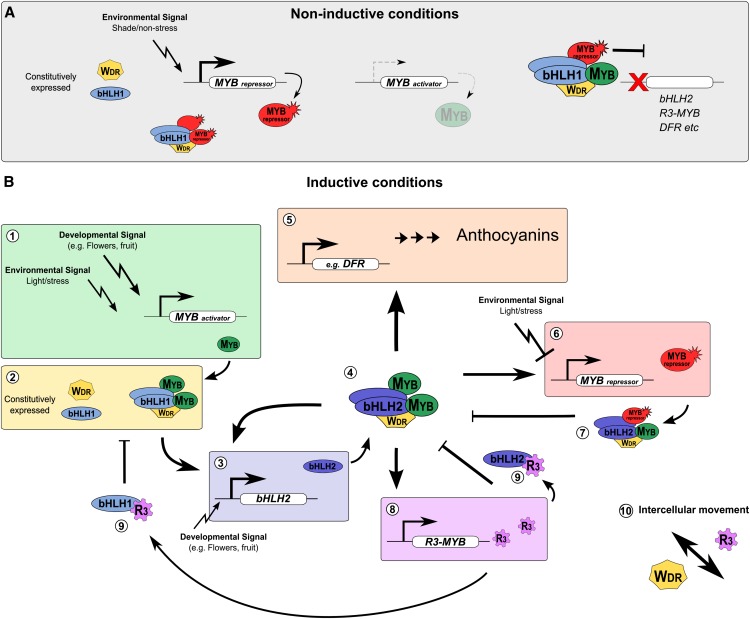
Model of the Anthocyanin Gene Regulation Network in Eudicots. (A) During noninductive conditions, active MYB repressors (typically R2R3-MYB) are expressed at high levels, and WDR proteins and bHLH1 (Ph-JAF13/At-EGL3 clade bHLH) are constitutively expressed. Repressor MBW complexes may form, titrating bHLH and WDR proteins. MYB repressors are in excess of R2R3-MYB activators, allowing recruitment of the repressor to target genes by MBW complexes containing an R2R3-MYB activator. Transcription is actively repressed through repression motifs (e.g., EAR domain). (B) (1) Anthocyanin synthesis is initiated in stressed leaves or developing flowers/fruit by activating the expression of the R2R3-MYB activator. (2) The R2R3-MYB activator, WDR, and bHLH1 (Ph-JAF13/At-EGL3 clade bHLH) proteins form an MBW activation complex that (3) activates the expression of bHLH2 (Ph-AN1/At-TT8 clade bHLH). (4) A core MBW activation complex containing bHLH2 proteins forms; this activates the expression of bHLH2 (reinforcement) and activates the expression of the anthocyanin biosynthesis genes (5), ultimately resulting in anthocyanin accumulation. The MBW complex also activates the expression of the MYB repressor (typically R2R3-MYB) (6), although this activation appears to be overruled by environmental signals in vegetative tissues. The inclusion of the repressor into the MBW complex (7) results in active transcriptional repression of target promoters of the core MBW complex (anthocyanin biosynthetic genes, such as DFR, bHLH2, R3-MYB, and MYB repressor). Feedback inhibition is provided by R3-MYB repressors; these are activated by the MBW complex (8) and inhibit the formation of new MBW complexes (9) by titrating bHLH factors. (10) The R3-MYB repressors and WDR proteins are capable of intercellular movement, which may contribute to pigmentation patterning.

References

    1. Aharoni A., De Vos C.H.R., Wein M., Sun Z.K., Greco R., Kroon A., Mol J.N.M., O’Connell A.P. (2001). The strawberry FaMYB1 transcription factor suppresses anthocyanin and flavonol accumulation in transgenic tobacco. Plant J. 28: 319–332. - PubMed
    1. Albert N.W., Arathoon S., Collette V.E., Schwinn K.E., Jameson P.E., Lewis D.H., Zhang H., Davies K.M. (2010). Activation of anthocyanin synthesis in Cymbidium orchids: variability between known regulators. Plant Cell Tissue Organ Cult. 100: 355–360.
    1. Albert N.W., Lewis D.H., Zhang H., Irving L.J., Jameson P.E., Davies K.M. (2009). Light-induced vegetative anthocyanin pigmentation in Petunia. J. Exp. Bot. 60: 2191–2202. - PMC - PubMed
    1. Albert N.W., Lewis D.H., Zhang H., Schwinn K.E., Jameson P.E., Davies K.M. (2011). Members of an R2R3-MYB transcription factor family in Petunia are developmentally and environmentally regulated to control complex floral and vegetative pigmentation patterning. Plant J. 65: 771–784. - PubMed
    1. An X.H., Tian Y., Chen K.Q., Wang X.F., Hao Y.J. (2012). The apple WD40 protein MdTTG1 interacts with bHLH but not MYB proteins to regulate anthocyanin accumulation. J. Plant Physiol. 169: 710–717. - PubMed

Publication types

MeSH terms

LinkOut - more resources