


Evidence for greater production of colonic short-chain fatty acids in overweight than lean humans
- PMID: 24642959
- PMCID: PMC3970979
- DOI: 10.1038/ijo.2014.46
Evidence for greater production of colonic short-chain fatty acids in overweight than lean humans
Abstract
Background: Short-chain fatty acids (SCFA) are produced by colonic microbiota from dietary carbohydrates and proteins that reach the colon. It has been suggested that SCFA may promote obesity via increased colonic energy availability. Recent studies suggest obese humans have higher faecal SCFA than lean, but it is unclear whether this difference is due to increased SCFA production or reduced absorption.
Objectives: To compare rectal SCFA absorption, dietary intake and faecal microbial profile in lean (LN) versus overweight and obese (OWO) individuals.
Design: Eleven LN and eleven OWO individuals completed a 3-day diet record, provided a fresh faecal sample and had SCFA absorption measured using the rectal dialysis bag method. The procedures were repeated after 2 weeks.
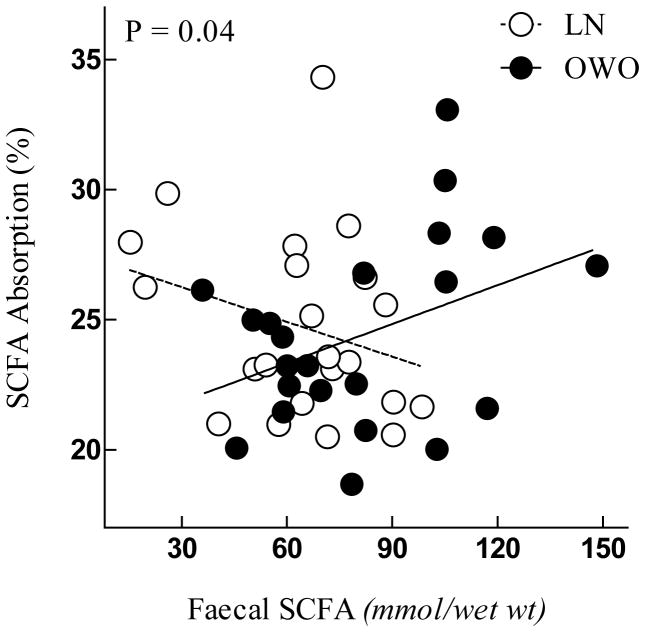
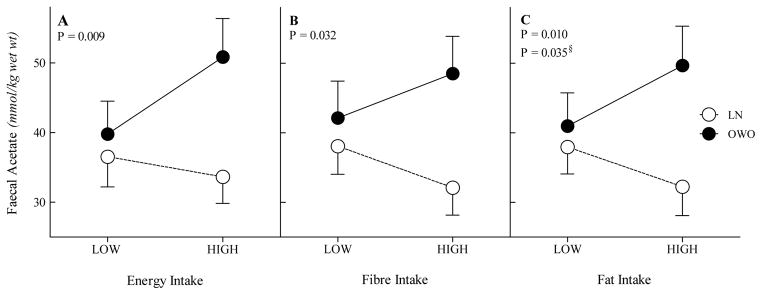
Results: Age-adjusted faecal SCFA concentration was significantly higher in OWO than LN individuals (81.3±7.4 vs 64.1±10.4 mmol kg(-1), P=0.023). SCFA absorption (24.4±0.8% vs 24.7±1.2%, respectively, P=0.787) and dietary intakes were similar between the groups, except for a higher fat intake in OWO individuals. However, fat intake did not correlate with SCFAs or bacterial abundance. OWO individuals had higher relative Firmicutes abundance (83.1±4.1 vs 69.5±5.8%, respectively, P=0.008) and a higher Firmicutes:Bacteriodetes ratio (P=0.023) than LN individuals. There was a positive correlation between Firmicutes and faecal SCFA within the whole group (r=0.507, P=0.044), with a stronger correlation after adjusting for available carbohydrate (r=0.615, P=0.005).
Conclusions: The higher faecal SCFA in OWO individuals is not because of differences in SCFA absorption or diet. Our results are consistent with the hypothesis that OWO individuals produce more colonic SCFA than LN individuals because of differences in colonic microbiota. However, further studies are needed to prove this.
Conflict of interest statement
S.R. Rozenbloom, J. Fernandes, G. B. Gloor, and T.M.S. Wolever have no conflicts of interest.
Figures
References
-
- Topping DL, Clifton PM. Short-chain fatty acids and human colonic function: Roles of resistant starch and nonstarch polysaccharides. Physiol Rev. 2001;81:1031–1064. - PubMed
-
- Wong JMW, De Souza R, Kendall CWC, Emam A, Jenkins DJA. Colonic health: Fermentation and short chain fatty acids. J Clin Gastroenterol. 2006;40:235–243. - PubMed
-
- Turnbaugh PJ, Ley RE, Mahowald MA, Magrini V, Mardis ER, Gordon JI. An obesity-associated gut microbiome with increased capacity for energy harvest. Nature. 2006;444:1027–1031. - PubMed
Publication types
MeSH terms
Substances
Grants and funding
LinkOut - more resources
Full Text Sources
Other Literature Sources
Medical
