


Cerebral hemodynamics in normal aging: central artery stiffness, wave reflection, and pressure pulsatility
- PMID: 24643081
- PMCID: PMC4050241
- DOI: 10.1038/jcbfm.2014.44
Cerebral hemodynamics in normal aging: central artery stiffness, wave reflection, and pressure pulsatility
Erratum in
- J Cereb Blood Flow Metab. 2014 Jul;34(7):1255. Tseng, Benjamin M [corrected to Tseng, Benjamin Y]
Abstract
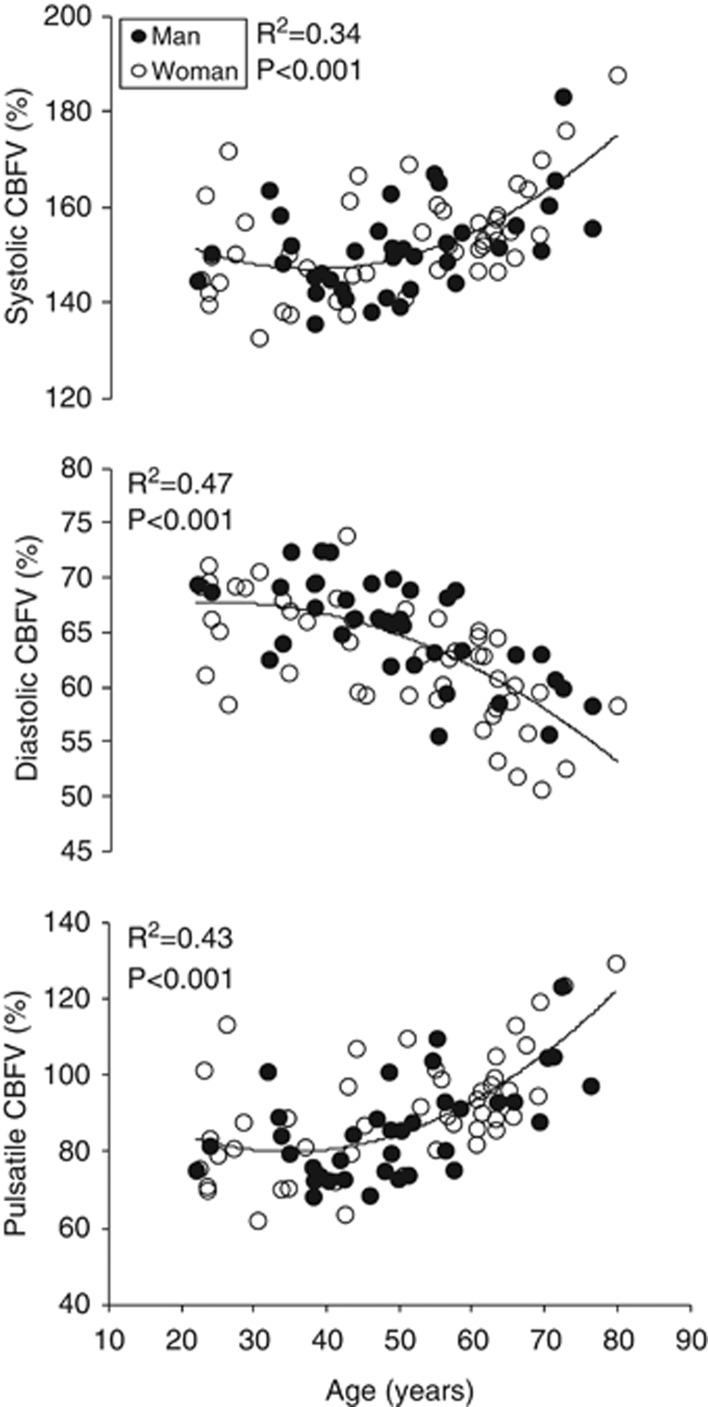
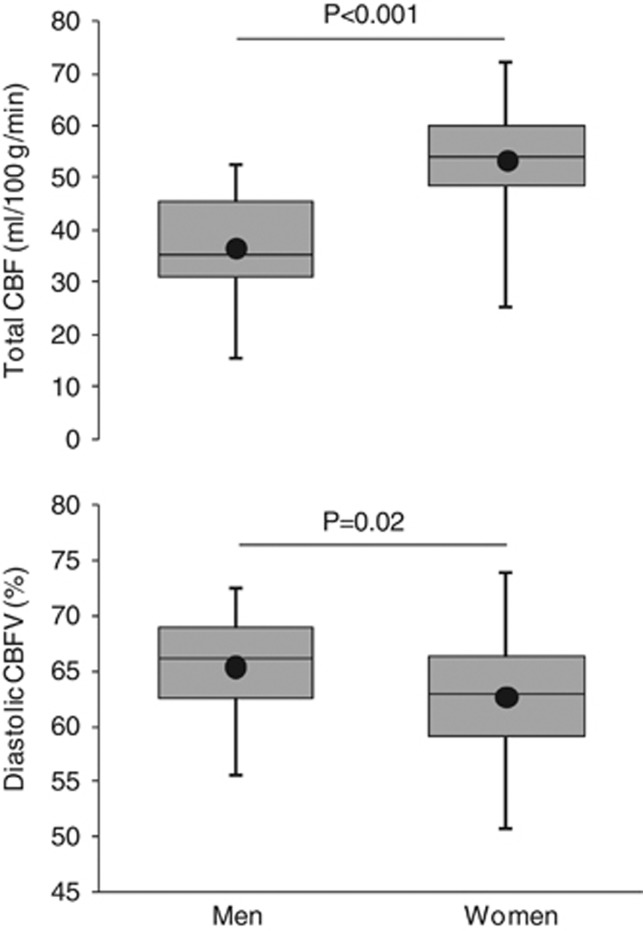
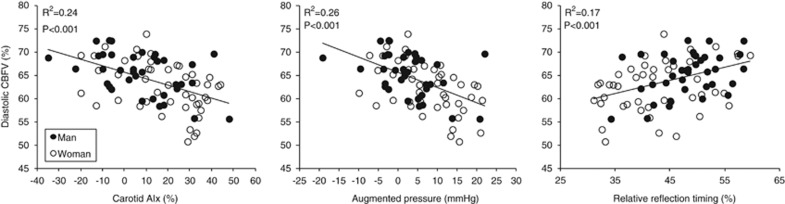
Blood ejected from the left ventricle perfuses the brain via central elastic arteries, which stiffen with advancing age and may elevate the risk of end-organ damage. The purpose of this study was to determine the impact of central arterial aging on cerebral hemodynamics. Eighty-three healthy participants aged 22 to 80 years underwent the measurements of cerebral blood flow (CBF) and CBF velocity (CBFV) using magnetic resonance imaging (MRI) and transcranial Doppler, respectively. The CBF pulsatility was determined by the relative amplitude of CBFV to the mean value (CBFV%). Central arterial stiffness (carotid-femoral pulse wave velocity), wave reflection (carotid augmentation index), and pressure were measured using applanation tonometry. Total volume of white-matter hyperintensity (WMH) was quantified from MR images. Total CBF decreased with age while systolic and pulsatile CBFV% increased and diastolic CBFV% decreased. Women showed greater total CBF and lower cerebrovascular resistance than men. Diastolic CBFV% was lower in women than in men. Age- and sex-related differences in CBF pulsatility were independently associated with carotid pulse pressure and arterial wave reflection. In older participants, higher pulsatility of CBF was associated with the greater total volume of WMH. These findings indicate that central arterial aging has an important role in age-related differences in cerebral hemodynamics.
Figures

References
-
- Ovbiagele B, Goldstein LB, Higashida RT, Howard VJ, Johnston SC, Khavjou OA, et al. Forecasting the future of stroke in the United States: a policy statement from the American Heart Association and American Stroke Association. Stroke. 2013;44:2361–2375. - PubMed
-
- O'Rourke MF, Safar ME. Relationship between aortic stiffening and microvascular disease in brain and kidney: cause and logic of therapy. Hypertension. 2005;46:200–204. - PubMed
-
- Goldstein LB, Bushnell CD, Adams RJ, Appel LJ, Braun LT, Chaturvedi S, et al. Guidelines for the primary prevention of stroke: a guideline for healthcare professionals from the American Heart Association/American Stroke Association. Stroke. 2011;42:517–584. - PubMed
-
- Henskens LH, Kroon AA, van Oostenbrugge RJ, Gronenschild EH, Fuss-Lejeune MM, Hofman PA, et al. Increased aortic pulse wave velocity is associated with silent cerebral small-vessel disease in hypertensive patients. Hypertension. 2008;52:1120–1126. - PubMed
Publication types
MeSH terms
Grants and funding
LinkOut - more resources
Full Text Sources
Other Literature Sources
