Review
. 2014 Jun;82(6):2162-9.
doi: 10.1128/IAI.00059-14. Epub 2014 Mar 18.

Impact of Staphylococcus aureus on pathogenesis in polymicrobial infections

Affiliations
Review

Impact of Staphylococcus aureus on pathogenesis in polymicrobial infections

Nisha Nair et al. Infect Immun. 2014 Jun.

Abstract

Polymicrobial infections involving Staphylococcus aureus exhibit enhanced disease severity and morbidity. We reviewed the nature of polymicrobial interactions between S. aureus and other bacterial, fungal, and viral cocolonizers. Microbes that were frequently recovered from the infection site with S. aureus are Haemophilus influenzae, Enterococcus faecalis, Pseudomonas aeruginosa, Streptococcus pneumoniae, Corynebacterium sp., Lactobacillus sp., Candida albicans, and influenza virus. Detailed analyses of several in vitro and in vivo observations demonstrate that S. aureus exhibits cooperative relations with C. albicans, E. faecalis, H. influenzae, and influenza virus and competitive relations with P. aeruginosa, Streptococcus pneumoniae, Lactobacillus sp., and Corynebacterium sp. Interactions of both types influence changes in S. aureus that alter its characteristics in terms of colony formation, protein expression, pathogenicity, and antibiotic susceptibility.


Figures
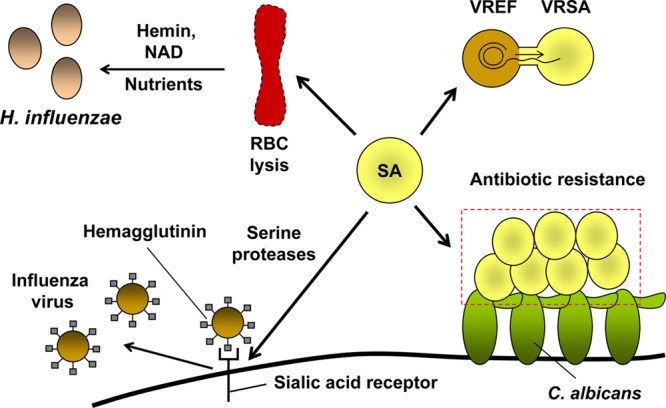
FIG 1
FIG 1
Cooperative interactions between S. aureus and other microbes. S. aureus can cocolonize with H. influenzae, E. faecalis, C. albicans, and influenza virus. S. aureus-induced lysis of red blood cells (RBC) leads to the release of hemin and NAD, which act as nutrients and support the growth of H. influenzae. S. aureus secretes proteases that cleave the host sialic acid receptor and increase the infectivity of influenza virus by releasing the virus from the host cell surface. S. aureus gained vancomycin resistance from E. faecalis due to horizontal gene transfer and became more resistant to antibiotics during coinfection with C. albicans. Symbols: SA, S. aureus; VRSA, vancomycin-resistant S. aureus; VREF, vancomycin-resistant E. faecalis.
FIG 2
FIG 2
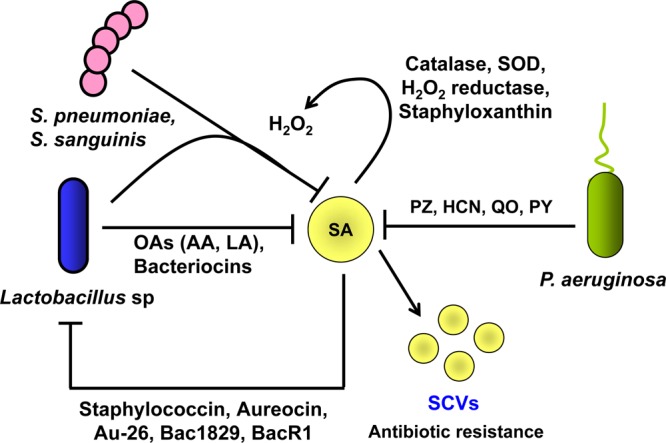
Competitive interactions between S. aureus and other microbes. S. aureus exhibits antagonism toward P. aeruginosa, Streptococcus sp., and Lactobacillus sp. P. aeruginosa produces phenazine (PZ), hydrogen cyanide (HCN), quinolone oxidase (QO), and pyocyanin (PY), resulting in the respiratory blockage of S. aureus, which in turn leads to the formation of small-colony variants (SCVs). SCVs are more persistent and are resistant to antibiotics. Lactobacillus sp. and Streptococcus sp. inhibit the growth of S. aureus by producing hydrogen peroxide (H2O2). S. aureus produces staphyloxanthin and catalase, which neutralize the toxic effects of H2O2. Additionally, Lactobacillus spp. produce organic acids and bacteriocins that limit the growth of S. aureus. Certain S. aureus strains also produce bacteriocins such as staphylococcin Au 26, which in turn inhibit the growth of lactobacilli. Blocked arrows indicate antagonism, and arrows indicate survival strategies of S. aureus.

References

    1. Williams RE. 1963. Healthy carriage of Staphylococcus aureus: its prevalence and importance. Bacteriol. Rev. 27:56–71 - PMC - PubMed
    1. Wertheim HF, Melles DC, Vos MC, van Leeuwen W, van Belkum A, Verbrugh HA, Nouwen JL. 2005. The role of nasal carriage in Staphylococcus aureus infections. Lancet Infect. Dis. 5:751–762. 10.1016/S1473-3099(05)70295-4 - DOI - PubMed
    1. Götz F, Bannerman T, Schleifer KH. 2006. The genera Staphylococcus and Macrococcus. Prokaryotes 4:5–75. 10.1007/0-387-30744-3_1 - DOI
    1. McCaig LF, McDonald LC, Mandal S, Jernigan DB. 2006. Staphylococcus aureus-associated skin and soft tissue infections in ambulatory care. Emerg. Infect. Dis. 12:1715–1723. 10.3201/eid1211.060190 - DOI - PMC - PubMed
    1. Garnier F, Tristan A, Francois B, Etienne J, Delage-Corre M, Martin C, Liassine N, Wannet W, Denis F, Ploy MC. 2006. Pneumonia and new methicillin-resistant Staphylococcus aureus clone. Emerg. Infect. Dis. 12:498–500. 10.3201/eid1203.051040 - DOI - PMC - PubMed

Publication types

MeSH terms

Substances