Review
. 2014 May;31(5):521-6.
doi: 10.1007/s10815-014-0200-9. Epub 2014 Mar 19.

Molecular mechanisms involved in varicocele-associated infertility

Affiliations
Review

Molecular mechanisms involved in varicocele-associated infertility

Matthew M Sheehan et al. J Assist Reprod Genet. 2014 May.

Abstract

Varicocele is a pathologic enlargement of the pampiniform venous plexus within the spermatic cord, a condition that is a common cause of impaired sperm production and decreased quality of sperm. While varicocele is the most common surgically correctable risk factor for male infertility, not all males with varicocele experience infertility. In fact, most men with varicocele have normal spermatogenesis. Despite its prevalence, the molecular mechanisms of varicocele and its effect on testicular function are yet to be completely understood. We postulate that men with varicocele-associated infertility could have preexisting genetic lesions or defects in molecular mechanisms that make them more susceptible to varicocele-mediated testicular injury affecting spermatogenesis.


Figures
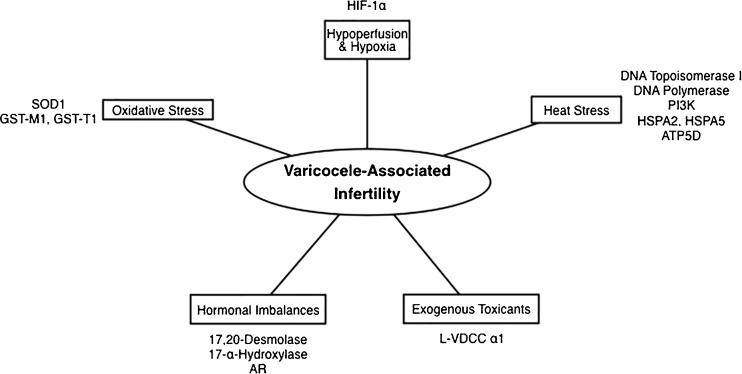
Fig. 1
Fig. 1
Summary of the molecular and genetic mechanisms identified to date that could contribute to the pathogenesis of varicocele-associated infertility. HIF-1α hypoxia-inducible factor-1α, PI3K phosphatidylinositol 3-kinase, HSPA2/5 heat shock protein A2/5, ATP5D adenosine triphosphate synthase (ATPase), delta subunit, L-VDCC α1 L-type voltage dependent calcium channel, α1 isotype, AR androgen receptor, SOD1 superoxide dismutase 1, GST-M1/T1 glutathione S-transferase M1/T1

References

    1. Dubin L, Amelar RD. Varicocele size and results of varicocelectomy in selected subfertile men with varicocele. Fertil Steril. 1970;21(8):606–9. - PubMed
    1. Clarke BG. Incidence of varicocele in normal men and among men of different ages. JAMA. 1966;198:1121–2. doi: 10.1001/jama.1966.03110230137039. - DOI - PubMed
    1. Skoog SJ, Roberts KP, Goldstein M, Pryor JL. The adolescent varicocele: what’s new with an old problem in young patients? Pediatrics. 1997;100(1):112–21. doi: 10.1542/peds.100.1.112. - DOI - PubMed
    1. Eisenberg ML, Lipshultz LI. Varicocele-induced infertility: newer insights into its pathophysiology. Indian J Urol. 2011;27:58–64. doi: 10.4103/0970-1591.78428. - DOI - PMC - PubMed
    1. Naughton CK, Nangia AK, Agarwal A. Pathophysiology of varicoceles in male infertility. Hum Reprod Update. 2011;7:461–72. - PubMed

LinkOut - more resources
