Identification of anticancer drugs for hepatocellular carcinoma through personalized genome-scale metabolic modeling
- PMID: 24646661
- PMCID: PMC4017677
- DOI: 10.1002/msb.145122
Identification of anticancer drugs for hepatocellular carcinoma through personalized genome-scale metabolic modeling
Abstract
Genome-scale metabolic models (GEMs) have proven useful as scaffolds for the integration of omics data for understanding the genotype-phenotype relationship in a mechanistic manner. Here, we evaluated the presence/absence of proteins encoded by 15,841 genes in 27 hepatocellular carcinoma (HCC) patients using immunohistochemistry. We used this information to reconstruct personalized GEMs for six HCC patients based on the proteomics data, HMR 2.0, and a task-driven model reconstruction algorithm (tINIT). The personalized GEMs were employed to identify anticancer drugs using the concept of antimetabolites; i.e., drugs that are structural analogs to metabolites. The toxicity of each antimetabolite was predicted by assessing the in silico functionality of 83 healthy cell type-specific GEMs, which were also reconstructed with the tINIT algorithm. We predicted 101 antimetabolites that could be effective in preventing tumor growth in all HCC patients, and 46 antimetabolites which were specific to individual patients. Twenty-two of the 101 predicted antimetabolites have already been used in different cancer treatment strategies, while the remaining antimetabolites represent new potential drugs. Finally, one of the identified targets was validated experimentally, and it was confirmed to attenuate growth of the HepG2 cell line.
Figures
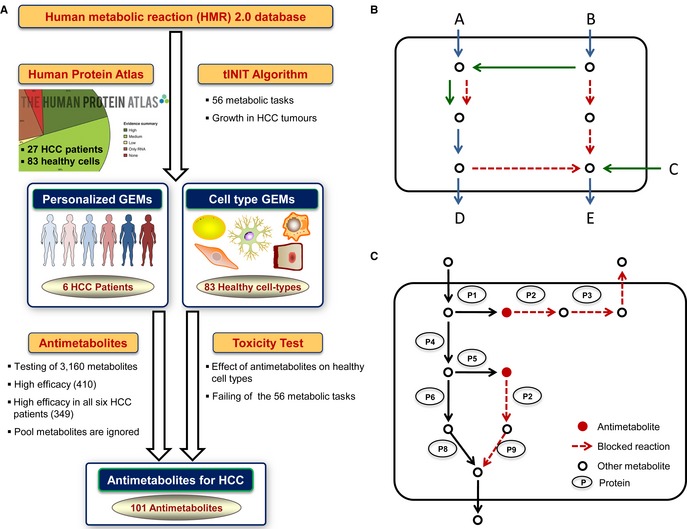
The presence/absence of 15,841 proteins in tumors obtained from 27
HCC patients was evaluated using immunohistochemistry. tINIT algorithm was developed and used for reconstruction of personalizedGEM s for sixHCC patients andGEM s for 83 healthy cell types based on proteomics data andHMR 2.0. A method identifying potential antimetabolites for the treatment of theHCC patients was developed, and the toxicity of each antimetabolite was predicted usingGEM s for healthy cells types.tINIT was used for reconstructing
GEM s which are in agreement with omics data and which could perform a set of predefined tasks. In this illustration, the model should perform two simple tasks; production of “D” from “A” and “E” from “B.” The resulting model should contain as many of the green reactions and as few of the red ones as possible. In the first step, all reactions were identified which, if removed from the network, cause any of the tasks to fail. These reactions were marked blue. In the second step, theINIT algorithm was used to find the network with the maximal number of green reactions compared to red, with the additional constraints that the model must be functional and that all blue reactions must be included. This would result in the dotted reactions being removed from the network. At this stage, the first task would be possible, but not the second one (since uptake of “C” makes the production of “E” possible without using any red reactions). In the final step, each task was tested and a gap‐filling algorithm was used to reinsert the reactions which were required for all tasks to work. This would result in the inclusion of the lower‐most red reaction.The effect of antimetabolites can be predicted in silico by using metabolic network and potential use of antimetabolites is illustrated.
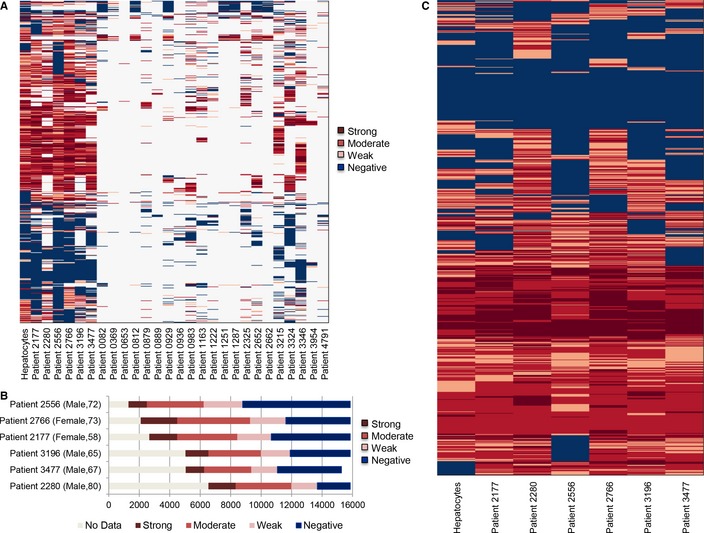
Clustering of the generated proteomics data between 27 different
HCC patients showed notable differences. The color indicates the protein expression differences between tissue samples.Due to the coverage of the proteomics data, we focused on the reconstruction of the personalized models for six
HCC patients. The number of the evaluated proteins in eachHCC patients varies between 9,312 and 14,561.The expression level of 4,936 proteins measured in all six
HCC patients and the proteomics data showed notable differences between theHCC patients and hepatocytes.
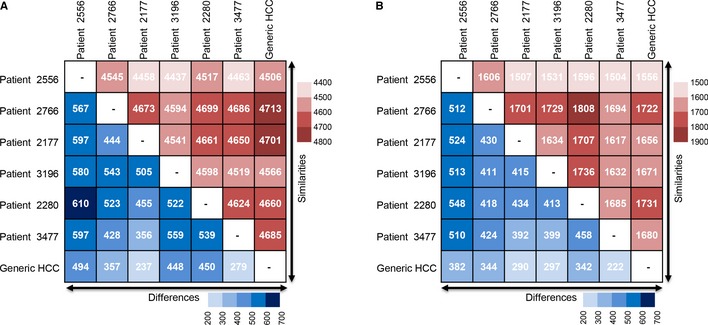
- A, B
The pairwise differences and similarities of the reactions (A) and genes (B) between personalized
HCC models and the genericHCC model that is reconstructed based on the average protein expression level of 27HCC patients.
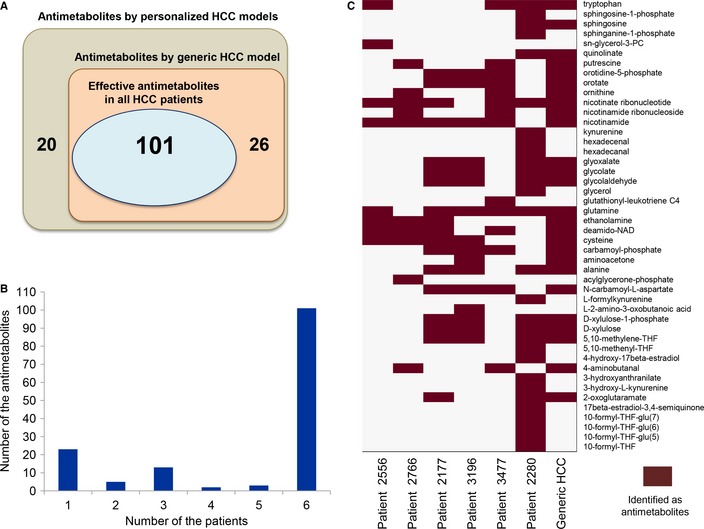
147 antimetabolites are predicted as potential anticancer drugs through personalized
HCC models and 101 of these antimetabolites are effective for inhibitingHCC tumor growth in all sixHCC patients. Antimetabolites are also predicted through the use of a genericHCC model that is reconstructed based on the average protein expression data inHCC patients, and 127 potential antimetabolites are identified. Twenty‐six of the antimetabolites predicted based on the genericHCC models are not effective in all sixHCC patients.Distribution of the antimetabolites that are predicted to be effective in number of the personalized
HCC models.46 of the antimetabolites identified through the use of personalized models cannot be used for inhibition of the
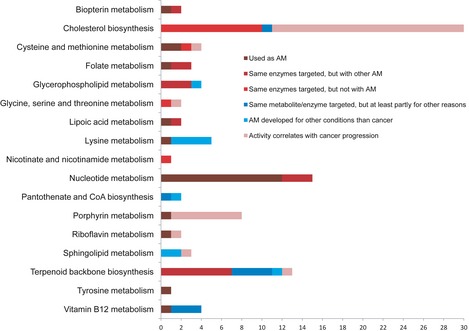
HCC tumor in all sixHCC patients. The differences between the 46 predicted antimetabolites are shown through the use of personalized and genericHCC models.
- A, B
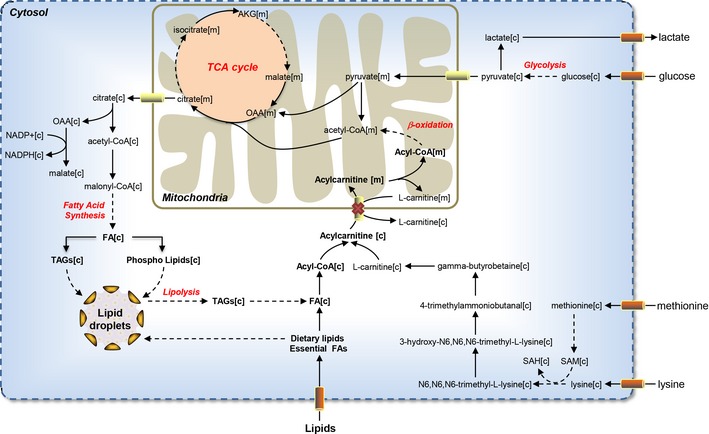
Perhexiline was used to mimic the effect of the
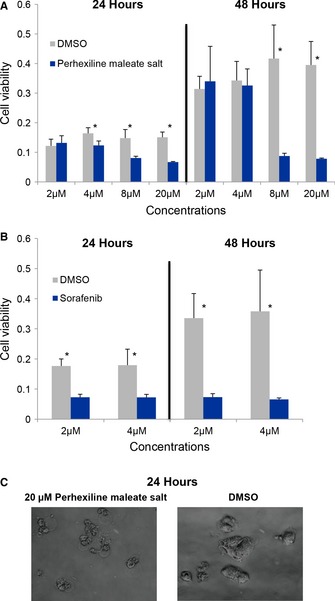
l ‐carnitine analog on the proliferation of the HepG2 cell line. The number of viable cells was determined after treatment with (A) perhexiline (2, 4, 8, and 20 μM) and (B) sorafenib (2 and 4 μM) for 24 and 48 h. Both perhexiline and sorafenib were dissolved inDMSO , and for each concentration of compounds analyzed, controls with corresponding concentration ofDMSO were analyzed. Each bar represents the results from eight replicate samples, and mean ± s.d. values are presented. Student's t‐test versus untreated cells: *P‐values < 0.001. - C
Example images for the HepG2 cell line after 24 h of the treatment with 20 μM perhexiline and corresponding concentration of
DMSO .
References
-
- Borena W, Strohmaier S, Lukanova A, Bjorge T, Lindkvist B, Hallmans G, Edlinger M, Stocks T, Nagel G, Manjer J, Engeland A, Selmer R, Haggstrom C, Tretli S, Concin H, Jonsson H, Stattin P, Ulmer H (2012) Metabolic risk factors and primary liver cancer in a prospective study of 578,700 adults. Int J Cancer 131: 193–200 - PubMed
Publication types
MeSH terms
Substances
LinkOut - more resources
Full Text Sources
Other Literature Sources
Medical