


A novel radioguided surgery technique exploiting β(-) decays
- PMID: 24646766
- PMCID: PMC3960579
- DOI: 10.1038/srep04401
A novel radioguided surgery technique exploiting β(-) decays
Abstract
The background induced by the high penetration power of the radiation is the main limiting factor of the current radio-guided surgery (RGS). To partially mitigate it, a RGS with β(+)-emitting radio-tracers has been suggested in literature. Here we propose the use of β(-)-emitting radio-tracers and β(-) probes and discuss the advantage of this method with respect to the previously explored ones: the electron low penetration power allows for simple and versatile probes and could extend RGS to tumours for which background originating from nearby healthy tissue makes probes less effective. We developed a β(-) probe prototype and studied its performances on phantoms. By means of a detailed simulation we have also extrapolated the results to estimate the performances in a realistic case of meningioma, pathology which is going to be our first in-vivo test case. A good sensitivity to residuals down to 0.1 ml can be reached within 1 s with an administered activity smaller than those for PET-scans thus making the radiation exposure to medical personnel negligible.
Conflict of interest statement
F.B., F.C., E.D.L., S.F., M.M., I.M., V.P., L.P., A.Sa., A.Sc., C.V. and R.F. are listed as inventors on an Italian patent application (RM2013A000053) entitled “Utilizzo di radiazione
Figures
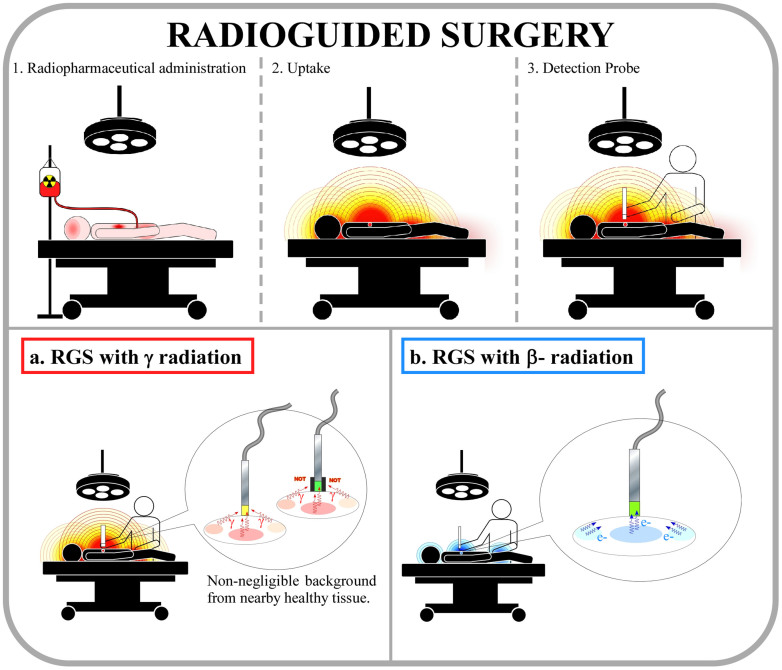
 -emitting tracers (a) with electron-emitting tracers (b). Due to the high penetration power of the photons, in the first case a non-negligible background can be produced by the healthy organs close to the lesion, sometimes preventing the applicability of the technique. To mitigate this effect a shielding or active veto is applied (see inset of box a) thus making the probes cumbersome. Electrons, instead, provide a clearer delineation of radioactive tissue's margins allowing for a simple and compact probe and requiring a smaller radio-pharmaceutical activity. [Figure drawn by S.M. and E.S.C.].
References
-
- Radioguided Surgery: A Comprehensive Team Approach. [Mariani, G., Giuliano, A. E. & Strauss, H. W. (eds)] (Springer, New York, 2006).
-
- Hoffman E. J. Tornai M. P. Janecek M. Patt B. E. & Iwanczyk J. S. Intraoperative probes and imaging probes. Eur. J. Nucl. Med. 26, 913–935 (1999). - PubMed
-
- Tsuchimochi M. & Hayamaand K. Intraoperative gamma cameras for radioguided surgery: Technical characteristics, performance parameters, and clinical application. Phys. Med. 29, 126–38 (2013). - PubMed
-
- Hickernell T. S. et al. Dual detector Probe for surgical Tumor Staging. J. Nucl. Med. 29, 1101 (1988). - PubMed
-
- Daghighian F. et al. Intraoperative beta probe: A device for detecting tissue labeled with positron or electron emitting isotopes during surgery. Med. Phys. 21, 153 (1994). - PubMed
MeSH terms
Substances
LinkOut - more resources
Full Text Sources
Other Literature Sources
