. 2014 Apr 15;82(15):1352-61.
doi: 10.1212/WNL.0000000000000315. Epub 2014 Mar 19.

Optimal target localization for subthalamic stimulation in patients with Parkinson disease

Affiliations

Optimal target localization for subthalamic stimulation in patients with Parkinson disease

Marie-Laure Welter et al. Neurology. .

Abstract

Objective: To further determine the causes of variable outcome from deep brain stimulation of the subthalamic nucleus (DBS-STN) in patients with Parkinson disease (PD).

Methods: Data were obtained from our cohort of 309 patients with PD who underwent DBS-STN between 1996 and 2009. We examined the relationship between the 1-year motor, cognitive, and psychiatric outcomes and (1) preoperative PD clinical features, (2) MRI measures, (3) surgical procedure, and (4) locations of therapeutic contacts.

Results: Pre- and postoperative results were obtained in 262 patients with PD. The best motor outcome was obtained when stimulating contacts were located within the STN as compared with the zona incerta (64% vs 49% improvement). Eighteen percent of the patients presented a postoperative cognitive decline, which was found to be principally related to the surgical procedure. Other factors predictive of poor cognitive outcome were perioperative confusion and psychosis. Nineteen patients showed a stimulation-induced hypomania, which was related to both the form of the disease (younger age, shorter disease duration, higher levodopa responsiveness) and the ventral contact location. Postoperative depression was more frequent in patients already showing preoperative depressive and/or residual axial motor symptoms.

Conclusion: In this homogeneous cohort of patients with PD, we showed that (1) the STN is the best target to improve motor symptoms, (2) postoperative cognitive deficit is mainly related to the surgery itself, and (3) stimulation-induced hypomania is related to a combination of both the disease characteristics and a more ventral STN location.


Figures
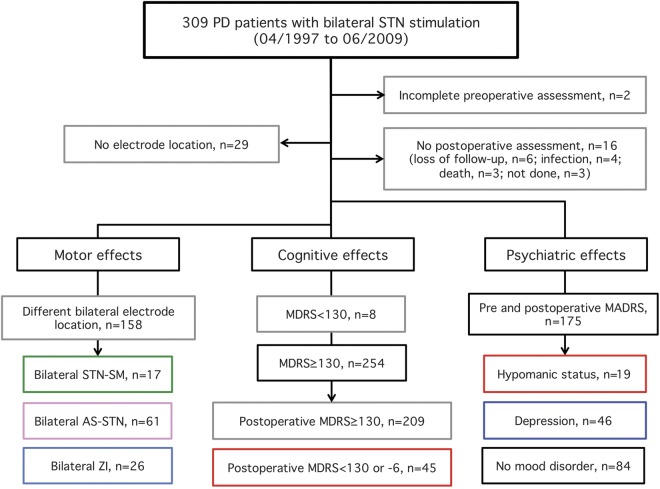
Figure 1
Figure 1. Flowchart of patients evaluated in this study
AS = associative; MADRS = Montgomery-Åsberg Depression Rating Scale; MDRS = Mattis Dementia Rating Scale; PD = Parkinson disease; SM = sensorimotor; STN = subthalamic nucleus; ZI = zona incerta.
Figure 2
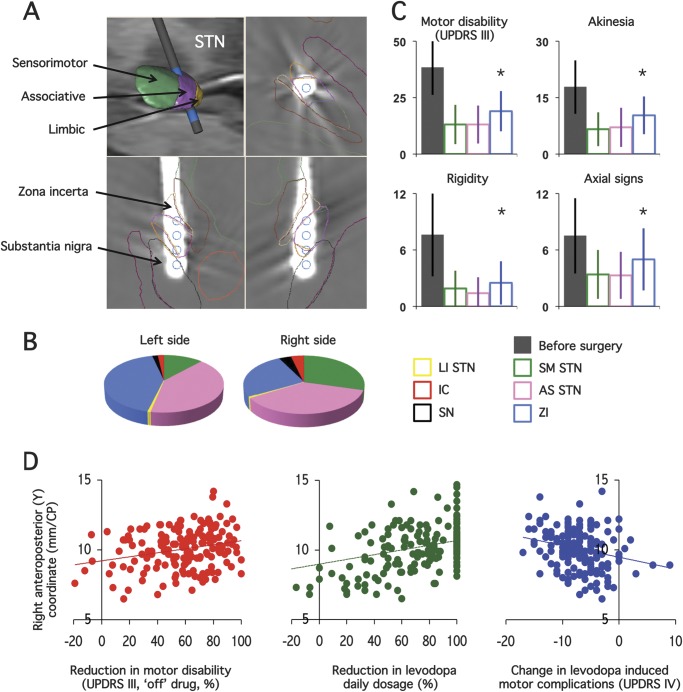
Figure 2. Effects of deep brain stimulation on parkinsonian motor disability as a function of stimulating contact location
(A) Example of one electrode location reconstructed on the 3-dimensional digitized basal ganglia atlas showing the 4 stimulating contacts (blue cylinder, upper left image). The position of each contact is seen on the axial (upper right), sagittal (lower left), and coronal (lower right) images reconstructed in the electrode plane. The location of the stimulating contact in the sensorimotor (SM, green), associative (AS, pink), or limbic (LI, yellow) parts of the subthalamic nucleus (STN), or outside the STN, such as in the substantia nigra (SN, black, located ventrally to the STN), the zona incerta/Forel field area (ZI, yellow, located medially to the STN), or the internal capsule (IC, red, located laterally to the STN), can therefore be accurately determined. (B) Relative distribution of locations of the chronically implanted stimulating contacts in the 262 patients with Parkinson disease, in the left and right hemispheres. (C) Effects of the bilateral stimulation of the SM-STN (green columns) vs AS-STN (pink columns) vs ZI (blue columns) on parkinsonian motor disability (Unified Parkinson’s Disease Rating Scale [UPDRS] part III), rigidity, akinesia, and axial signs 1 year after surgery (on stimulation, off drug). The first gray column represents the scores before surgery without antiparkinsonian treatment (off drug). Asterisks indicate significant differences between groups. (D) Relationship between the anteroposterior (Y) coordinate of the right stimulating contact and the improvement in motor disability with bilateral stimulation alone (on stimulation, off drug; left graph), reduction in the levodopa replacement therapy (middle graph), and change in levodopa-induced motor complications (right graph), 12 months after surgery. CP = commissure posterior.
Figure 3
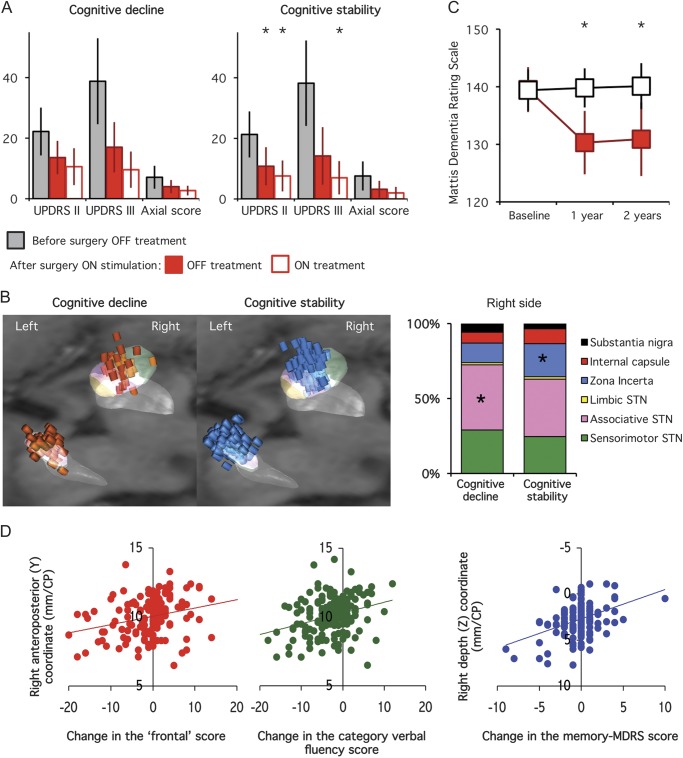
Figure 3. Postoperative parkinsonian disability and stimulating contact location in PD patients with vs without cognitive decline 1 year after surgery
(A) Differences in parkinsonian activities of daily living (UPDRS part II), motor disability (UPDRS part III), and axial motor sign scores with bilateral subthalamic stimulation alone (OFF, solid red bars) or with drug (ON, empty red bars) in patients with PD who had postoperative cognitive decline (left panel) vs cognitive stability (right panel). The first bars (gray) represent the results obtained for the same scores in the off-drug condition before surgery in each group. (B) Location of the stimulating contacts of the patients with PD who had postoperative cognitive decline (left panel, red cylinders) vs cognitive stability (right panel, blue cylinders). The graph represents the relative proportion of stimulating contacts located within the different subthalamic subregions (sensorimotor, associative, and limbic) and surrounding areas (zona incerta/Forel field, internal capsule, substantia nigra pars reticulata). (C) Changes in the mean MDRS score in PD patients with (filled red squares) vs without (black squares) cognitive decline, 1 and 2 years after surgery. Note that in both groups cognitive status did not significantly change between the first and the second year postsurgery. (D) Relationship between the anteroposterior (Y) coordinate of the right stimulating contact and the change in the frontal score (left panel) and category verbal fluency (middle panel), and the depth (Z) of the right stimulating contact and the change in the MDRS score (right panel). Asterisks indicate significant differences between the 2 groups. CP = commissure posterior; MDRS = Mattis Dementia Rating Scale; PD = Parkinson disease; STN = subthalamic nucleus; UPDRS = Unified Parkinson’s Disease Rating Scale.
Figure 4
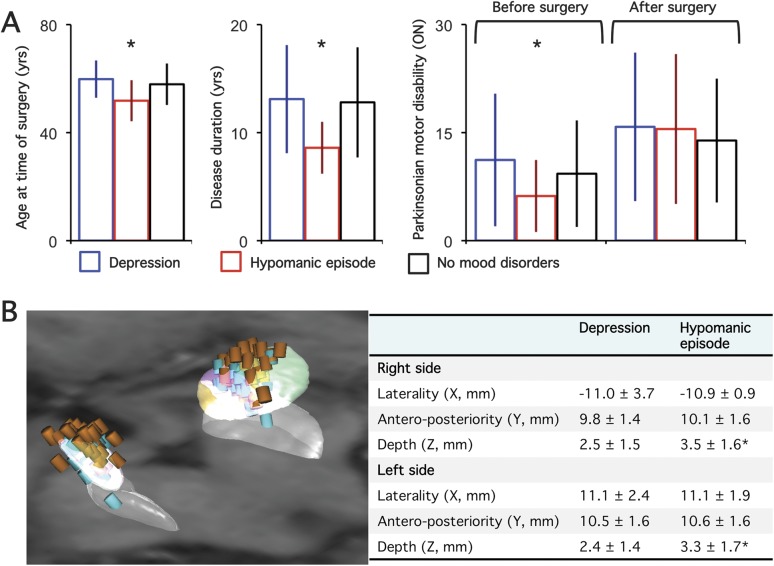
Figure 4. Psychiatric effects of deep brain stimulation in patients with PD as a function of age, disease characteristics, postoperative motor disability improvement, and stimulating electrode locations
(A) Differences in age at time of surgery, disease duration, parkinsonian motor disability “on” drug before surgery and “on” stimulation alone after surgery in patients with Parkinson disease (PD) who had postoperative depression (blue bars), hypomanic episodes (red bars), or no mood disorders (black bars). (B) Left panel: stimulating contacts used in patients with PD who had postoperative depression (blue cylinders) or hypomania (brown cylinders); right panel: mean (SD) X, Y, and Z coordinates in the anterior commissure–posterior commissure space of the stimulating contacts in patients with PD who had postoperative depression or hypomania. Asterisks indicate significant differences between groups.

References

    1. Limousin P, Krack P, Pollak P, et al. Electrical stimulation of the subthalamic nucleus in advanced Parkinson's disease. N Engl J Med 1998;339:1105–1111 - PubMed
    1. Parsons TD, Rogers SA, Braaten AJ, Woods SP, Troster AI. Cognitive sequelae of subthalamic nucleus deep brain stimulation in Parkinson's disease: a meta-analysis. Lancet Neurol 2006;5:578–588 - PubMed
    1. Voon V, Kubu C, Krack P, Houeto JL, Troster AI. Deep brain stimulation: neuropsychological and neuropsychiatric issues. Mov Disord 2006;21(suppl 14):S305–S327 - PubMed
    1. Williams A, Gill S, Varma T, et al. Deep brain stimulation plus best medical therapy versus best medical therapy alone for advanced Parkinson's disease (PD SURG trial): a randomised, open-label trial. Lancet Neurol 2010;9:581–591 - PMC - PubMed
    1. Daniels C, Krack P, Volkmann J, et al. Is improvement in the quality of life after subthalamic nucleus stimulation in Parkinson's disease predictable? Mov Disord 2011;26:2516–2521 - PubMed

Publication types