. 2014 Jun;52(6):1901-10.
doi: 10.1128/JCM.03584-13. Epub 2014 Mar 19.

Molecular and serological diversity of Neisseria meningitidis carrier strains isolated from Italian students aged 14 to 22 years

Affiliations

Molecular and serological diversity of Neisseria meningitidis carrier strains isolated from Italian students aged 14 to 22 years

Roberto Gasparini et al. J Clin Microbiol. 2014 Jun.

Abstract

Neisseria meningitidis is an obligate human commensal that commonly colonizes the oropharyngeal mucosa. Carriage is age dependent and very common in young adults. The relationships between carriage and invasive disease are not completely understood. In this work, we performed a longitudinal carrier study in adolescents and young adults (173 subjects). Overall, 32 subjects (18.5%) had results that were positive for meningococcal carriage in at least one visit (average monthly carriage rate, 12.1%). Only five subjects tested positive at all four visits. All meningococcal isolates were characterized by molecular and serological techniques. Multilocus sequence typing, PorA typing, and sequencing of the 4CMenB vaccine antigens were used to assess strain diversity. The majority of positive subjects were colonized by capsule null (34.4%) and capsular group B strains (28.1%), accounting for 23.5% and 29.4% of the total number of isolates, respectively. The fHbp and nhba genes were present in all isolates, while the nadA gene was present in 5% of the isolates. The genetic variability of the 4CMenB vaccine antigens in this collection was relatively high compared with that of other disease-causing strain panels. Indications about the persistence of the carriage state were limited to the time span of the study. All strains isolated from the same subject were identical or cumulated minor changes over time. The expression levels and antigenicities of the 4CMenB vaccine antigens in each strain were analyzed by the meningococcal antigen typing system (MATS), which revealed that expression can change over time in the same individual. Future analysis of antigen variability and expression in carrier strains after the introduction of the MenB vaccine will allow for a definition of its impact on nasopharyngeal/oropharyngeal carriage.


Figures

FIG 1
FIG 1
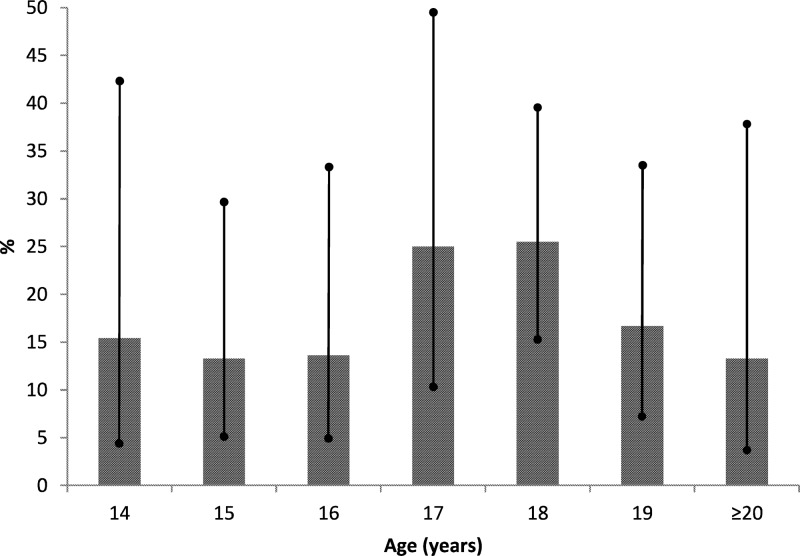
Distribution of the percentage of carriages, with 95% confidence intervals, by age.
FIG 2
FIG 2
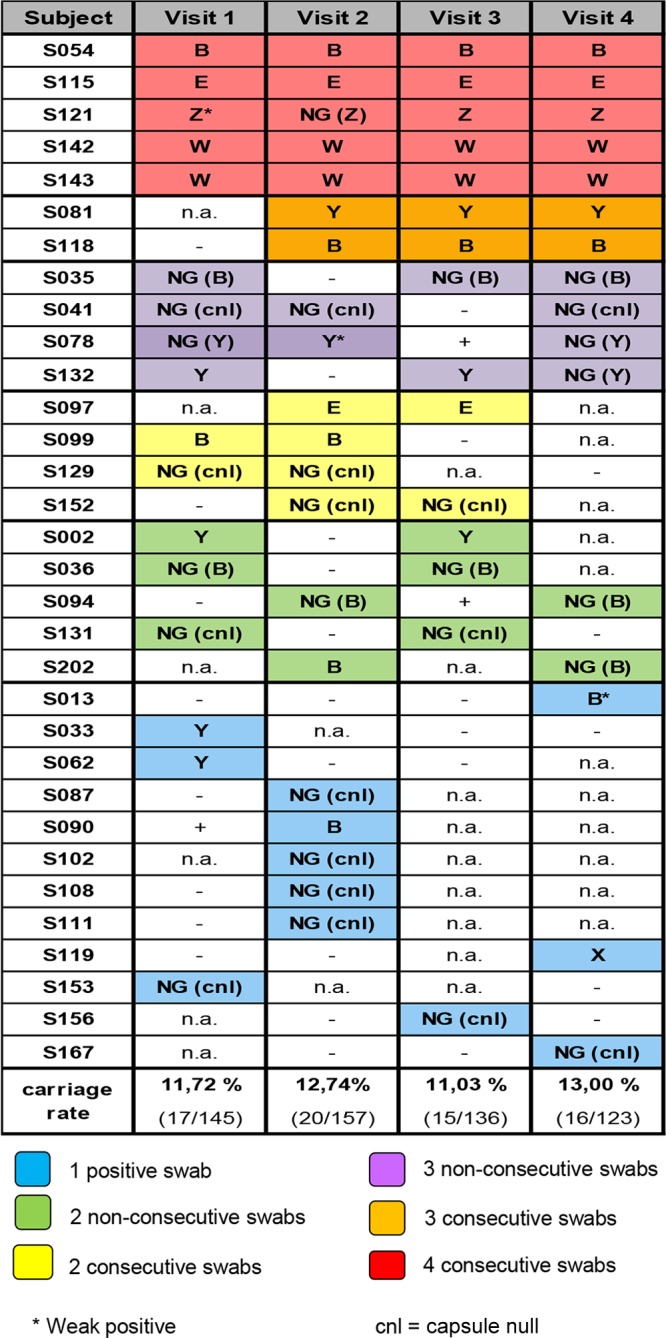
Representation of N. meningitidis carriage positivity across the four visits for the 32 carrier subjects. The subjects are ordered based on the number of positive visits and by numerical order. Boxes corresponding to positive visits are colored. The color coding is indicated in the legend. Serogroups are reported (*, weak expression of capsule). For nongroupable (NG) isolates, capsular groups are reported in parentheses. −, negative isolation; n.a., not assessed (absence of the subject at a given visit); +, PCR positivity of unavailable isolates. The carriage rates are calculated from the number of individual swabs at each visit.
FIG 3
FIG 3
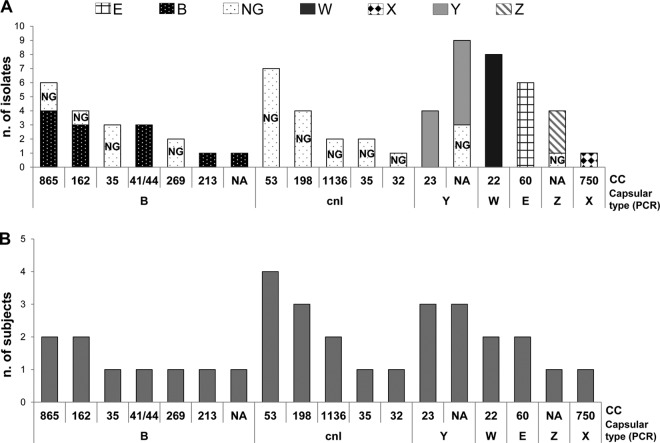
Association of serogroups and MLST clonal complexes identified in this study. (A) A histogram was built, taking into account the total number of N. meningitidis isolates, which are stratified based on the combination of the cc and serogroup, as determined by PCR. The different shading of the bars corresponds to different capsule expression as determined by slide agglutination. (B) A histogram was built showing the correspondence serogroup/cc, assuming that for each subject, identical strains were isolated at different visits (each of the 32 positive subjects corresponds to one strain).
FIG 4
FIG 4
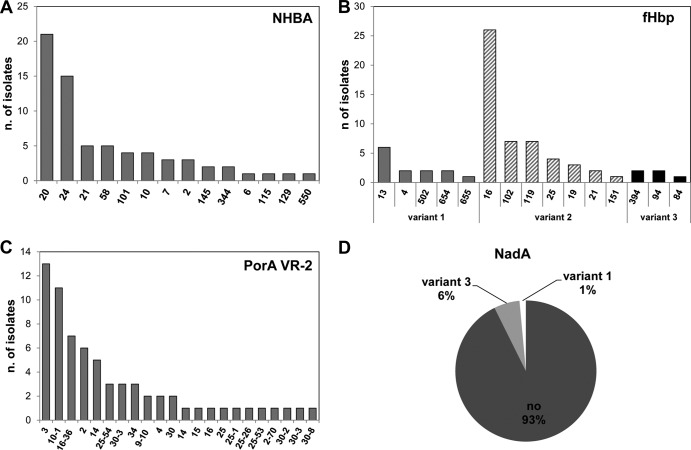
Genetic characterization of the 4CMenB vaccine antigens in the 68 N. meningitidis strains isolated in this study. (A) Prevalence of NHBA peptides; (B) fHbp main variants 1, 2, and 3 and subvariants numeric identifiers; (C) prevalence of PorA VR2 subtype; (D) pie graph of nadA gene presence.
FIG 5
FIG 5
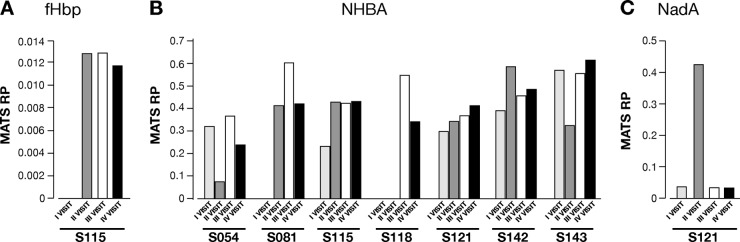
4CMenB antigen expression trends determined by MATS on strains isolated from subjects showing detectable differential expression at different visits. The histograms show the RP trends for fHbp in subject S115 (A), NHBA in subjects S054, S081, S115, S118, S121, S142, and S143 (B), and NadA in subject S121 (C).
FIG 6
FIG 6
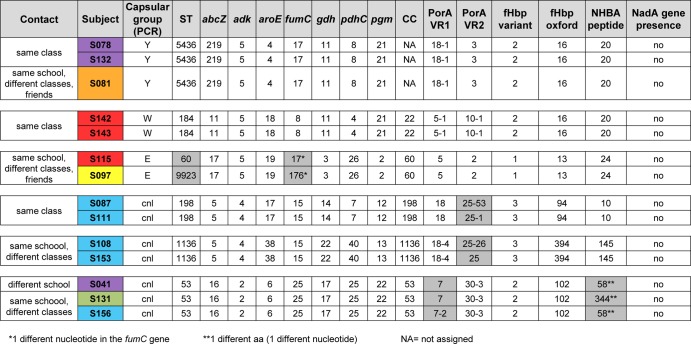
Relationships among subjects carrying strains with identical or very similar features. Six identical or similar strains were isolated in >1 subject. The different subjects carrying identical or very similar strains most frequently attended the same class or school or were friends. The color coding of the boxes is the same as that shown in Fig. 2. The differences identified through the molecular characterization are shaded in gray.

References

    1. Hill DJ, Griffiths NJ, Borodina E, Virji M. 2010. Cellular and molecular biology of Neisseria meningitidis colonization and invasive disease. Clin. Sci. (Lond.) 118:547–564 - PMC - PubMed
    1. Gasparini R, Amicizia D, Lai PL, Panatto D. 2012. Neisseria meningitidis, pathogenetic mechanisms to overcome the human immune defences. J. Prev. Med. Hyg. 53:50–55 - PubMed
    1. Muzzi A, Mora M, Pizza M, Rappuoli R, Donati C. 2013. Conservation of meningococcal antigens in the genus Neisseria. mBio 4(3):e00163–13. 10.1128/mBio.00163-13 - DOI - PMC - PubMed
    1. Yazdankhah SP, Caugant DA. 2004. Neisseria meningitidis: an overview of the carriage state. J. Med. Microbiol. 53:821–832. 10.1099/jmm.0.45529-0 - DOI - PubMed
    1. Goldschneider I, Gotschlich EC, Artenstein MS. 1969. Human immunity to the meningococcus. I. The role of humoral antibodies. J. Exp. Med. 129:1307–1326 - PMC - PubMed

Publication types

MeSH terms

LinkOut - more resources