Review
. 2014:2014:572097.
doi: 10.1155/2014/572097. Epub 2014 Feb 6.

Methyl jasmonate: putative mechanisms of action on cancer cells cycle, metabolism, and apoptosis

Affiliations
Review

Methyl jasmonate: putative mechanisms of action on cancer cells cycle, metabolism, and apoptosis

Italo Mario Cesari et al. Int J Cell Biol. 2014.

Abstract

Methyl jasmonate (MJ), an oxylipid that induces defense-related mechanisms in plants, has been shown to be active against cancer cells both in vitro and in vivo, without affecting normal cells. Here we review most of the described MJ activities in an attempt to get an integrated view and better understanding of its multifaceted modes of action. MJ (1) arrests cell cycle, inhibiting cell growth and proliferation, (2) causes cell death through the intrinsic/extrinsic proapoptotic, p53-independent apoptotic, and nonapoptotic (necrosis) pathways, (3) detaches hexokinase from the voltage-dependent anion channel, dissociating glycolytic and mitochondrial functions, decreasing the mitochondrial membrane potential, favoring cytochrome c release and ATP depletion, activating pro-apoptotic, and inactivating antiapoptotic proteins, (4) induces reactive oxygen species mediated responses, (5) stimulates MAPK-stress signaling and redifferentiation in leukemia cells, (6) inhibits overexpressed proinflammatory enzymes in cancer cells such as aldo-keto reductase 1 and 5-lipoxygenase, and (7) inhibits cell migration and shows antiangiogenic and antimetastatic activities. Finally, MJ may act as a chemosensitizer to some chemotherapics helping to overcome drug resistant. The complete lack of toxicity to normal cells and the rapidity by which MJ causes damage to cancer cells turn MJ into a promising anticancer agent that can be used alone or in combination with other agents.


Figures

Figure 1
Figure 1
Chemical structure of methyl jasmonate (cyclopentaneaceticacid, 3-oxo-2-(2-penten-1-yl)-, methyl ester).
Figure 2
Figure 2
Effect of methyl jasmonate (MJ) on the mitochondrial bioenergetic metabolism of cancer cells. MJ dissociates HK2 from VDAC1 on the outer surface of mitochondria. As an immediate consequence, glycolysis dissociates from oxidative phosphorylation (OXPHOS) and a series of rapid events that occur, such the PTPC opening, mitochondrial membrane permeability deregulation and swelling, decrease of Δψ m and OXPHOS, ATP depletion, cytochrome c release, induction of proapoptotic proteins, and cell death through apoptotic and nonapoptotic pathways.
Figure 3
Figure 3
5-Lipoxygenase (5-LOX) pathway in mammalian cells. Methyl jasmonate (MJ) can inhibit this pathway at the 5-LOX level in cancer cells [47]. The multiple consequences of this effect are (1) blocking 5-lipoxygenase-mediated ROS production (lipid hydroperoxides—LOOH); (2) antiproliferative effect linked to inhibition of 5-HETE production; (3) inhibition of leukotrienes production.
Figure 4
Figure 4
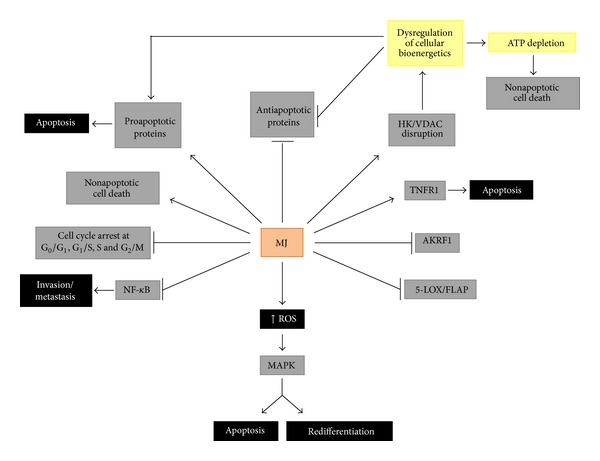
Methyl jasmonate mediated activities in cancer cells. MJ and other jasmonates (JAs) (1) arrest cell cycle, inhibiting cell growth and proliferation; (2) cause cell death by triggering the intrinsic and extrinsic proapoptotic pathways and induce also p53-independent apoptosis and nonapoptotic cell death or necrosis; (3) detach hexokinase (HK) from the voltage-dependent anion channel isoform 1 (VDAC1), dissociating glycolytic and mitochondrial functions, decreasing the mitochondrial membrane potential (Δψ m), favoring cytochrome c release, causing ATP depletion, and activating proapoptotic and inactivating antiapoptotic proteins; (4) induce reactive oxygen species (ROS), triggering and/or mediating different cellular responses; (5) stimulate MAPK-stress signaling pathways and induce redifferentiation in leukemia cells; (6) inhibit overexpressed cancer cell enzymes such as aldo-keto reductase 1 (AKR1) and 5-lipoxygenase (5-LOX).

References

    1. Ertel A, Verghese A, Byers SW, Ochs M, Tozeren A. Pathway-specific differences between tumor cell lines and normal and tumor tissue cells. Molecular Cancer. 2006;5, article 55 - PMC - PubMed
    1. Mou X, Kesari S, Wen PY, Huang X. Crude drugs as anticancer agents. International Journal of Clinical and Experimental Medicine. 2011;4(1):17–25. - PMC - PubMed
    1. Liechti R, Farmer EE. The Jasmonate pathway. Science. 2002;296(5573):1649–1650. - PubMed
    1. Weber H. Fatty acid-derived signals in plants. Trends in Plant Science. 2002;7(5):217–224. - PubMed
    1. Christie WW. Plant oxylipins: chemistry and biology. 2010, http://lipidlibrary.aocs.org/lipids/eicplant/index.htm.

LinkOut - more resources