


Clinical characteristics and prognostic analysis of triple-negative breast cancer patients
- PMID: 24649341
- PMCID: PMC3917786
- DOI: 10.3892/mco.2013.230
Clinical characteristics and prognostic analysis of triple-negative breast cancer patients
Abstract
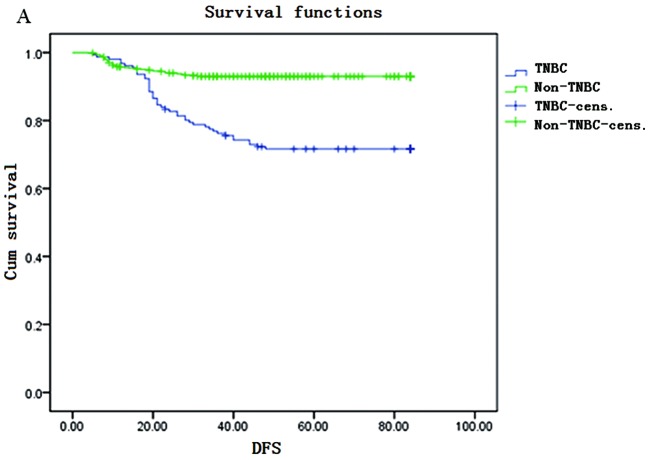
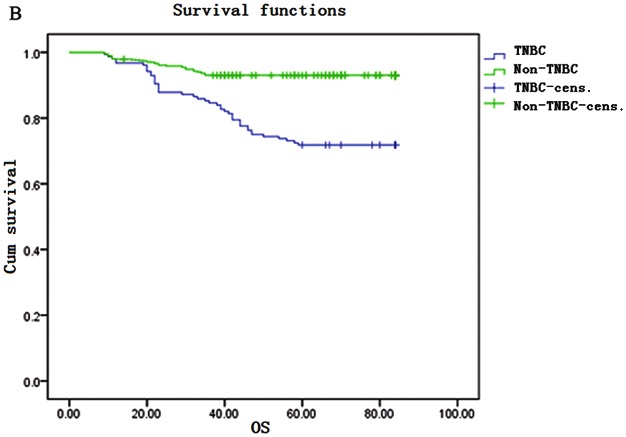
It is well-established that triple-negative breast cancer (TNBC) is a subtype of breast cancer, characterized by a poor prognosis and aggressive biological behavior. However, the available relevant data on TNBC in non-Western populations are limited. In order to analyze the clinicopathological and molecular biological characteristics and observe survival and prognostic factors, 972 breast cancer patients (156 of whom had TNBC) who received treatment at the First Affiliated Hospital of Medical School of Xi'an Jiaotong University and the First Hospital of China Medical University, between January, 2004 and January, 2007 were retrospectively evaluated. In the univariate analysis, tumor size, TNM stage, axillary lymph node status and recurrence or metastasis were identified as prognostic factors for 7-year disease-free survival (DFS) and overall survival (OS). Our multivariate Cox's regression analysis demonstrated that tumor size and axillary lymph node status were significant prognostic factors for 7-year DFS and OS. Notably, tumor subgroup (TNBC vs. non-TNBC) was a significant prognostic factor associated with 7-year DFS and OS in breast cancer. It was suggested that TNBC exhibited a worse 7-year survival compared with that in non-TNBC patients, most likely due to its more aggressive behavior and insensitivity to specific therapy.
Keywords: clinicopathological characteristics; prognostic analysis; survival analysis; triple-negative breast cancer.
Figures
References
-
- Alkis N, Durnali AG, Arslan UY, et al. Optimal timing of adjuvant treatment in patients with early breast cancer. Med Oncol. 2011;28:1255–1259. - PubMed
-
- Jha K, Shukla M, Pandey M. Survivin expression and targeting in breast cancer. Surg Oncol. 2012;21:125–131. - PubMed
-
- Perou CM, Sorlie T, Eisen MB, et al. Molecular portraits of human breast tumours. Nature. 2000;406:747–752. - PubMed
-
- Ono M, Tsuda H, Shimizu C, et al. Tumor-infiltrating lymphocytes are correlated with response to neoadjuvant chemotherapy in triple-negative breast cancer. Breast Cancer Res Treat. 2012;132:793–805. - PubMed
-
- Hicks DG, Short SM, Prescott NL, et al. Breast cancers with brain metastases are more likely to be estrogen receptor negative, express the basal cytokeratin CK5/6, and overexpress HER2 or EGFR. Am J Surg Pathol. 2006;30:1097–1104. - PubMed
LinkOut - more resources
Full Text Sources
Other Literature Sources