


De novo SCN2A splice site mutation in a boy with Autism spectrum disorder
- PMID: 24650168
- PMCID: PMC3994485
- DOI: 10.1186/1471-2350-15-35
De novo SCN2A splice site mutation in a boy with Autism spectrum disorder
Abstract
Background: SCN2A is a gene that codes for the alpha subunit of voltage-gated, type II sodium channels, and is highly expressed in the brain. Sodium channel disruptions, such as mutations in SCN2A, may play an important role in psychiatric disorders. Recently, de novo SCN2A mutations in autism spectrum disorder (ASD) have been identified. The current study characterizes a de novo splice site mutation in SCN2A that alters mRNA and protein products.
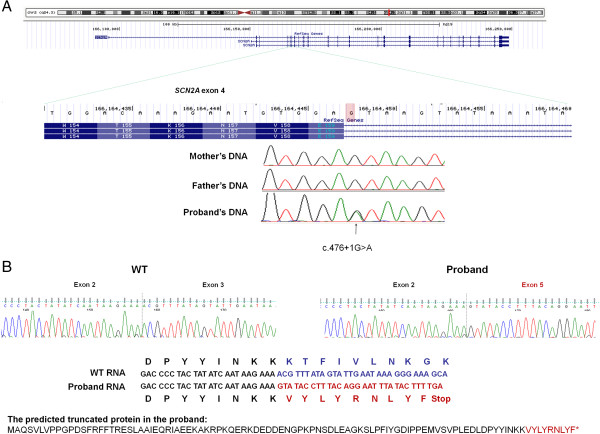
Case presentation: We describe results from clinical and genetic characterizations of a seven-year-old boy with ASD. Psychiatric interview and gold standard autism diagnostic instruments (ADOS and ADI-R) were used to confirm ASD diagnosis, in addition to performing standardized cognitive and adaptive functioning assessments (Leiter-R and Vineland Adaptive Behavior Scale), and sensory reactivity assessments (Sensory Profile and Sensory Processing Scales). Genetic testing by whole exome sequencing revealed four de novo events, including a splice site mutation c.476 + 1G > A in SCN2A, a missense mutation (c.2263G > A) causing a p.V755I change in the TLE1 gene, and two synonymous mutations (c.2943A > G in the BUB1 gene, and c.1254 T > A in C10orf68 gene). The de novo SCN2A splice site mutation produced a stop codon 10 amino acids downstream, possibly resulting in a truncated protein and/or a nonsense-mediated mRNA decay. The participant met new DSM-5 criteria for ASD, presenting with social and communication impairment, repetitive behaviors, and sensory reactivity issues. The participant's adaptive and cognitive skills fell in the low range of functioning.
Conclusion: This report indicates that a splice site mutation in SCN2A might be contributing to the risk of ASD. Describing the specific phenotype associated with SCN2A mutations might help to reduce heterogeneity seen in ASD.
Figures
References
-
- American Psychiatric Association. Diagnostic and statistical manual of mental disorders. 5. Arlington, VA: American Psychiatric Publishing; 2013.
-
- Neale BM, Kou Y, Liu L, Ma'ayan A, Samocha KE, Sabo A, Lin CF, Stevens C, Wang LS, Makarov V, Polak P, Yoon S, Maguire J, Crawford EL, Campbell NG, Geller ET, Valladares O, Schafer C, Liu H, Zhao T, Cai G, Lihm J, Dannenfelser R, Jabado O, Peralta Z, Nagaswamy U, Muzny D, Reid JG, Newsham I, Wu Y. et al. Patterns and rates of exonic de novo mutations in autism spectrum disorders. Nature. 2012;15(7397):242–245. doi: 10.1038/nature11011. - DOI - PMC - PubMed
Publication types
MeSH terms
Substances
Grants and funding
LinkOut - more resources
Full Text Sources
Other Literature Sources
Miscellaneous
