Applying spatial analysis tools in public health: an example using SaTScan to detect geographic targets for colorectal cancer screening interventions
- PMID: 24650619
- PMCID: PMC3965324
- DOI: 10.5888/pcd11.130264
Applying spatial analysis tools in public health: an example using SaTScan to detect geographic targets for colorectal cancer screening interventions
Abstract
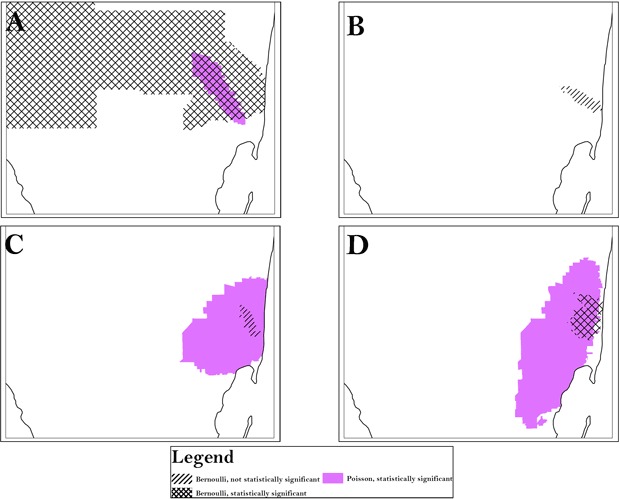
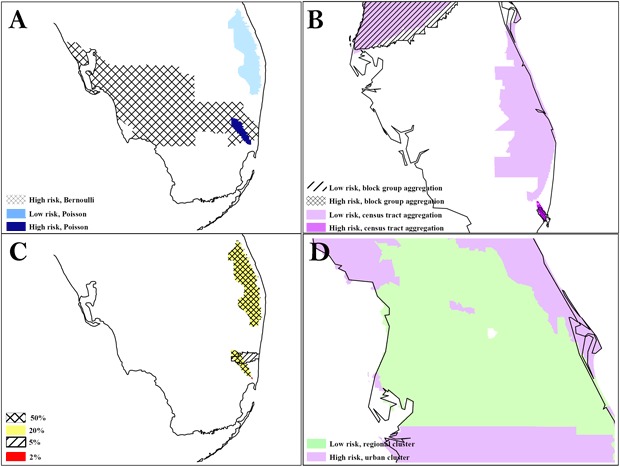
Epidemiologists are gradually incorporating spatial analysis into health-related research as geocoded cases of disease become widely available and health-focused geospatial computer applications are developed. One health-focused application of spatial analysis is cluster detection. Using cluster detection to identify geographic areas with high-risk populations and then screening those populations for disease can improve cancer control. SaTScan is a free cluster-detection software application used by epidemiologists around the world to describe spatial clusters of infectious and chronic disease, as well as disease vectors and risk factors. The objectives of this article are to describe how spatial analysis can be used in cancer control to detect geographic areas in need of colorectal cancer screening intervention, identify issues commonly encountered by SaTScan users, detail how to select the appropriate methods for using SaTScan, and explain how method selection can affect results. As an example, we used various methods to detect areas in Florida where the population is at high risk for late-stage diagnosis of colorectal cancer. We found that much of our analysis was underpowered and that no single method detected all clusters of statistical or public health significance. However, all methods detected 1 area as high risk; this area is potentially a priority area for a screening intervention. Cluster detection can be incorporated into routine public health operations, but the challenge is to identify areas in which the burden of disease can be alleviated through public health intervention. Reliance on SaTScan's default settings does not always produce pertinent results.
Figures
References
-
- Melnick AL. Introduction to geographic information systems in public health. Gaithersburg (MD): Aspen Publishers; 2002.
-
- Tagnon I, Blot WJ, Stroube RB, Day NE, Morris LE, Peace BB, et al. Mesothelioma associated with the shipbuilding industry in coastal Virginia. Cancer Res 1980;40(11):3875–9. - PubMed
Publication types
MeSH terms
Grants and funding
LinkOut - more resources
Full Text Sources
Other Literature Sources
Medical
Research Materials