


Mobile technology for obesity prevention: a randomized pilot study in racial- and ethnic-minority girls
- PMID: 24650843
- PMCID: PMC3962588
- DOI: 10.1016/j.amepre.2013.12.011
Mobile technology for obesity prevention: a randomized pilot study in racial- and ethnic-minority girls
Abstract
Background: Mobile technologies have wide-scale reach and disseminability, but no known studies have examined mobile technologies as a stand-alone tool to improve obesity-related behaviors of at-risk youth.
Purpose: To test a 12-week mobile technology intervention for use and estimate effect sizes for a fully powered trial.
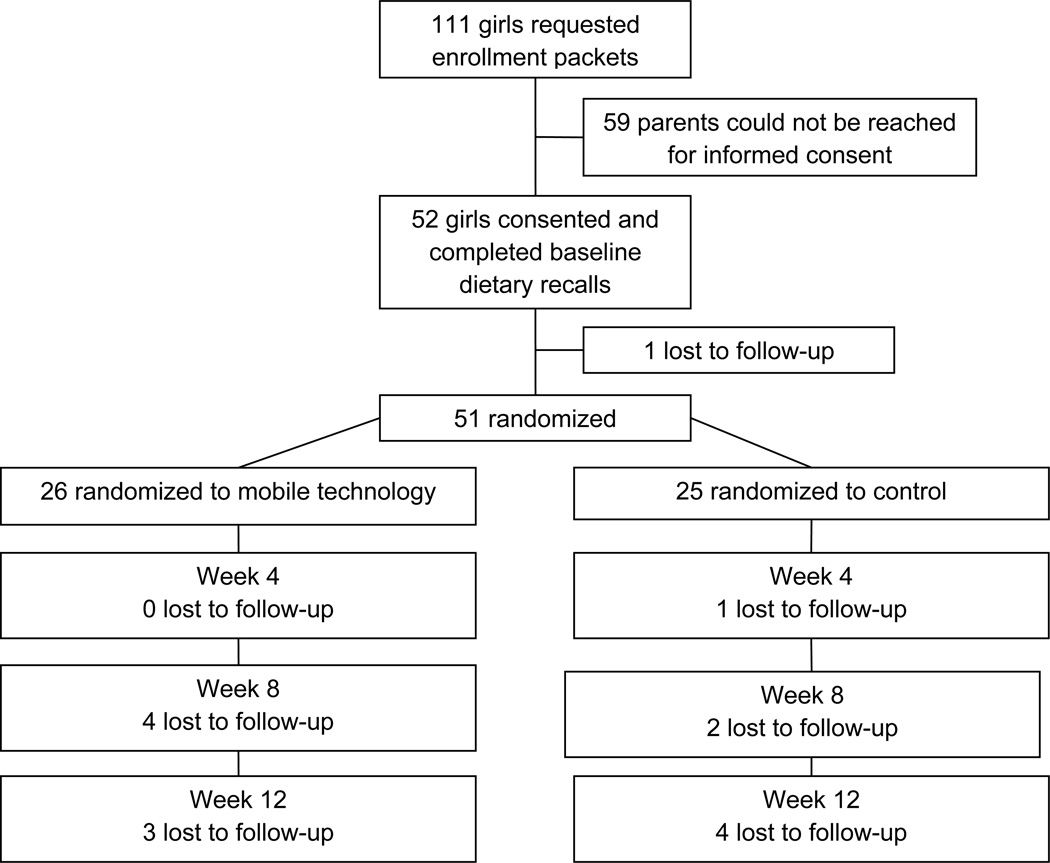
Methods: Fifty-one low-income, racial/ethnic-minority girls aged 9-14 years were randomized to a mobile technology (n=26) or control (n=25) condition. Both conditions lasted 12 weeks and targeted fruits/vegetables (FVs; Weeks 1-4); sugar-sweetened beverages (SSBs; Weeks 5-8), and screen time (Weeks 9-12). The mobile intervention prompted real-time goal setting and self-monitoring and provided tips, feedback, and positive reinforcement related to the target behaviors. Controls received the same content in a written manual but no prompting. Outcomes included device utilization and effect size estimates of FVs, SSBs, screen time, and BMI. Data were collected and analyzed in 2011-2012.
Results: Mobile technology girls used the program on 63% of days and exhibited trends toward increased FVs (+0.88, p=0.08) and decreased SSBs (-0.33, p=0.09). The adjusted difference between groups of 1.0 servings of FVs (p=0.13) and 0.35 servings of SSBs (p=0.25) indicated small to moderate effects of the intervention (Cohen's d=0.44 and -0.34, respectively). No differences were observed for screen time or BMI.
Conclusions: A stand-alone mobile app may produce small to moderate effects for FVs and SSBs. Given the extensive reach of mobile devices, this pilot study demonstrates the need for larger-scale testing of similar programs to address obesity-related behaviors in high-risk youth.
Copyright © 2014 American Journal of Preventive Medicine. Published by Elsevier Inc. All rights reserved.
References
-
- Singh GK, Siahpush M, Kogan MD. Rising social inequalities in U.S. childhood obesity, 2003–2007. Ann Epidemiol. 2010;20(1):40–52. - PubMed
-
- Kesten JM, Griffiths PL, Cameron N. A systematic review to determine the effectiveness of interventions designed to prevent overweight and obesity in pre-adolescent girls. Obes Rev. 2011;12(12):997–1021. - PubMed
-
- Lenhart A. Teens, smartphones, and texting. Washington DC: Pew Internet & American Life Project; 2012. www.pewinternet.org/Reports/2012/Teens-and-smartphones.aspx.
Publication types
MeSH terms
Grants and funding
LinkOut - more resources
Full Text Sources
Other Literature Sources
Medical
