


Kappa free light chains: diagnostic and prognostic relevance in MS and CIS
- PMID: 24651567
- PMCID: PMC3940961
- DOI: 10.1371/journal.pone.0089945
Kappa free light chains: diagnostic and prognostic relevance in MS and CIS
Abstract
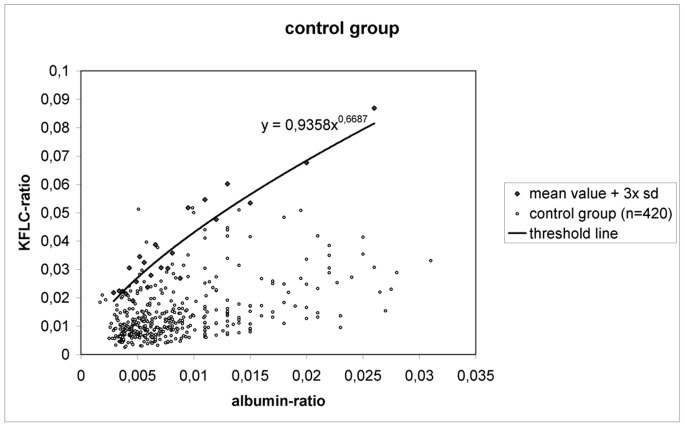
Background: Quantification of kappa free light chains (KFLC) in cerebrospinal fluid shows high diagnostic sensitivity in multiple sclerosis and clinically isolated syndrome patients. However, a clearly defined threshold value is still missing and a possible prognostic value of the KFLC levels in these patients remains undefined.
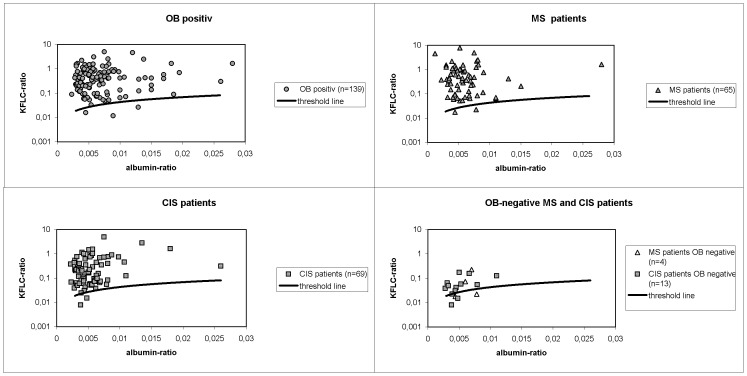
Methods: Results of KFLC quantification in 420 controls were used to set an upper limit of normal KFLC concentration in CSF under different blood-CSF-barrier conditions. Additionally, KFLC values of MS and CIS patients were assessed and results were evaluated with reference to the patients corresponding disease courses.
Results: The calculated upper limit of normal KFLC-concentration covers 98% of these control patients. Using this cut-off, plasma cell activity in CSF can be detected in 97% of MS patients and in 97% of CIS patients. However, there is no evidence that the extent of KFLC elevation provides prognostic value in MS and CIS patients in this study.
Conclusion: KFLC determination should become a first line screen in the diagnostic algorithms of MS and CIS. The extent of elevation of intrathecal KFLC has no prognostic value on the disease course in MS and CIS patients.
Conflict of interest statement
Figures
References
-
- Tintore M, Rovira A, Rio J, Tur C, Pelayo R, et al. (2008) Do oligoclonal bands add information to MRI in first attacks of multiple sclerosis? Neurology 70: 1079–1083. - PubMed
-
- Zipoli V, Hakiki B, Portaccio E, Lolli F, Siracusa G, et al. (2009) The contribution of cerebrospinal fluid oligoclonal bands to the early diagnosis of multiple sclerosis. Mult Scler 15: 472–478. - PubMed
-
- Schaffler N, Kopke S, Winkler L, Schippling S, Inglese M, et al. (2011) Accuracy of diagnostic tests in multiple sclerosis–a systematic review. Acta Neurol Scand 124: 151–164. - PubMed
-
- Polman CH, Reingold SC, Edan G, Filippi M, Hartung HP, et al. (2005) Diagnostic criteria for multiple sclerosis: 2005 revisions to the “McDonald Criteria”. Ann Neurol 58: 840–846. - PubMed
-
- Reiber H, Ungefehr S, Jacobi C (1998) The intrathecal, polyspecific and oligoclonal immune response in multiple sclerosis. Mult Scler 4: 111–117. - PubMed
MeSH terms
Substances
LinkOut - more resources
Full Text Sources
Other Literature Sources
Medical
