. 2014 Mar 20;10(3):e1004208.
doi: 10.1371/journal.pgen.1004208. eCollection 2014 Mar.

Validation and genotyping of multiple human polymorphic inversions mediated by inverted repeats reveals a high degree of recurrence

Affiliations

Validation and genotyping of multiple human polymorphic inversions mediated by inverted repeats reveals a high degree of recurrence

Cristina Aguado et al. PLoS Genet. .

Abstract

In recent years different types of structural variants (SVs) have been discovered in the human genome and their functional impact has become increasingly clear. Inversions, however, are poorly characterized and more difficult to study, especially those mediated by inverted repeats or segmental duplications. Here, we describe the results of a simple and fast inverse PCR (iPCR) protocol for high-throughput genotyping of a wide variety of inversions using a small amount of DNA. In particular, we analyzed 22 inversions predicted in humans ranging from 5.1 kb to 226 kb and mediated by inverted repeat sequences of 1.6-24 kb. First, we validated 17 of the 22 inversions in a panel of nine HapMap individuals from different populations, and we genotyped them in 68 additional individuals of European origin, with correct genetic transmission in ∼ 12 mother-father-child trios. Global inversion minor allele frequency varied between 1% and 49% and inversion genotypes were consistent with Hardy-Weinberg equilibrium. By analyzing the nucleotide variation and the haplotypes in these regions, we found that only four inversions have linked tag-SNPs and that in many cases there are multiple shared SNPs between standard and inverted chromosomes, suggesting an unexpected high degree of inversion recurrence during human evolution. iPCR was also used to check 16 of these inversions in four chimpanzees and two gorillas, and 10 showed both orientations either within or between species, providing additional support for their multiple origin. Finally, we have identified several inversions that include genes in the inverted or breakpoint regions, and at least one disrupts a potential coding gene. Thus, these results represent a significant advance in our understanding of inversion polymorphism in human populations and challenge the common view of a single origin of inversions, with important implications for inversion analysis in SNP-based studies.


Conflict of interest statement

The authors have declared that no competing interests exist.

Figures
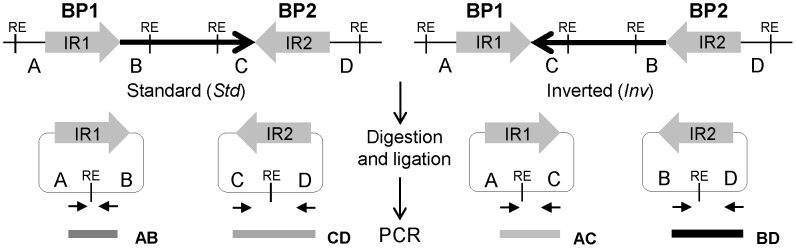
Figure 1
Figure 1. Diagram of iPCR validation of inversions mediated by inverted repeats (IRs).
Standard and inverted arrangements are represented by unique regions A, B, C and D, which are separated by IR1 and IR2 at each inversion breakpoint (BP). The iPCR involves three steps: digestion at the restriction enzyme target sites (RE), circularization of the digested fragments by self-ligation, and PCR amplification with primers (small arrows) flanking the restriction site to generate products of different size depending on the orientation of the segment between both repeats.
Figure 2
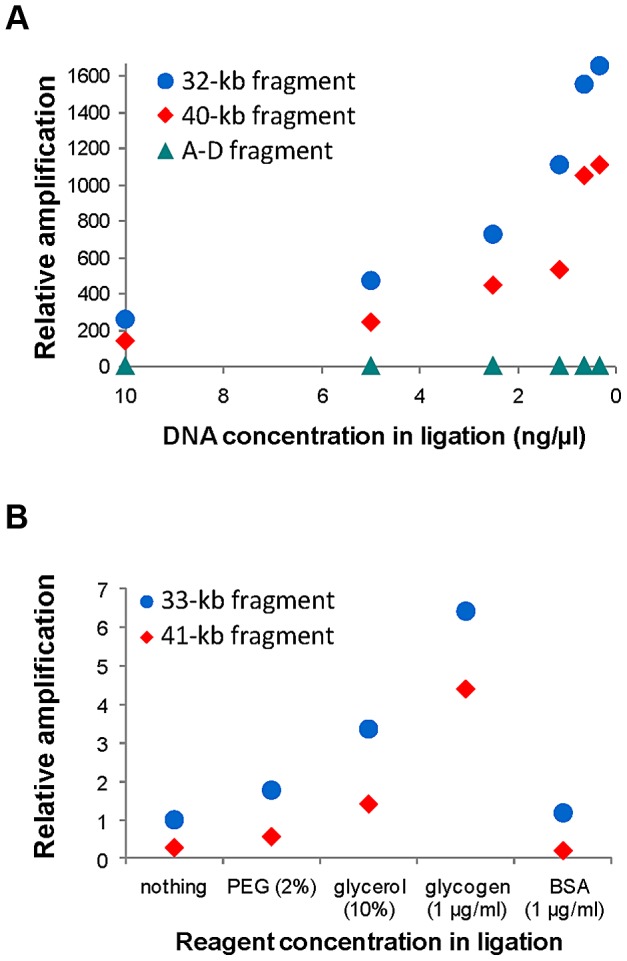
Figure 2. Quantification of self-ligation efficiency in iPCR with different DNA dilutions and different reagents.
A. Effect of DNA dilution during ligation on iPCR amplification of staggered-end fragments from HsInv0340 of 32 kb (AB) and 40 kb (BD) and the A–D concatamer. B. Effect of different reagent concentrations during ligation on iPCR amplification of blunt-end fragments from HsInv0286 of 33 kb (BD) and 41 kb (AB). The A–D fragment with 10 ng/µl of DNA and the 41 kb fragment with no additional reagent were selected as reference to calculate the relative amplification in A and B, respectively. NA18517 DNA that is heterozygous for both inversions was used in the analysis.
Figure 3
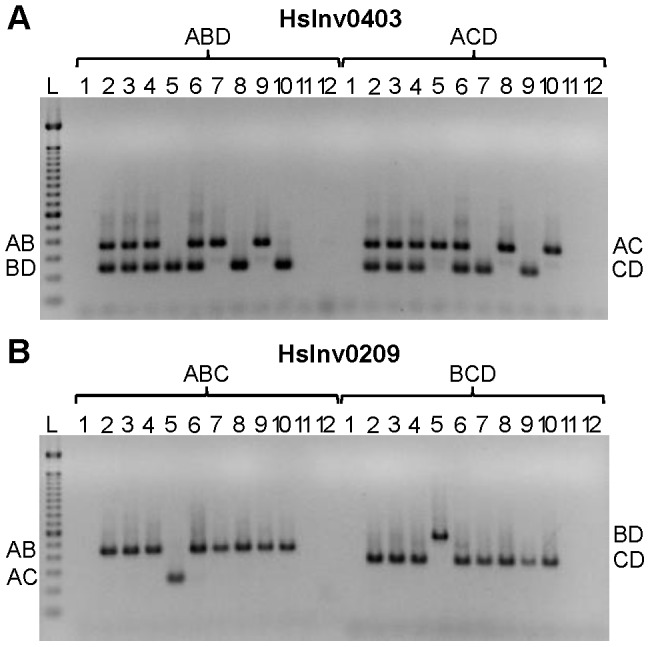
Figure 3. Multiplex iPCR results of two validated inversions in nine human samples.
A. HsInv0403 ABD and ACD iPCRs. Band sizes are: AB, 364 bp; BD, 239 bp; AC, 350 bp; CD, 225 bp; and AD, 265 bp. B. HsInv0209 ABC and BCD iPCRs. Band sizes are AB, 435 bp; AC, 243 bp; BD, 543 bp; CD, 351 bp; and BC, 470 bp. For both panels the genomic DNA samples are: 1, negative control; 2, NA12156; 3, NA12878; 4, NA15510; 5, NA18507; 6, NA18517; 7, NA18555; 8, NA18956; 9, NA19129; 10, NA19240; 11, DNA without restriction enzyme; 12, DNA without T4 DNA ligase; and L, 100 bp DNA Ladder (Invitrogen).
Figure 4
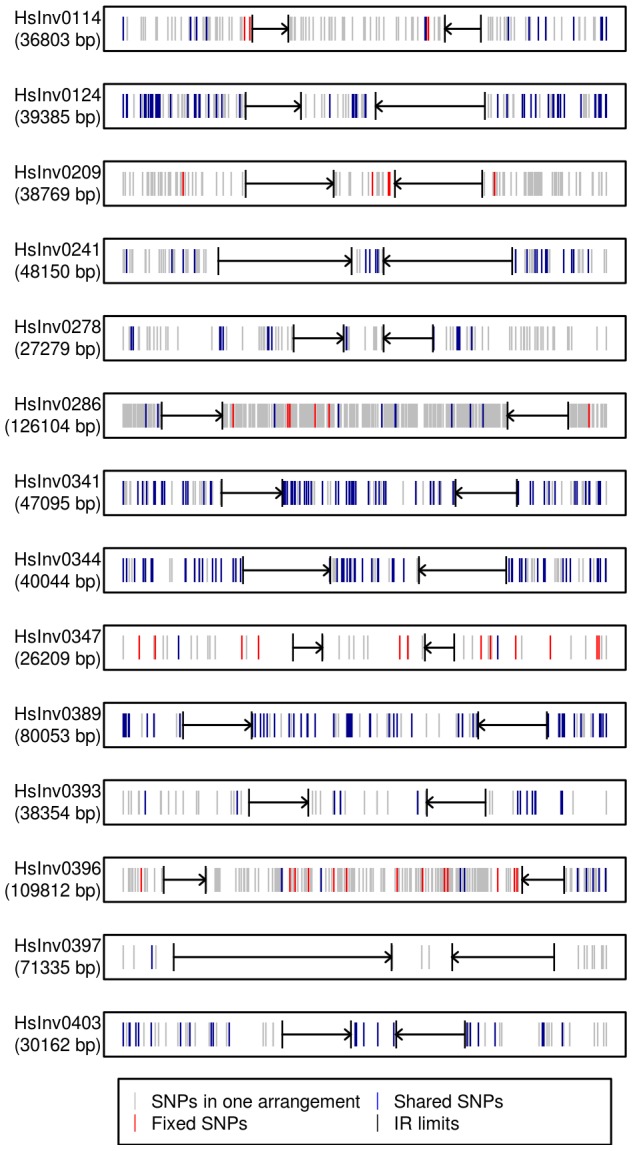
Figure 4. Distribution of SNPs along 14 polymorphic inversions in CEU individuals.
SNP distribution was calculated according to the haplotypes inferred from the 1000 Genomes Project data by PHASE. Both the inverted region and 10(indicated by black arrows) are represented. Polymorphic SNPs in the Std or Inv arrangement are shown in grey, fixed SNPs between arrangements are shown in red, and shared SNPs between arrangements are shown in blue.
Figure 5
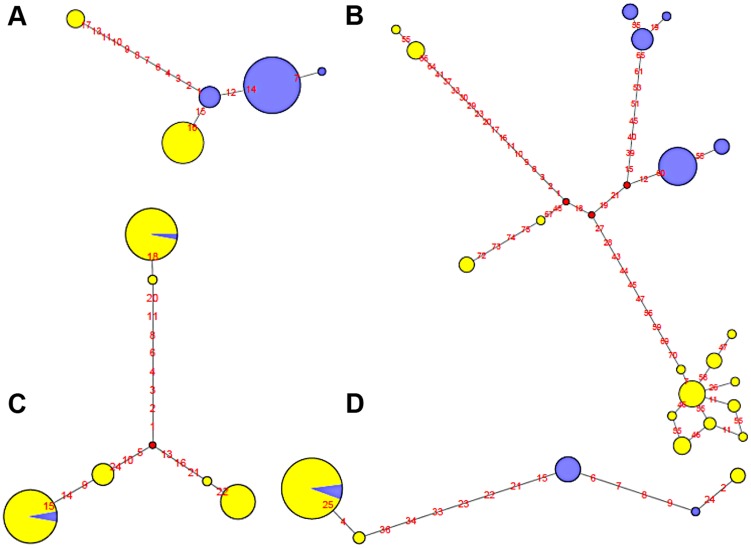
Figure 5. Haplotype network of four human polymorphic inversions from phased HapMap SNP data showing unique or recurrent origins.
A. HsInv0114. B. HsInv0286. C. HsInv0341. D. HsInv0389. Circles correspond to the different haplotypes found for the region of the inversion and circle sizes are proportional to the frequency of each haplotype. Std and Inv haplotypes are represented in yellow and blue, respectively. Small red circles represent hypothetical haplotypes. Nucleotide changes between haplotypes are indicated as red numbers.

References

    1. Conrad DF, Pinto D, Redon R, Feuk L, Gokcumen O, et al. (2010) Origins and functional impact of copy number variation in the human genome. Nature 464: 704–712. - PMC - PubMed
    1. Cooper GM, Coe BP, Girirajan S, Rosenfeld JA, Vu TH, et al. (2011) A copy number variation morbidity map of developmental delay. Nat Genet 43: 838–846. - PMC - PubMed
    1. Craddock N, Hurles ME, Cardin N, Pearson RD, Plagnol V, et al. (2010) Genome-wide association study of CNVs in 16,000 cases of eight common diseases and 3,000 shared controls. Nature 464: 713–720. - PMC - PubMed
    1. Feuk L (2010) Inversion variants in the human genome: role in disease and genome architecture. Genome Med 2: 11. - PMC - PubMed
    1. Hoffmann AA, Rieseberg LH (2008) Revisiting the impact of inversions in evolution: From population genetic markers to drivers of adaptive shifts and speciation? Annu Rev Ecol Evol Syst 39: 21–42. - PMC - PubMed

Publication types

LinkOut - more resources