Review
. 2014 Feb;47(3):179-91.
doi: 10.1590/1414-431X20133063. Epub 2014 Mar 3.

From Escherichia coli heat-stable enterotoxin to mammalian endogenous guanylin hormones

Affiliations
Review

From Escherichia coli heat-stable enterotoxin to mammalian endogenous guanylin hormones

A A M Lima et al. Braz J Med Biol Res. 2014 Feb.

Abstract

The isolation of heat-stable enterotoxin (STa) from Escherichia coli and cholera toxin from Vibrio cholerae has increased our knowledge of specific mechanisms of action that could be used as pharmacological tools to understand the guanylyl cyclase-C and the adenylyl cyclase enzymatic systems. These discoveries have also been instrumental in increasing our understanding of the basic mechanisms that control the electrolyte and water balance in the gut, kidney, and urinary tracts under normal conditions and in disease. Herein, we review the evolution of genes of the guanylin family and STa genes from bacteria to fish and mammals. We also describe new developments and perspectives regarding these novel bacterial compounds and peptide hormones that act in electrolyte and water balance. The available data point toward new therapeutic perspectives for pathological features such as functional gastrointestinal disorders associated with constipation, colorectal cancer, cystic fibrosis, asthma, hypertension, gastrointestinal barrier function damage associated with enteropathy, enteric infection, malnutrition, satiety, food preferences, obesity, metabolic syndrome, and effects on behavior and brain disorders such as attention deficit, hyperactivity disorder, and schizophrenia.


Figures
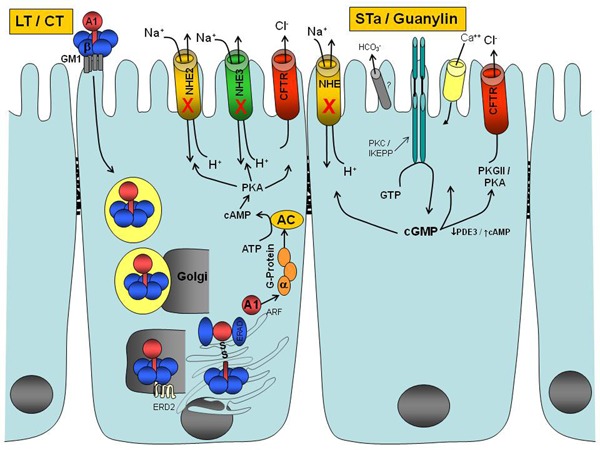
Figure 1
Figure 1. Mechanisms of action of the cholera toxin (CT), heat-labile (LT) and heat-stable enterotoxin (STa) from Escherichia coli, and endogenous peptide ligands of guanylyl cyclase C (GC-C). CT or LT binds to the monosialoganglioside GM1 receptor at the host mucosa surface and triggers endocytosis of the holotoxin. The A1 domain of the A subunit is transported through the Golgi complex and endoplasmic reticulum to activate the Gsα subunit of G-protein. This A1 domain interacts with ADP-ribosylating factors to ADP-ribosylate this Gsα subunit in order to activate G-protein and consequently adenylyl cyclase (AC). The AC cleaves ATP to cAMP and subsequently activates protein kinase A, which inhibits NaCl absorption (NHE transporters) and increases chloride secretion through the cystic fibrosis transmembrane regulator (CFTR). Peptide ligands of the extracellular domain of GC-C activate the intracellular catalytic domain of GC-C resulting in cGMP formation, which activates several pathways: a) inhibition of the NHE3 transporter, which decreases NaCl absorption; b) activation of CFTR, which leads to secretion of chloride; and c) increased calcium influx.
Figure 2
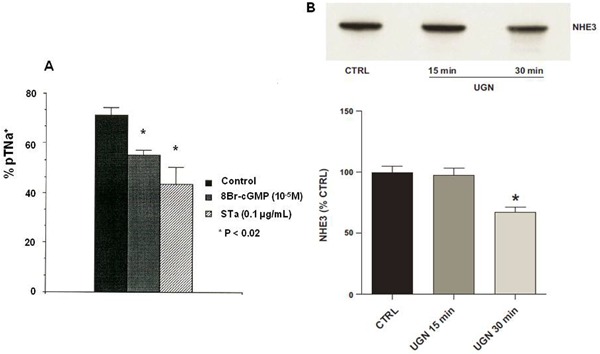
Figure 2. Effect of heat-stable enterotoxin (STa) from Escherichia coli and endogenous uroguanylin (UGN) mammalian peptide ligand of guanylyl cyclase C on net sodium balance in the kidney. Panel A shows the decreased effect of STa and 8Br-cGMP on proximal sodium tubule transport (pTNa+) in isolated perfused rat kidney (reproduced from Ref. 4, with permission). Panel B also shows the reduced effect of UGN on sodium proton transporter NHE3 in renal proximal tubules, as well as the surface NHE3 expression in proximal tubule cells in culture (reproduced from Ref. 69, with permission). CTRL: control. *P<0.05, compared to UGN 15 min and control (Bonferoni test).
Figure 3
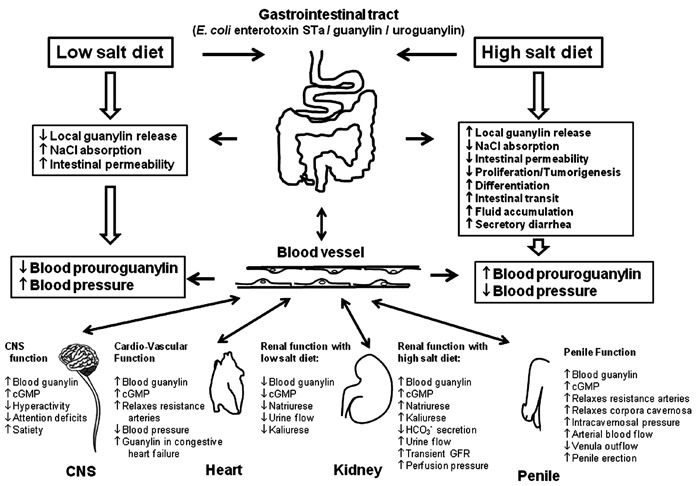
Figure 3. Major physiological functions associated with the heat-stable enterotoxin (Sta) from Escherichia coli, guanylin, and uroguanylin in guanylate cyclase C (GC-C) signaling pathways. GC-C is expressed on the surface of the intestinal epithelial cells where it is activated by the STa enterotoxin from E. coli and by the endogenous hormones guanylin and uroguanylin. These endogenous hormones are synthesized in the intestine and secreted into the lumen and blood circulation. GC-C is also a receptor for these peptides that activates the catalytic portion of this protein, resulting in the conversion of guanosine triphosphate to cyclic-guanosine-3′,5′-monophosphate (cGMP). Increased cGMP concentration activates protein kinase GII, which phosphorylates and activates the cystic fibrosis transmembrane conductance regulator, leading to chloride/bicarbonate secretion. In addition, cGMP inhibits the sodium-hydrogen exchanger NHE3, decreasing sodium absorption. Local intestinal secretion of guanylin and uroguanylin co-regulates via GC-C signaling the homeostasis of the crypt-villus axis as well as intestinal barrier function and mechanisms underlying colorectal cancer. High or low salt diets co-regulate local intestinal secretion or systemic circulation of these endogenous hormones, which results in electrolyte and water homeostasis influenced by their effects on the gastrointestinal and urinary tracts. The blood circulation of guanylin and uroguanylin alters the functions of several other systems such as the central nervous system (CNS), cardiovascular system, kidney function, and penile function (see text for further details).
Figure 4
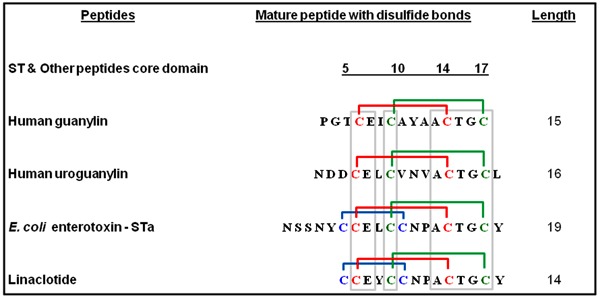
Figure 4. Primary peptide structures of human guanylin and uroguanylin, Escherichia coli heat-stable enterotoxin (STa) and linaclotide. The lines connect the disulfide bonds between the cysteine residues. Note that two disulfide bonds are formed in the active conformation of human guanylin and uroguanylin and three disulfide bonds formed the active conformation of STa enterotoxin and linaclotide. The conservative peptide core domains with identical amino acids are marked by boxes.

References

    1. WHO. Future directions for research on enterotoxigenic Escherichia coli vaccines for developing countries. Wkly Epidemiol Rec. 2006;81:97–104. - PubMed
    1. Lima AAM. Estudo dos efeitos das toxinas do V. cholerae e E. coli no rim isolado do rato. Pharmacology, Federal University of Ceará; 1983. [Master's degree]
    1. Fonteles MC, Lima AAM. Efeitos das toxinas do V. cholerae e E. coli no rim perfundido; XVII Congresso Brasileiro de Fisiologia; 1983. 46
    1. Lima AA, Monteiro HS, Fonteles MC. The effects of Escherichia coli heat-stable enterotoxin in renal sodium tubular transport. Pharmacol Toxicol. 1992;70:163–167. doi: 10.1111/j.1600-0773.1992.tb00449.x. - DOI - PubMed
    1. Fonteles MC, Lima AAM, Fang G, Guerrant RL. Effect of STa and Cholera toxin on renal electrolyte transport: possible roles of endogenous ST-like compound in the isolated kidney. Twenty-Seventh Joint Conference on Cholera and Related Diarrheal Diseases. 1991:100–105.

Publication types

MeSH terms