


Dental health status among sensory impaired and blind institutionalized children aged 6 to 20 years
- PMID: 24653604
- PMCID: PMC3959138
Dental health status among sensory impaired and blind institutionalized children aged 6 to 20 years
Abstract
Background: This study was planned to assess the dental caries status among disabled children as dental health is an integral part of general body health and this group is deprived of health care needs.
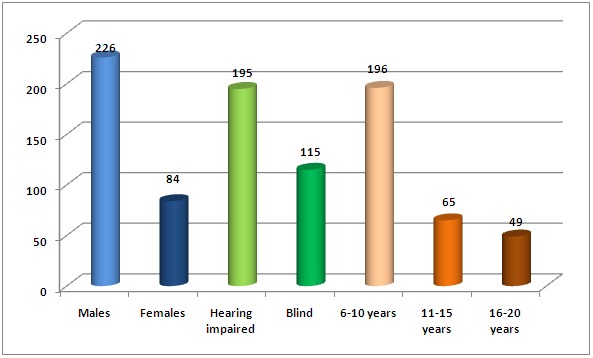
Materials & methods: A sample of 310 disabled children was gathered including 195- Hearing impaired, 115 - blind. Of which 226 were males and 84 were females. A study questionnaire was prepared to include demographic information and WHO oral health assessment form (1997) to record dental caries status.Data was analysed using student's test and ANOVA test was used at p≤0.05.
Results: The overall mean for DMFT scores for males and females was 2.11 (1.753) and 1.75 (1.275) respectively. Similarly overall mean for dft was 0.31 (0.254) for males and 0.27 (0.143) for females. Mean DMFT of blind students was more as compared to hearing impaired ones as 2.16 (2.005) and 1.80 (1.264) respectively. Age factor showed a significant increase in the mean DMFT scores with advancing age at p ≤ 0.001.
Conclusion: Overall mean scores of caries was very high and it increased with increasing age. Blind children experienced more caries then hearing impaired children in permanent, whereas it was opposite in primary dentition. So there is urgent need of both comprehensive and incremental dental care for this subgroup of population. How to cite the article: Sanjay V, Shetty SM, Shetty RG, Managoli NA, Gugawad SC, Hitesh D. Dental health status among sensory impaired and blind institutionalized children aged 6 to 20 years. J Int Oral Health 2014;6(1):55-8.
Keywords: Blind; dental caries; hearing impaired children.
Conflict of interest statement
Conflict of Interest: None
Figures
References
-
- M Jain, A Mathur, S Kumar, RJ Dagli, P Duraiswamy, S Kulkarni. Dentition status and treatment needs among children with impaired hearing attending a special school for the deaf and mute in Udaipur, India. J Oral Sci. 2008;50(2):161–165. - PubMed
-
- N Chi, K Yang. A study on the dental disease of the handicapped. J Dent Child. 2003;70:153–158. - PubMed
-
- WE Mouradian. The face of a child: children’s oral health and dental education. J Dent Educ. 2001;65(9):821–831. - PubMed
-
- J Fiske, DM Davis, C Frances, S Gelbier. The emotional effects of tooth loss in edentulous people. Br Dent J. 1998;184:90–93. - PubMed
LinkOut - more resources
Full Text Sources