


Androgen receptor (AR) pathophysiological roles in androgen-related diseases in skin, bone/muscle, metabolic syndrome and neuron/immune systems: lessons learned from mice lacking AR in specific cells
- PMID: 24653668
- PMCID: PMC3960937
- DOI: 10.1621/nrs.11001
Androgen receptor (AR) pathophysiological roles in androgen-related diseases in skin, bone/muscle, metabolic syndrome and neuron/immune systems: lessons learned from mice lacking AR in specific cells
Abstract
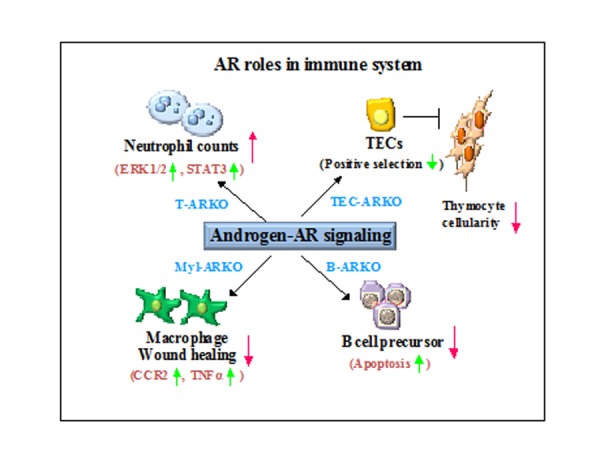
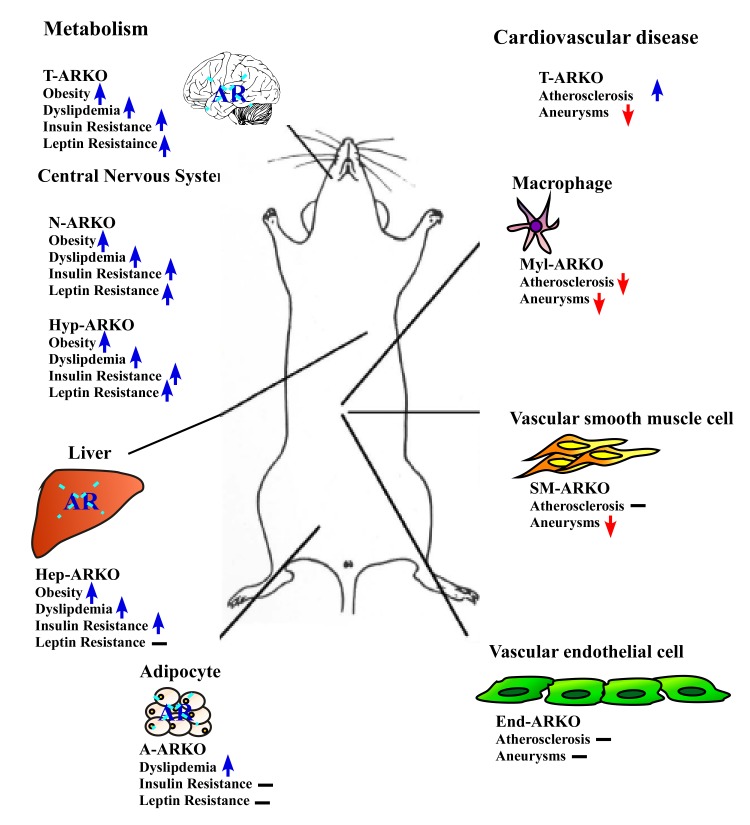
The androgen receptor (AR) is expressed ubiquitously and plays a variety of roles in a vast number of physiological and pathophysiological processes. Recent studies of AR knockout (ARKO) mouse models, particularly the cell type- or tissue-specific ARKO models, have uncovered many AR cell type- or tissue-specific pathophysiological roles in mice, which otherwise would not be delineated from conventional castration and androgen insensitivity syndrome studies. Thus, the AR in various specific cell types plays pivotal roles in production and maturation of immune cells, bone mineralization, and muscle growth. In metabolism, the ARs in brain, particularly in the hypothalamus, and the liver appear to participate in regulation of insulin sensitivity and glucose homeostasis. The AR also plays key roles in cutaneous wound healing and cardiovascular diseases, including atherosclerosis and abdominal aortic aneurysm. This article will discuss the results obtained from the total, cell type-, or tissue-specific ARKO models. The understanding of AR cell type- or tissue-specific physiological and pathophysiological roles using these in vivo mouse models will provide useful information in uncovering AR roles in humans and eventually help us to develop better therapies via targeting the AR or its downstream signaling molecules to combat androgen/AR-related diseases.
Figures
References
-
- Accili D. Lilly lecture 2003: the struggle for mastery in insulin action: from triumvirate to republic. Diabetes. 2004;53:1633–42. - PubMed
-
- Albertelli M. A., Scheller A., Brogley M., Robins D. M. Replacing the mouse androgen receptor with human alleles demonstrates glutamine tract length-dependent effects on physiology and tumorigenesis in mice. Mol Endocrinol. 2006;20:1248–60. - PubMed
-
- Albright F. The effect of hormones on osteogenesis in man. Recent Prog Horm Res. 1947;1:293–353. - PubMed
-
- Almeida M., Han L., Martin-Millan M., Plotkin L. I., Stewart S. A., Roberson P. K., Kousteni S., O'Brien C. A., Bellido T., Parfitt A. M., Weinstein R. S., Jilka R. L., Manolagas S. C. Skeletal involution by age-associated oxidative stress and its acceleration by loss of sex steroids. J Biol Chem. 2007;282:27285–97. - PMC - PubMed
Publication types
MeSH terms
Substances
Grants and funding
LinkOut - more resources
Full Text Sources
Other Literature Sources
Research Materials
