


Human immunodeficiency virus and nodular regenerative hyperplasia of liver: A systematic review
- PMID: 24653794
- PMCID: PMC3953810
- DOI: 10.4254/wjh.v6.i1.55
Human immunodeficiency virus and nodular regenerative hyperplasia of liver: A systematic review
Abstract
Aim: To investigate the diagnosis, pathogenesis, natural history, and management of nodular regenerative hyperplasia (NRH) in patients with human immunodeficiency virus (HIV).
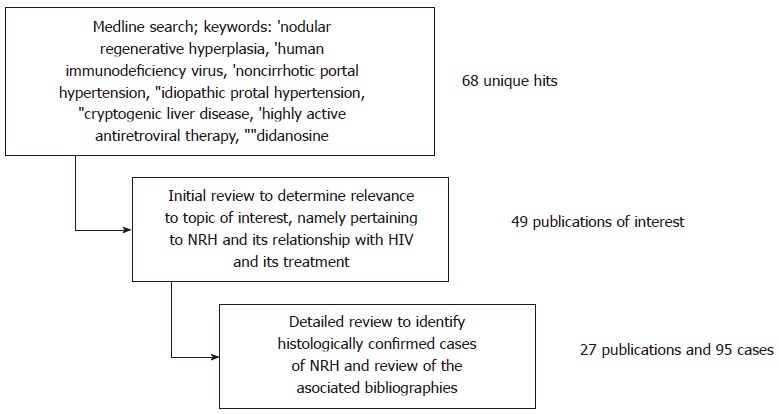
Methods: We performed a systematic review of the medical literature regarding NRH in patients with HIV. Inclusion criteria include reports with biopsy proven NRH. We studied the clinical features of NRH, in particular, related to its presenting manifestation and laboratory values. Combinations of the following keywords were implemented: "nodular regenerative hyperplasia", "human immunodeficiency virus", "noncirrhotic portal hypertension", "idiopathic portal hypertension", "cryptogenic liver disease", "highly active antiretroviral therapy" and "didanosine". The bibliographies of these studies were subsequently searched for any additional relevant publications.
Results: The clinical presentation of patients with NRH varies from patients being completely asymptomatic to the development of portal hypertension - namely esophageal variceal bleeding and ascites. Liver associated enzymes are generally normal and synthetic function well preserved. There is a strong association between the occurrence of NRH and the use of antiviral therapies such as didanosine. The management of NRH revolves around treating the manifestations of portal hypertension. The prognosis of NRH is generally good since liver function is preserved. A high index of suspicion is required to make a identify NRH.
Conclusion: The appropriate management of HIV-infected persons with suspected NRH is yet to be outlined. However, NRH is a clinically subtle condition that is difficult to diagnose, and it is important to be able to manage it according to the best available evidence.
Keywords: Ascites; Human immunodeficiency virus; Liver complications; Nodular regenerative hyperplasia; Systematic review.
Figures
References
-
- Wanless IR. Micronodular transformation (nodular regenerative hyperplasia) of the liver: a report of 64 cases among 2,500 autopsies and a new classification of benign hepatocellular nodules. Hepatology. 1990;11:787–797. - PubMed
-
- Chang PE, Miquel R, Blanco JL, Laguno M, Bruguera M, Abraldes JG, Bosch J, Garcia-Pagan JC. Idiopathic portal hypertension in patients with HIV infection treated with highly active antiretroviral therapy. Am J Gastroenterol. 2009;104:1707–1714. - PubMed
-
- Shimamatsu K, Wanless IR. Role of ischemia in causing apoptosis, atrophy, and nodular hyperplasia in human liver. Hepatology. 1997;26:343–350. - PubMed
-
- Mallet V, Blanchard P, Verkarre V, Vallet-Pichard A, Fontaine H, Lascoux-Combe C, Pol S. Nodular regenerative hyperplasia is a new cause of chronic liver disease in HIV-infected patients. AIDS. 2007;21:187–192. - PubMed
Publication types
LinkOut - more resources
Full Text Sources
Other Literature Sources
