Superior canal dehiscence patients have smaller mastoid volume than age- and sex-matched otosclerosis and temporal bone fracture patients
- PMID: 24653885
- PMCID: PMC3936659
- DOI: 10.7874/kja.2012.16.3.120
Superior canal dehiscence patients have smaller mastoid volume than age- and sex-matched otosclerosis and temporal bone fracture patients
Abstract
Background and objectives: The purpose of the study was to compare the mastoid air-cell volume of the patients with superior semicircular canal dehiscence syndrome (SCDS) and that of the control patients with otosclerosis and temporal bone (TB) fracture.
Subjects and methods: Ten patients with SCDS were enrolled and 10 patients with bilateral otosclerosis and TB fracture were selected as control groups by age and sex matching. To measure the mastoid air-cell volume, 3D reconstruction software was used.
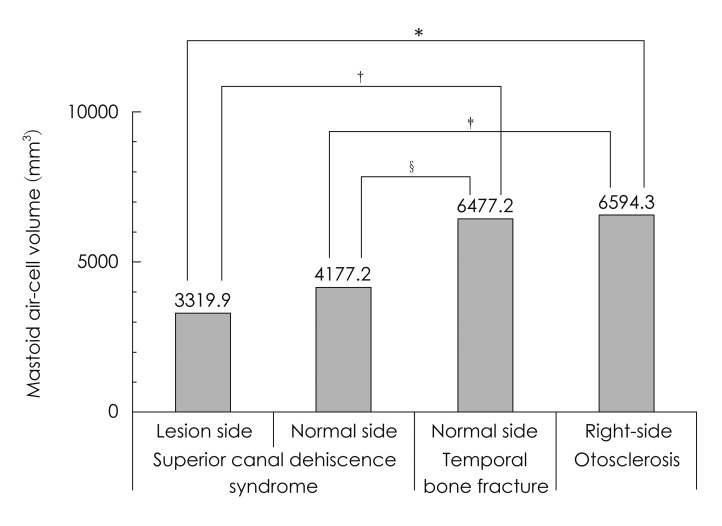
Results: In 10 patients with SCDS, the mean age was 44.5 years, ranging from 16 to 79 years (M : F=4 : 6). Mean mastoid air-cell volume in the SCDS side was 3319.9 mm(3), whereas 4177.2 mm(3) in the normal side (p=0.022). Mean mastoid air-cell volume in the right side of otosclerosis patients was 6594.3 mm(3) and it was not different from 6380.5 mm(3) in the left side (p=0.445). Mean mastoid air-cell volume in normal side of TB fracture was 6477.2 mm(3). The mastoid air-cell volume in the SCDS side was significantly smaller than that of otosclerosis and TB fracture patients (p=0.009, p=0.002, respectively). The mastoid air-cell volume in the normal side of SCDS was significantly smaller than that of TB fracture (p=0.019), but not significant with that of otosclerosis (p=0.063).
Conclusions: Our findings revealed that the mastoid air-cell volume in the SCDS side was significantly smaller than control group, which suggest that the decreased mastoid pneumatization is closely related to the generation of SCDS.
Keywords: Computed tomography; Dehiscence; Mastoid; Radiology; Semicircular canals.
Figures

References
-
- Minor LB, Solomon D, Zinreich JS, Zee DS. Sound- and/or pressure-induced vertigo due to bone dehiscence of the superior semicircular canal. Arch Otolaryngol Head Neck Surg. 1998;124:249–258. - PubMed
-
- Minor LB. Clinical manifestations of superior semicircular canal dehiscence. Laryngoscope. 2005;115:1717–1727. - PubMed
-
- Mikulec AA, McKenna MJ, Ramsey MJ, Rosowski JJ, Herrmann BS, Rauch SD, et al. Superior semicircular canal dehiscence presenting as conductive hearing loss without vertigo. Otol Neurotol. 2004;25:121–129. - PubMed
-
- Cremer PD, Minor LB, Carey JP, Della Santina CC. Eye movements in patients with superior canal dehiscence syndrome align with the abnormal canal. Neurology. 2000;55:1833–1841. - PubMed
-
- Friedland DR, Michel MA. Cranial thickness in superior canal dehiscence syndrome: implications for canal resurfacing surgery. Otol Neurotol. 2006;27:346–354. - PubMed
LinkOut - more resources
Full Text Sources