


The broader autism phenotype in infancy: when does it emerge?
- PMID: 24655649
- PMCID: PMC3989934
- DOI: 10.1016/j.jaac.2013.12.020
The broader autism phenotype in infancy: when does it emerge?
Abstract
Objective: This study had 3 goals, which were to examine the following: the frequency of atypical development, consistent with the broader autism phenotype, in high-risk infant siblings of children with autism spectrum disorder (ASD); the age at which atypical development is first evident; and which developmental domains are affected.
Method: A prospective longitudinal design was used to compare 294 high-risk infants and 116 low-risk infants. Participants were tested at 6, 12, 18, 24, and 36 months of age. At the final visit, outcome was classified as ASD, Typical Development (TD), or Non-TD (defined as elevated Autism Diagnostic Observation Schedule [ADOS] score, low Mullen Scale scores, or both).
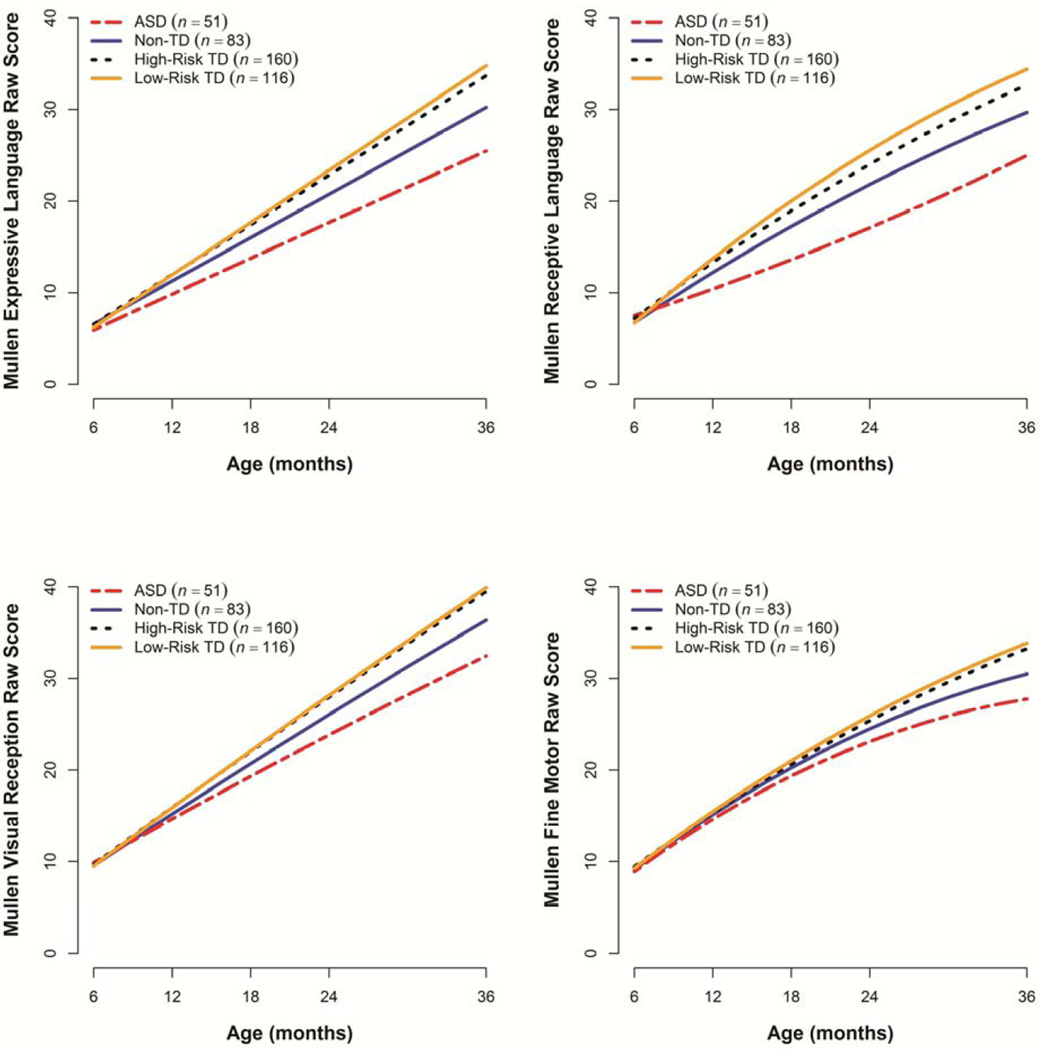
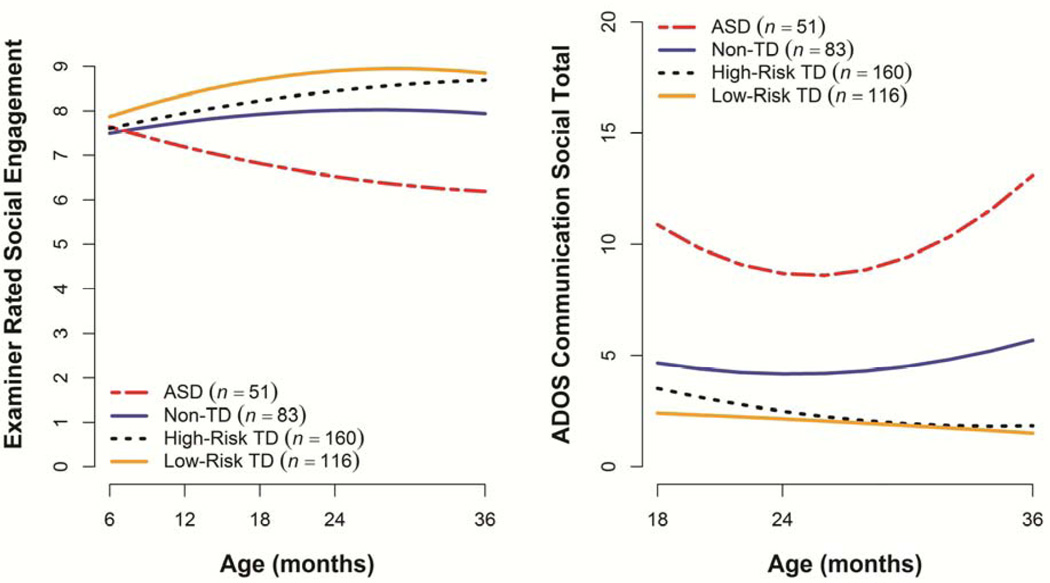
Results: Of the high-risk group, 28% were classified as Non-TD at 36 months of age. Growth curve models demonstrated that the Non-TD group could not be distinguished from the other groups at 6 months of age, but differed significantly from the Low-Risk TD group by 12 months on multiple measures. The Non-TD group demonstrated atypical development in cognitive, motor, language, and social domains, with differences particularly prominent in the social-communication domain.
Conclusions: These results demonstrate that features of atypical development, consistent with the broader autism phenotype, are detectable by the first birthday and affect development in multiple domains. This highlights the necessity for close developmental surveillance of infant siblings of children with ASD, along with implementation of appropriate interventions as needed.
Keywords: autism spectrum disorder; broader autism phenotype; infancy; siblings; social-communication.
Copyright © 2014 American Academy of Child and Adolescent Psychiatry. Published by Elsevier Inc. All rights reserved.
Conflict of interest statement
Disclosure: Drs. Ozonoff, Young, Hutman, Johnson, Miller, Rogers, Schwichtenberg, Steinfeld, and Iosif, and Ms. Belding, Ms. M. Hill and Ms. A. Hill report no biomedical financial disclosures or potential conflicts of interest to report
Figures
Comment in
-
BAP: not-quite-autism in infants.J Am Acad Child Adolesc Psychiatry. 2014 Apr;53(4):392-4. doi: 10.1016/j.jaac.2014.01.011. J Am Acad Child Adolesc Psychiatry. 2014. PMID: 24655647 No abstract available.
-
The relationship between social communication disorder (SCD) and broad autism phenotype (BAP).J Am Acad Child Adolesc Psychiatry. 2014 Oct;53(10):1130. doi: 10.1016/j.jaac.2014.06.011. J Am Acad Child Adolesc Psychiatry. 2014. PMID: 25245357 No abstract available.
-
Drs. Ozonoff and Miller reply.J Am Acad Child Adolesc Psychiatry. 2014 Oct;53(10):1130-1. doi: 10.1016/j.jaac.2014.06.010. J Am Acad Child Adolesc Psychiatry. 2014. PMID: 25245358 Free PMC article. No abstract available.
References
-
- Bolton P, Macdonald H, Pickles A, et al. A case-control family history study of autism. J Child Psychol Psychiatry. 1994;35(5):877–900. - PubMed
-
- Bailey A, Palferman S, Heavey L, Le Couteur A. Autism: The phenotype in relatives. J Autism Dev Disorder. 1998;28(5):369–392. - PubMed
-
- Sucksmith E, Roth I, Hoekstra RA. Autistic traits below the clinical threshold: Reexamining the broader autism phenotype in the 21st century. Neuropsychol Rev. 2011;21(4):360–389. - PubMed
-
- Landa R, Garrett-Mayer E. Development in infants with autism spectrum disorders: A prospective study. J Child Psychol Psychiatry. 2006;47(6):629–638. - PubMed
-
- Zwaigenbaum L, Bryson S, Rogers T, Roberts W, Brian J, Szatmari P. Behavioral manifestations of autism in the first year of life. Int J Dev Neurosci. 2005;23(2):143–152. - PubMed
Publication types
MeSH terms
Grants and funding
LinkOut - more resources
Full Text Sources
Other Literature Sources
