. 2014 Apr;20(4):626-33.
doi: 10.3201/eid2004.131478.

Rapid increase in pertactin-deficient Bordetella pertussis isolates, Australia

Rapid increase in pertactin-deficient Bordetella pertussis isolates, Australia

Connie Lam et al. Emerg Infect Dis. 2014 Apr.

Abstract

Acellular vaccines against Bordetella pertussis were introduced in Australia in 1997. By 2000, these vaccines had replaced whole-cell vaccines. During 2008-2012, a large outbreak of pertussis occurred. During this period, 30% (96/320) of B. pertussis isolates did not express the vaccine antigen pertactin (Prn). Multiple mechanisms of Prn inactivation were documented, including IS481 and IS1002 disruptions, a variation within a homopolymeric tract, and deletion of the prn gene. The mechanism of lack of expression of Prn in 16 (17%) isolates could not be determined at the sequence level. These findings suggest that B. pertussis not expressing Prn arose independently multiple times since 2008, rather than by expansion of a single Prn-negative clone. All but 1 isolate had ptxA1, prn2, and ptxP3, the alleles representative of currently circulating strains in Australia. This pattern is consistent with continuing evolution of B. pertussis in response to vaccine selection pressure.

Keywords: Australia; Bordetella pertussis; bacteria; evolution; genes; immunization; outbreaks; pertactin; prn gene; vaccination; vaccine; whooping cough.


Figures
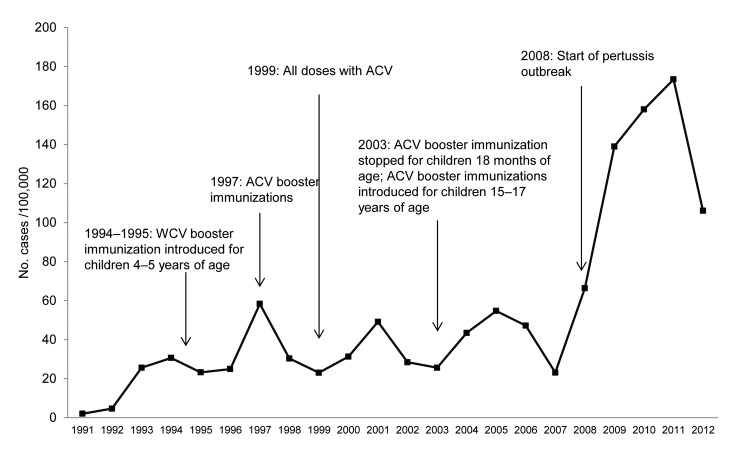
Figure 1
Figure 1
Pertussis cases/100,000 population in Australia, 2008–20012, since mandatory reporting was instituted in 1991 and changes to pertussis vaccination schedule, including introduction of whole-cell vaccine (WCV) booster vaccinations for 4–5-year-old children in 1994–1995 and introduction of acellular vaccine (ACV) booster vaccinations in 1997. By 1999–2000, ACVs were used for all pertussis vaccinations. In 2003, the booster vaccinations for children 18 months of age was removed and replaced with a booster vaccination for children 15–17 years of age (3).
Figure 2
Figure 2
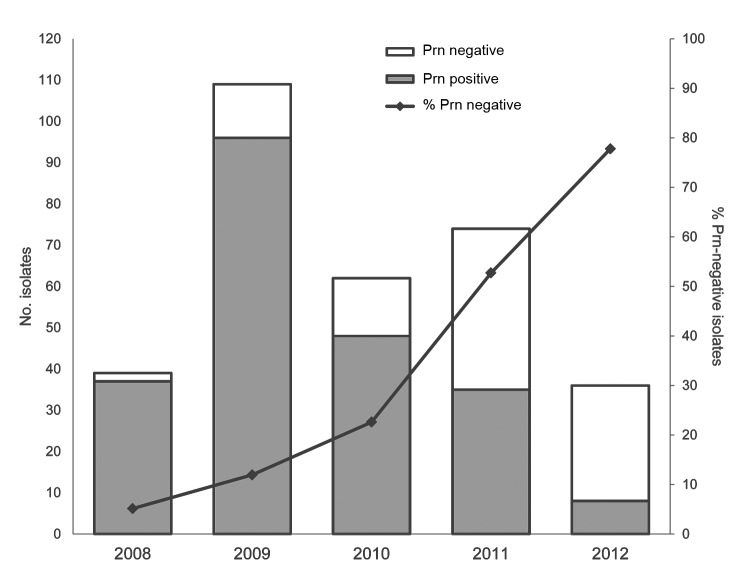
Number and percentage of pertactin (Prn)–negative Bordetella pertussis isolates in Australia, 2008–2012. During this period, 320 B. pertussis isolates obtained in New South Wales, Queensland, South Australia, Victoria, and Western Australia were identified as expressing prn or not expressing prn by using Western immunoblotting. The increasing percentage of prn-negative isolates each year during 2008–2012 was 5%, 12%, 23%, 53%, and 78% respectively. Data for individual states and years can be found in the Table. Gray bars indicate number of isolates expressing prn, and white bars indicate number of isolates not expressing prn. Error bars indicate 95% CIs.
Figure 3
Figure 3
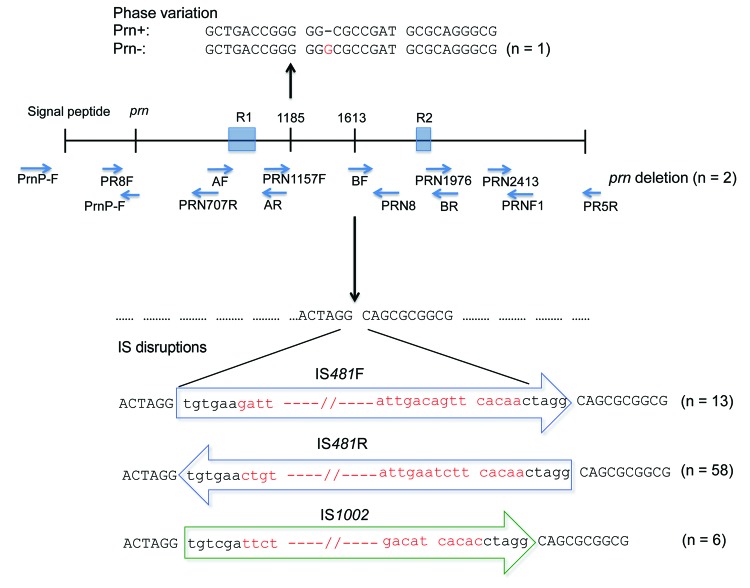
Variations in protactin (prn) gene of prn-negative Bordetella pertussis isolates, Australia, 2008–2012, Ninety-six B. pertussis isolates were identified as prn negative. Eighty of these isolates had 1 of 4 mechanisms of prn disruption: IS481 (in forward and reverse directions) and IS1002, which were inserted at the ACTAGG motif within prn, or an extended homopolymeric tract of G residues (n = 1). Lower case letters indicate residues that are conserved in all IS disruptions, and red letters indicate differences in IS disruptions. Positions of nucleotides have been numbered relative to the first start codon of sequence AJ011092 (17). The prn gene of 2 isolates was not amplified by PCR with a combination of primers from published studies (19), which indicated a deletion of the entire gene. Sixteen isolates that had no gene disruptions were also observed.

References

    1. Kurniawan J, Maharjan RP, Chan WF, Reeves PR, Sintchenko V, Gilbert GL, et al. Bordetella pertussis clones identified by multilocus variable-number tandem-repeat analysis. Emerg Infect Dis. 2010;16:297–300. 10.3201/eid1602.081707 - DOI - PMC - PubMed
    1. Quinn HE, Mahajan D, Hueston L, Campbell P, Menzies RI, Gilbert GL, et al. The seroepidemiology of pertussis in NSW: fluctuating immunity profiles related to changes in vaccination schedules. N S W Public Health Bull. 2011;22:224–9. 10.1071/NB11023 - DOI - PubMed
    1. Campbell P, McIntyre P, Quinn H, Hueston L, Gilbert GL, McVernon J. Increased population prevalence of low pertussis toxin antibody levels in young children preceding a record pertussis epidemic in Australia. PLoS ONE. 2012;7:e35874. 10.1371/journal.pone.0035874 - DOI - PMC - PubMed
    1. Spokes PJ, Quinn HE, McAnulty JM. Review of the 2008–2009 pertussis epidemic in NSW: notifications and hospitalisations. N S W Public Health Bull. 2010;21:167–73. 10.1071/NB10031 - DOI - PubMed
    1. Mooi FR, van der Maas NA, de Melker HE. Pertussis resurgence: waning immunity and pathogen adaptation: two sides of the same coin. Epidemiol Infect. 2013;13:1–10. 10.1017/S0950268813000071 - DOI - PMC - PubMed

Publication types

MeSH terms

LinkOut - more resources