doi: 10.3201/eid2004.130960.
Burkholderia pseudomallei type G in Western Hemisphere
- PMID: 24655932
- PMCID: PMC3966370
- DOI: 10.3201/eid2004.130960
Item in Clipboard
Burkholderia pseudomallei type G in Western Hemisphere
Emerg Infect Dis.
2014 Apr.
Abstract
Burkholderia pseudomallei isolates from the Western Hemisphere are difficult to differentiate from those from regions in which melioidosis is traditionally endemic. We used internal transcribed spacer typing to determine that B. pseudomallei isolates from the Western Hemisphere are consistently type G. Knowledge of this relationship might be useful for epidemiologic investigations.
Keywords: Burkholderia pseudomallei; Western Hemisphere; bacteria; internal transcribed spacer; melioidosis; molecular typing; type G.
Figures
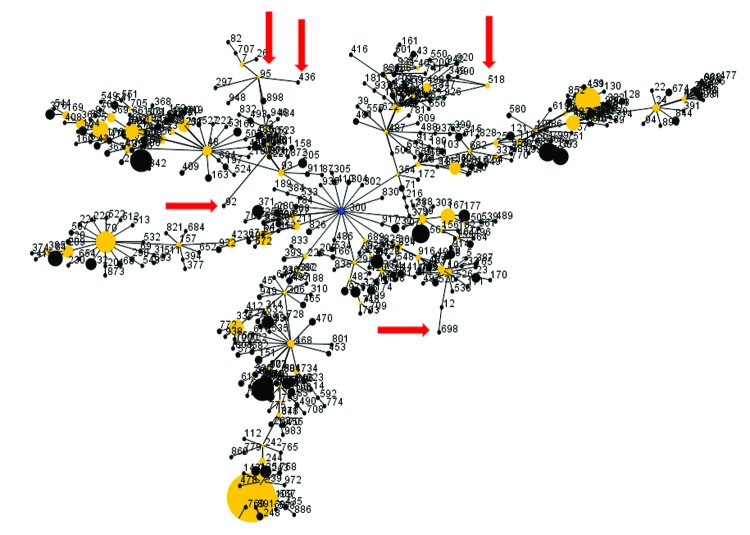
Diagram of eBURST (3) analysis of multilocus sequence types (STs) of Burkholderia pseudomallei isolates; default settings were used. Dots represent sequence types. Blue dot represents the calculated primary founder, yellow dots represent calculated subgroup founders, and black dots represent the remaining STs. The sizes of dots are proportional to the number of isolates in the database representing a given ST. A single line between sequence types indicates that they are single-locus variants of each other. Red arrows indicate positions of STs associated with isolates from the Western Hemisphere and that are type G according to internal transcribed spacer typing.
References
-
- Godoy D, Randle G, Simpson AJ, Aanensen DM, Pitt TL, Kinoshita R, et al. Multilocus sequence typing and evolutionary relationships among the causative agents of melioidosis and glanders, Burkholderia pseudomallei and Burkholderia mallei. J Clin Microbiol. 2003;41:2068–79. 10.1128/JCM.41.5.2068-2079.2003 - DOI - PMC - PubMed
Publication types
MeSH terms
Substances
Grants and funding
LinkOut - more resources
Full Text Sources
Other Literature Sources
Molecular Biology Databases