


Randomized clinical trial of self versus clinical administration of subcutaneous depot medroxyprogesterone acetate
- PMID: 24656555
- PMCID: PMC4086940
- DOI: 10.1016/j.contraception.2014.01.026
Randomized clinical trial of self versus clinical administration of subcutaneous depot medroxyprogesterone acetate
Abstract
Objectives: To evaluate feasibility, acceptability, continuation, and trough serum levels following self-administration of subcutaneous (sc) depot medroxyprogesterone acetate (DMPA).
Study design: Women presenting to a family planning clinic to initiate, restart or continue DMPA were offered study entry. Participants were randomized in a 2:1 ratio to self- or clinician administered sc DMPA 104 mg. Those randomized to self-administration were taught to self-inject and were supervised in performing the initial injection; they received printed instructions and a supply of contraceptive injections for home use. Participants randomized to clinician administration received usual care. Continued DMPA use was assessed by self-report and trough medroxyprogesterone acetate levels at 6 and 12 months.
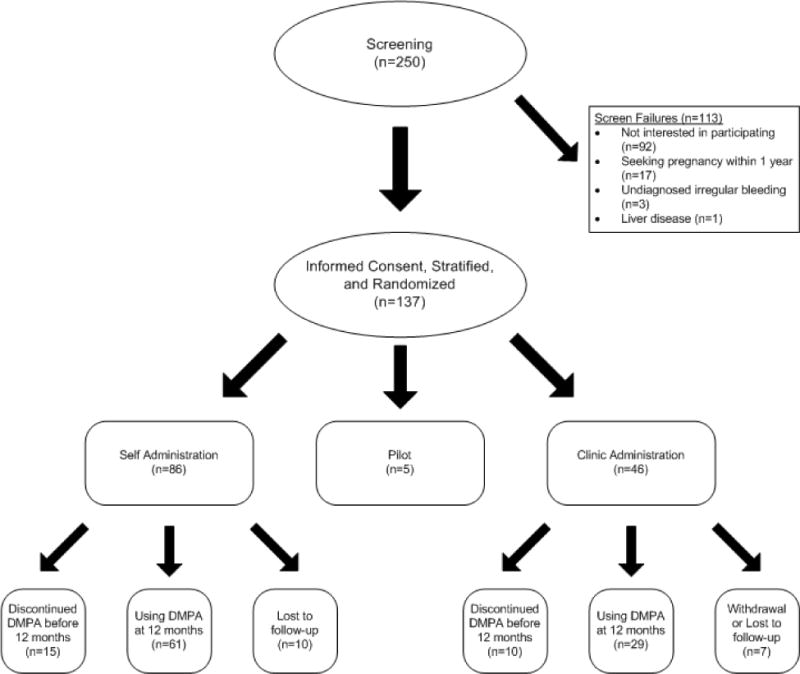
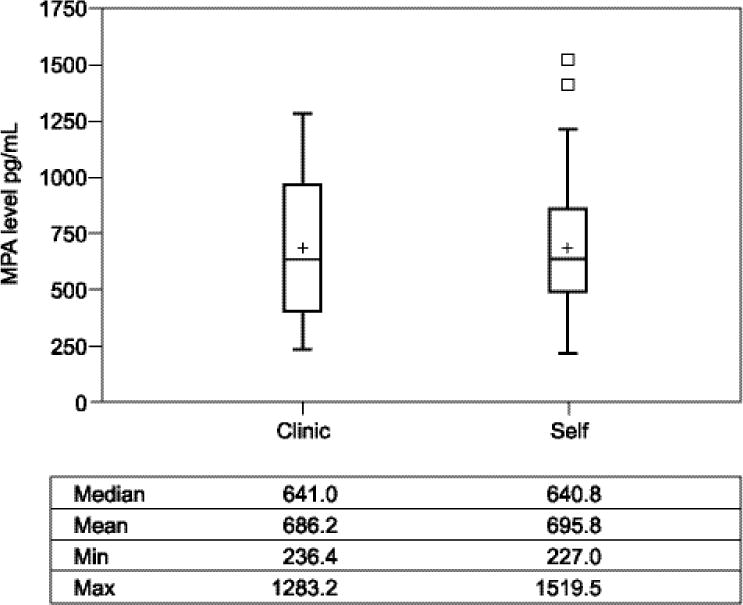
Results: Two hundred fifty women were invited to participate, and 137 (55%) enrolled. Of these, 91 were allocated to self-administration, and 90/91 were able to correctly self-administer sc DMPA. Eighty-seven percent completed follow-up. DMPA use at 1 year was 71% for the self-administration group and 63% for the clinic group (p=0.47). Uninterrupted DMPA use was 47% and 48% for the self and clinic administration groups at 1 year (p=0.70), respectively. Serum analyses confirmed similar mean DMPA levels in both groups and therapeutic trough levels in all participants.
Conclusions: Sixty-three percent of women approached were interested in trying self-administration of DMPA, even in the context of a randomized trial, and nearly all eligible for enrollment were successful at doing so. Self-administration and clinic administration resulted in similar continuation rates and similar DMPA serum levels. Self-administration of sc DMPA is feasible and may be an attractive alternative for many women.
Implications: Self-administration of sc DMPA is a feasible and attractive option for many women. Benefits include increased control over contraceptive measures and less time spent on contracepting behaviors. Globally, self-administration has the potential to revolutionize contraceptive uptake by increasing the number of women with access to DMPA.
Trial registration: ClinicalTrials.gov NCT01019369.
Keywords: Contraception; Depot medroxyprogesterone acetate; Injectable; Self-administration.
Copyright © 2014 Elsevier Inc. All rights reserved.
Conflict of interest statement
Figures
Comment in
-
Injectable contraception: issues and opportunities.Contraception. 2014 May;89(5):331-4. doi: 10.1016/j.contraception.2014.03.014. Epub 2014 Apr 4. Contraception. 2014. PMID: 24767245 No abstract available.
References
-
- Frost JJ, Darroch JE, Remez L. Improving contraceptive use in the United States. New York: Guttmacher Institute; 2008. In Brief. - PubMed
-
- Moreau C, Cleland K, Trussell J. Contraceptive discontinuation attributed to method dissatisfaction in the United States. Contraception. 2007 Oct;76(4):267–72. - PubMed
-
- Paul C, Skegg DCG, Williams S. Depot medroxyprogesterone acetate: Patterns of use and reasons for discontinuation. Contraception. 1997;56(4):209–14. - PubMed
-
- Polaneczky M, Liblanc M. Long-term depot medroxyprogesterone acetate (Depo-Provera) use in inner-city adolescents. Journal of Adolescent Health. 1998;23(2):81–8. - PubMed
-
- Bahamondes L, Marchi NM, Nakagava HM, De Melo ML, Cristofoletti Mde L, Pellini E, et al. Self-administration with UniJect of the once-a-month injectable contraceptive Cyclofem. Contraception. 1997;56(5):301–4. - PubMed
Publication types
MeSH terms
Substances
Associated data
Grants and funding
LinkOut - more resources
Full Text Sources
Other Literature Sources
Medical
