


Age and sex differences in childhood and adulthood obesity association with phthalates: analyses of NHANES 2007-2010
- PMID: 24657244
- PMCID: PMC8114794
- DOI: 10.1016/j.ijheh.2014.02.005
Age and sex differences in childhood and adulthood obesity association with phthalates: analyses of NHANES 2007-2010
Abstract
Background: Exposure to environmental chemicals may play a role in the development of obesity. Evidence suggests phthalate exposure may be associated with obesity in children and adults.
Objective: To examine the association of ten urinary phthalate metabolites mono-n-butyl phthalate (MnBP), mono-ethyl phthalate (MEP), mono-isobutyl phthalate (MiBP), mono-2-ethyl-5-carboxypentyl phthalate (MECPP), mono-2-ethyl-5-hydroxyhexyl phthalate (MEHHP), mono-(2-ethyl-5-oxohexyl) phthalate (MEOHP), mono-2-ethylhexyl phthalate (MEHP), mono-benzyl phthalate (MBzP), mono-(carboxylnonyl) phthalate (MCNP), and mono-(carboxyoctyl) phthalate (MCOP) grouped by molecular weight of their parent compounds with body weight outcomes in children, adolescent and adult participants in the National Health and Nutrition Examination Survey (NHANES) 2007-2010.
Methods: We performed multinomial logistic regression to analyze the association between obesity and urinary phthalate metabolite concentrations in children and adolescents and adults.
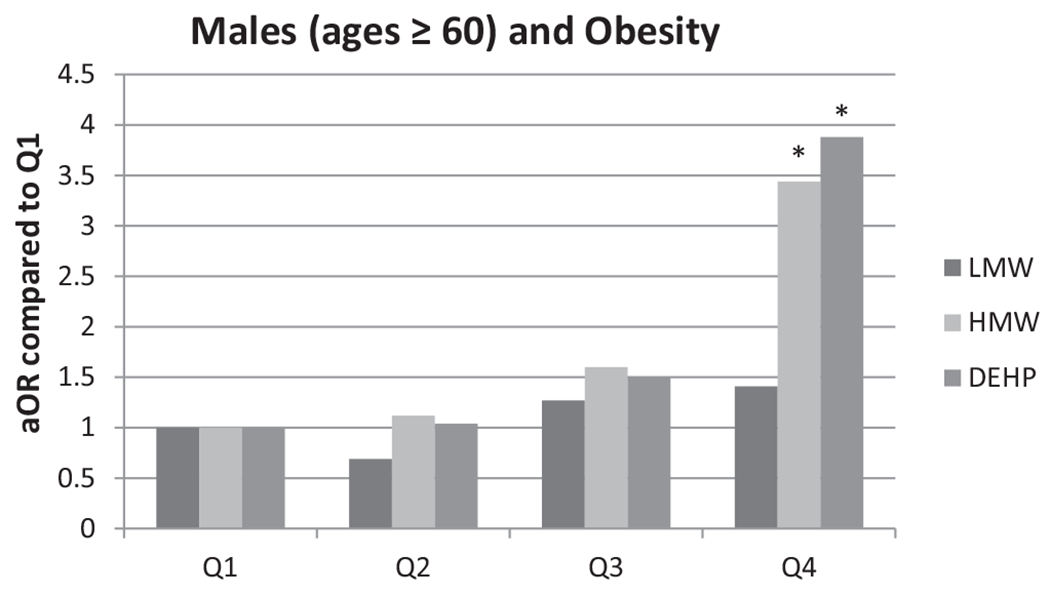
Results: Low molecular weight (LMW) phthalate metabolites (MnBP, MEP and MiBP) are significantly (p<0.05) associated with higher odds for obesity in male children and adolescents. High molecular weight (HMW) phthalate metabolites (MECPP, MEHHP, MEOHP, MEHP, MBzP, MCNP, and MCOP) and di-2-ethylhexyl phthalate (DEHP) metabolites (MEHHP, MEOHP, MEHP and MECPP) are significantly (p<0.05) associated with higher OR for obesity in all adults. Additionally, DEHP metabolites are significantly associated with obesity in all female adults; whereas DEHP and HMW metabolites are significantly associated with OR for obesity in males 60 years and older.
Conclusions: We found age and sex differences in the association between urinary phthalate metabolite concentrations and body weight outcomes. Reverse causation cannot be excluded since overweight and obese people will have more fat mass, they may store more phthalates, thus leading to higher excretion concentrations.
Keywords: Adolescents; Adults; Children; Obesity; Phthalates.
Published by Elsevier GmbH.
Figures
References
-
- Andra SS, Makris KC, 2012. Thyroid disrupting chemicals in plastic additives and thyroid health. J. Environ. Sci. Health C Environ. Carcinog. Ecotoxicol. Rev 30 (2), 107–151. - PubMed
-
- ATSDR. Agency for Toxic Substances and Disease Registry, 2001. Toxicological Profile for Di-n-Butyl. US Department of Health and Human Services, Public Health Service, Atlanta, GA.
-
- ATSDR. Agency for Toxic Substances and Disease Registry, 2002. Toxicological Profile for Di(2-thylhexyl) Phthalate. US Department of Health and Human Services, Public Health Service, Atlanta, GA.
-
- Bility MT, Thompson JT, McKee RH, David RM, Butala JH, Vanden Heuvel JP, Peters JM, 2004. Activation of mouse and human peroxisome proliferator-activated receptors (PPARs) by phthalate monoesters. Toxicol. Sci 82 (1), 170–182. - PubMed
Publication types
MeSH terms
Substances
Grants and funding
LinkOut - more resources
Full Text Sources
Other Literature Sources
Medical
